
Addendum vs Change Order: The Flooring Estimator's Guide
Addendum vs change order: one revises your bid before award, the other prices a contract change after. See how flooring estimators should handle each.

Amruta Naik
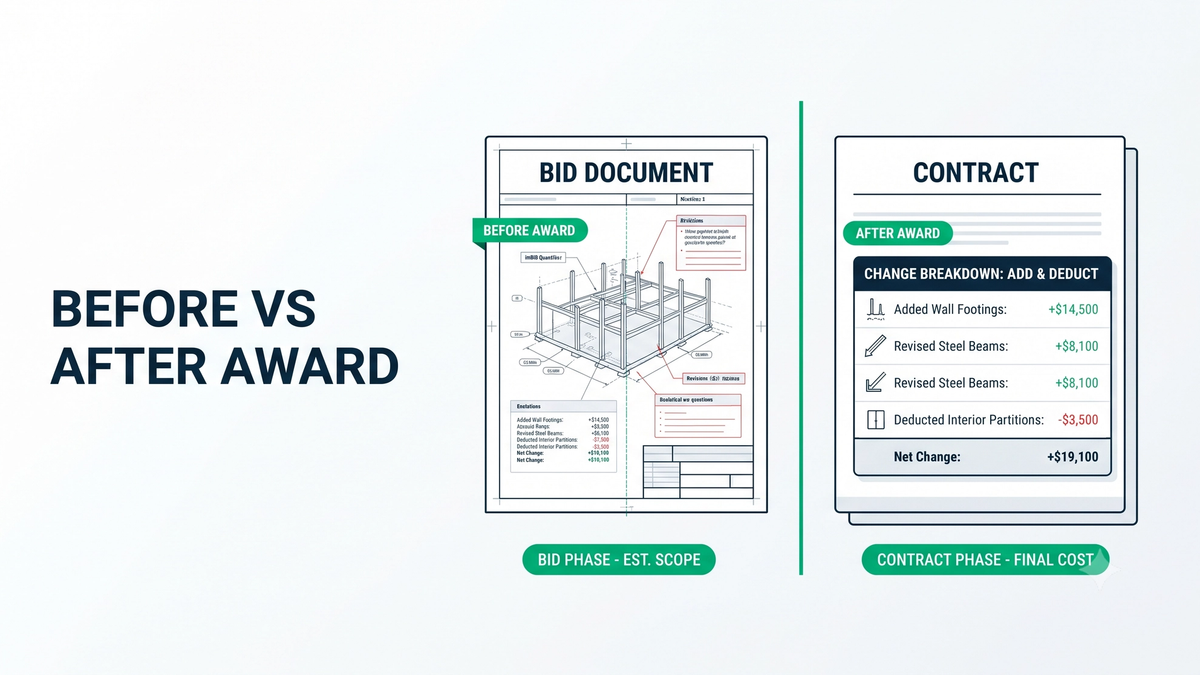
Two Documents That Both Change Your Scope, at Opposite Ends of the Job
Addenda and change orders are two of the most important documents a commercial flooring estimator handles, and confusing how to treat them is a direct route to lost money. Both can change the flooring scope. Both can shift quantities and pricing. Both create expensive mistakes when they are overlooked. The addendum vs change order distinction matters because they happen at different stages and demand completely different handling.
The short version: an addendum modifies the bidding documents before the contract is awarded, so it changes your original bid. A change order modifies the contracted scope after the contract is in place, so it changes the contract value, scope, or schedule after award. One asks you to revise the bid. The other asks you to price a change to a contract you already hold.
That difference is not academic. The risk sits in what each one hides:
- With an addendum, the danger is bidding from outdated documents, so quantities, materials, or finish assignments no longer match the current set
- With a change order, the danger is performing unpriced work, or pricing only the added material while forgetting the credit for what was removed
- With both, the danger is treating the change as "one more drawing to look at" instead of a potential revision to the entire flooring scope, accessories and floor prep included
A flooring estimator who reads only the revised floor plan, measures the obvious change, and moves on will miss the finish schedule change, the transition that shifted, and the waste that moved with a new tile size. This guide breaks down what each document is, the workflow for handling each, and where a disciplined process keeps a revision from becoming a bid problem or a contract dispute, whether you are handling flooring bid revisions before award or flooring scope changes after it. (Contract terminology varies, so the project's own contract documents and GC or owner instructions always control how a given project defines and processes these.)
Addendum vs Change Order, Defined for Flooring Estimators
An addendum modifies the bidding documents before a contract is awarded, so a flooring estimator revises the original bid. A change order modifies the contracted scope after award, so the estimator prices the change, including additions, deletions, and credits. Unicalibre Estimating handles both by connecting drawings, finish schedule, specifications, and scope to the quantities and pricing impact.
A construction addendum is information issued during bidding that modifies, clarifies, or supplements the original bid documents: revised drawings, revised specifications, new details, answers to bidder questions, revised finish schedules, new or deleted flooring products, and scope changes. For the estimator, an addendum means the documents you originally used may no longer represent the current scope, so the whole flooring scope needs a re-review, not just the sheet the addendum names. The standard contract frameworks published by the American Institute of Architects and the specification practices of the Construction Specifications Institute both treat addenda as formal modifications to the bidding documents for exactly this reason.
A construction change order is a formal modification to the contracted work after the contract is established: adding or removing flooring, changing material, changing quantities, adding floor prep or moisture mitigation, or shifting the schedule. Here you are not preparing the original bid. You are determining what changed, what additional work is required, and what that change should cost, net of any credit for removed scope.
Unicalibre Estimating is an architect-led firm that treats revision work as more than measuring a changed drawing. Our commercial flooring estimating services connect the drawings, finish schedule, specifications, and scope to the quantity and pricing impact, so a revision does not open a scope gap. If you have a revised set or a change request in hand, upload your plans and get a fast takeoff quote.
How to Handle Each, Without Missing Scope
The two documents share a principle and diverge on workflow.
The addendum workflow: protect the original bid
Do not treat an addendum as one more drawing. Treat it as a potential revision to the entire flooring bid. Record the addendum number and date against your bid and drawing revision first, so you always know which version you bid. Then read the addendum completely before touching the plans, and compare the current drawing set against the previous one, looking for new, deleted, or resized rooms, changed finishes, relocated walls, and revised corridors or stairs, not just the clouded area.
Re-review the finish schedule specifically. A schedule can flip Room 102 from carpet to LVT while the floor plan looks unchanged, and an estimator comparing only floor-plan quantities will miss the material change entirely. Update the takeoff in MeasureSquare or RFMS by reconciling what changed, never by simply adding the new quantity to the old, because the original takeoff may already hold quantities that were changed or deleted. Recalculate waste when material or tile size changes (a room can keep its area while a switch from 12x24 to 24x48 tile changes the yield), re-review every accessory that moves with flooring (base, transitions, weld rod, floor prep), and document the impact as an audit trail.
The change order workflow: price the change to the contract
After award, establish the original contracted scope first, using the accepted proposal, contract drawings, original takeoff, and any prior change orders. Without that baseline you cannot tell what is genuinely additional. Then identify exactly what changed, calculate the ADD scope (new material, waste, adhesive, prep, transitions, base, labor), and calculate the DEDUCT or credit scope for the removed material and its installation. This is the step that separates change order estimating from a simple commercial flooring takeoff: converting carpet to LVT is both an LVT add and a carpet credit, not just a new-flooring price. Review floor prep (the new system may need different substrate work), transitions (a carpet-to-LVT edge differs from LVT-to-tile), labor, and schedule impact, then present a clean net breakdown of original versus revised versus change.
The mistakes that turn a revision into a loss
- Reviewing only the revised or clouded floor plan and missing finish schedule or spec changes.
- Adding new quantities to the old total instead of reconciling what changed or was deleted.
- Forgetting to recalculate waste when material or tile dimensions change.
- Missing accessories (base, transitions, weld rod) that shift when the flooring changes.
- Not tracking the addendum number, so the bid is built on the wrong document version.
- On a change order, pricing only the added material and forgetting the credit for removed scope.
- Ignoring floor prep, labor, and schedule impact on a change order.
The discipline that keeps revisions clean
- Run the addendum sequence: receive, read fully, compare old versus new set, identify flooring impact, revise the takeoff, recalculate waste and accessories, document.
- Run the change-order sequence: establish original scope, identify the change, calculate the add, calculate the deduct or credit, review prep, accessories, labor, and schedule.
- Always compare the current set against the previous set, not just the clouded area.
- Track the addendum number and date on every revision.
- Peer-review revisions, because version-comparison is where errors hide.
Who should manage your revisions and change orders
DIY (owner handling revisions after hours). Fast, but comparing multiple document versions under deadline is exactly when a deleted room or a credit gets missed.
In-house estimator. Reliable with capacity, but a fully loaded domestic hire is a heavy fixed cost, and cost estimator market data shows why carrying one through slow periods is hard to justify.
Per-project outsourced takeoff. Absorbs addendum and change-order work so your team stays on live bids, turned on when revision volume spikes.
Dedicated remote estimator (FTE model). The same estimator tracking versions and pricing changes consistently, typically a 50 to 60 percent cost reduction versus a fully loaded in-house hire.
Buried in revisions on a live bid? Request a risk-free pilot takeoff and see how the version comparison is handled.
What Disciplined Revision Handling Changes
The payoff is bids that stay accurate through revisions and change orders that get paid in full. A few anonymized patterns.
A commercial flooring subcontractor kept bidding from superseded drawing sets because addenda were logged but not fully carried through. After adopting a strict addendum workflow that compares old versus new sets, revision-driven bid errors fell sharply and the team stopped submitting numbers built on outdated finish schedules, protecting an estimated 5 to 15 percent of margin on affected jobs.
A multifamily flooring contractor was pricing carpet-to-LVT change orders as straight LVT adds and never crediting the removed carpet, which made its change pricing look inflated and slowed approvals. Building proper add-and-deduct breakdowns got change orders approved faster and priced correctly.
A healthcare flooring specialist handling frequent revisions used overflow support to keep addenda and change orders moving while its in-house team stayed on current bids, reclaiming an estimated 10 to 15 hours a week of senior estimator time. See how a dedicated estimator helps you bid more.
None of these are guarantees, and every project differs. The pattern holds: the estimator who compares versions and reconciles scope protects the bid, while the one who measures only the change hands a discrepancy to the GC.
What You Send and What You Get Back
Revision work depends on having both versions and the full document set.
What you send. The current and previous drawing sets, finish schedule, specifications, details, all addenda and RFI responses, and for change orders the contract documents, original takeoff, and any prior change orders.
What you get. For an addendum, a revised takeoff that reconciles changed and deleted scope, recalculated waste and accessories, and a documented impact summary. For a change order, a clean add, deduct, and net breakdown with credits, prep, accessories, and labor identified. Delivered in your native software (MeasureSquare, RFMS, Bluebeam, PlanSwift, or Callidus) with marked-up plans and documented assumptions, cleared through peer review first.
Timeline. Most revisions turn in 24 to 48 hours, with same-day rush available near a deadline.
Communication. Email, phone, and your PM tools, with version conflicts and scope questions flagged as RFIs rather than silent assumptions.
Want the addendum and change-order checklist your team can run on every revision? Download the checklist.
Frequently Asked Questions
What is the difference between an addendum and a change order?
An addendum generally modifies the bidding or construction documents before the contract is awarded, so the estimator revises the original bid. A change order generally modifies the contracted scope after the contract is established, so the estimator prices the change against the existing contract. The exact definitions and procedures depend on the project's contract documents.
How should a flooring estimator handle an addendum?
Record the addendum number and date, read it completely, compare the current and previous drawing sets, re-review the finish schedule and specifications, identify every flooring impact, update the takeoff by reconciling changed and deleted scope rather than adding to the old total, recalculate waste and accessories, and document the revisions before submitting the revised bid.
How should a flooring estimator price a change order?
Start by establishing the original contracted scope. Then identify exactly what changed, calculate the added flooring and its installation, calculate the credit for any removed material, review floor preparation, transitions, and accessories, account for labor and schedule impact, and present a clear net breakdown of original versus revised quantities.
Does an addendum change the original flooring estimate?
It can. An addendum may change flooring materials, quantities, room layouts, installation requirements, specifications, or accessories. Because it modifies the documents the original bid was based on, the estimator should re-review the full flooring scope and update the bid, not just measure the clouded area.
Why do flooring change orders get missed or underpriced?
The most common causes are pricing only the new flooring while forgetting the credit for removed scope, failing to establish the original contract baseline, overlooking floor prep the new system requires, missing changed transitions, and not documenting assumptions. Each leaves the change order incomplete and slows approval or erodes margin.
Addendum Updates the Bid. Change Order Prices the Change.
The simplest way to hold the addendum vs change order distinction is this: an addendum means update the bid, and a change order means price the change to the contract. But for a flooring estimator the real difference is in the handling. An addendum requires you to protect the accuracy of the original bid by finding and incorporating every document change. A change order requires you to establish the original contract scope and price what changed, including additions, deletions, credits, prep, accessories, and labor.
In both cases the estimator has to look past the square footage and ask two questions in order: what changed, and what else does that change affect. That second question is where the transition, the waste, the base, and the floor prep live, and it is where experienced commercial flooring estimating earns its keep. Missing it is how a revision becomes a bid discrepancy or a contract dispute.
Revisions do not slow down as a deadline approaches, and the estimator who tracks versions and reconciles scope is the one who protects both the bid and the contract. Book a call and send your plans for turnaround and pricing with Unicalibre Estimating, the architect-led, peer-reviewed flooring estimating partner built to handle addenda and change orders without missed scope.