
AI Flooring Takeoff Review: Where the Second Set of Eyes Matters
AI produced the takeoff. But who reviews it before it becomes a bid? Here are 10 checkpoints every human estimator should run.

Amruta Naik
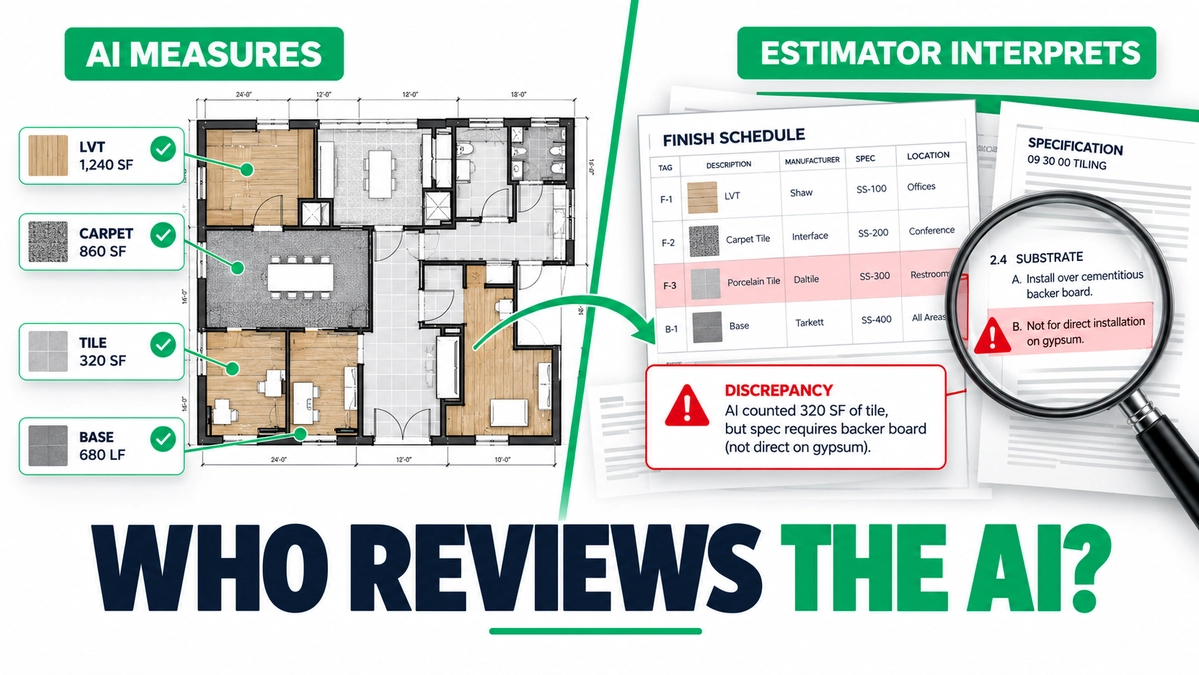
AI Produced the Takeoff. The Rooms Are Measured. So Are You Ready to Bid?
Not yet. AI can produce a flooring takeoff. The real question is who reviews it before it becomes a bid. That is the AI flooring takeoff review conversation most contractors are not having, and it is where the next 18 months of commercial estimating will quietly separate the firms that stayed profitable from the ones that trusted a model and absorbed the gap. AI is very good at identifying and measuring what is visible on a drawing. Commercial flooring estimating is also about understanding what is not obvious. Those are two different jobs, and only one of them is finished when the quantities look clean.
The industry conversation has moved from "can AI do a takeoff" to "AI did the takeoff." But almost no one is asking the question that actually determines whether the bid holds: what does a human estimator need to review before anyone trusts the number? A human in the loop on AI construction estimating is the answer that is finally emerging, and it is the only workflow that holds up on bid day. AI finds, measures, and organizes. The estimator interprets, questions, and validates. The project manager and procurement use, purchase, and execute. Skip the middle step and the first step is wasted and the third step is a problem.
The pattern of what AI consistently misses is predictable:
- Addenda or a revised drawing set issued after the file the AI read
- Finish schedule conflicts with the floor plan it was given
- Rooms that are not labeled consistently (small spaces, closets, mechanical areas)
- Accessories outside the finish (wall base, transitions, Schluter profiles, weld rod)
- Waste methodology appropriate to the layout, not a default percentage
- Seam and layout planning dictated by roll width and pattern
- Floor preparation and moisture scope buried in Division 09
- Transitions at material interfaces that the plan does not call out
- Installation requirements that the field will need
- Assumptions and uncertainty the model should have surfaced
None of these are AI failures. They are review failures, and they are what happens when a takeoff moves from the software directly to the bid without an experienced commercial flooring estimator in between. This guide walks the 10 checkpoints a disciplined AI flooring takeoff review runs, why each matters, and where the second set of eyes earns its keep.
What an AI Flooring Takeoff Review Actually Is
An AI flooring takeoff review is a structured, human review of an AI-generated commercial flooring takeoff before it becomes a bid. It cross-checks the drawing set, finish schedule, specifications, and responsibility matrix the AI could not interpret, flags assumptions, and validates waste, seams, accessories, and prep. Unicalibre Estimating treats every AI-generated takeoff as the first draft, not the deliverable.
The distinction is structural. AI tools are strong at pattern recognition on what the drawing clearly shows. They are weaker at the judgment calls that live across multiple documents, at scope that lives in specifications, and at risks that live in site conditions. Construction management bodies like the Construction Management Association of America have been consistent on this point: technology accelerates estimating, but the responsibility for a defensible number sits with the professional, not the tool. Trade authorities like the Resilient Floor Covering Institute frame installation scope the same way, because the specification governs the system, not the pixel count on the plan.
Unicalibre Estimating is an architect-led firm that treats AI output as a starting point, not a finished takeoff. Our commercial flooring estimating services and flooring takeoff services run every AI-generated or human-generated takeoff through a mandatory second-estimator peer review, delivering a peer-reviewed takeoff with the drawing set, finish schedule, specifications, addenda, and responsibility matrix cross-checked before pricing. If you are running AI takeoff tools and want a disciplined review before the bid goes out, upload your plans and get a fast takeoff quote.
The 10 Checkpoints a Human Estimator Must Run
Each of these is a point where measurement turns into estimating judgment, and judgment is what AI cannot fully replace.
1. Drawing set and revisions
Is the AI working from the current drawing set? Were all addenda incorporated? Was a revised floor plan issued after the original drawings? A perfectly measured outdated drawing is still the wrong takeoff, and this is the first place the review has to land.
2. Finish schedule versus floor plan
Does the flooring shown on the plan match the finish schedule? When the plan says carpet and the finish schedule says LVT, do not let the software choose. Investigate the documents, flag the discrepancy, and resolve it before pricing. This is the single most common AI miss on commercial flooring projects.
3. Room-by-room scope
Did the AI identify every applicable room? Small rooms, corridors, closets, offices, storage rooms, mechanical spaces, and transition areas are where "almost complete" becomes expensive. A commercial flooring takeoff that misses a utility closet or a mechanical mezzanine is a bid that is short on award day.
4. Flooring accessories
This is one of the first places to look. Did the takeoff capture wall base, transitions, reducers, end caps, stair accessories, Schluter profiles, adhesives, weld rod, underlayment, waterproofing, and other specified accessories? AI identifies the floor. The estimator has to understand the complete installation scope, and accessories are where most of the hidden margin sits.
5. Waste methodology
Do not just ask what waste factor the AI used. Ask why it is appropriate for this project. A simple rectangular room and a fragmented floor plan with angled walls should not carry the same percentage. Pattern repeat, tile size, plank direction, roll width, and room geometry all shape the real material requirement, and defaults are rarely the right answer.
6. Layout and seam planning
This matters most on sheet vinyl and broadloom carpet. The quantity can be mathematically correct and the layout still unbuildable. For sheet vinyl, the chain is roll width to layout to cuts to seams to welds. For carpet, it is roll width to direction to pattern repeat to seam placement to stretching. An AI-generated square footage can look perfect and still create a layout the installer cannot execute.
7. Floor preparation
Look beyond the finish. The specifications and project requirements may call for patching, skim coating, self-leveling underlayment, grinding, moisture testing, moisture mitigation, existing adhesive removal, or substrate preparation. Prep is where commercial flooring contractors absorb the most margin after award, and AI cannot read Division 09 the way a trained estimator can.
8. Transitions and interfaces
Where does one flooring material meet another? Carpet to LVT, LVT to tile, flooring to existing flooring, flooring to stairs, flooring to a doorway. These interfaces are easy for AI to overlook because they do not always appear as obvious quantities on the floor plan, and each one is a line item on the bid.
9. Installation requirements
If you were installing this, what would you need to know? Installation direction, pattern, seam requirements, adhesive, substrate requirements, movement joints, flash cove, corners, and accessories. The estimator has to think beyond the drawing, which is the exact gap between a measurement pass and a bid-ready scope gap review.
10. Assumptions, exclusions, and uncertainty
This may be the most important checkpoint of all. What did the AI assume? What could it not determine? What was not visible? What needs an RFI? A good review does not try to make uncertainty disappear. It makes uncertainty visible, which is the opposite of what a confidence score on an AI output does.
The pattern behind every checkpoint
None of these are speed problems. All of them are interpretation problems, and they are what separate a measurement pass from a professional commercial flooring estimator. The second review should happen at the points where measurement turns into estimating judgment, not at the point where someone checks whether the AI measured the room correctly.
Who should run the review
DIY (owner reviewing after hours). Fast but exhausted, and that is exactly when AI assumptions get rubber-stamped instead of challenged.
In-house estimator. Strong when experienced and available, but a fully loaded domestic hire is a heavy fixed cost, and cost estimator market data shows why carrying one just to review AI output is hard to justify.
Per-project outsourced flooring takeoff review. An experienced commercial flooring estimator running the full 10-checkpoint pass on the bids that matter, turned on when AI output volume spikes.
Dedicated remote estimator (FTE model). The same estimator reviewing every AI-generated takeoff and learning your standards, typically a 50 to 60 percent cost reduction versus a fully loaded in-house hire.
Want a second set of eyes on your next AI-generated flooring takeoff? Request a risk-free pilot takeoff and compare the review output against the raw AI pass.
What AI Plus Human Review Changes on Real Bids
The payoff is bids that use AI for speed and humans for judgment, instead of trusting one or the other. A few anonymized patterns.
A commercial flooring subcontractor adopted an AI takeoff tool and shipped the output directly to pricing, then spent the first quarter after award chasing missed accessories, misread finish schedules, and prep that was never flagged. Adding a mandatory human review pass caught those gaps before submission and recovered an estimated 5 to 15 percent of margin on affected jobs, because scope was priced rather than discovered.
A multifamily flooring contractor was running AI across 200-unit packages and finding that unit-type variations and corridor transitions were systematically missed. Adding a room-by-room human cross-check against the finish schedule resolved the pattern and reclaimed an estimated 10 to 15 hours a week previously lost to post-award RFIs.
A healthcare flooring specialist found that AI consistently missed moisture scope and substrate prep because those live in Division 09, not on the drawing. Running a specifications pass as part of every AI takeoff review removed that recurring hit. See how a dedicated estimator helps you bid more.
None of these are guarantees. The pattern holds: AI accelerates the measurement, the human review protects the bid, and the two together produce a defensible number that neither one would reach alone.
What You Send and What You Get Back
An AI takeoff review works best when the human reviewer has the whole document set, not just the AI output.
What you send. The AI-generated takeoff (native file or report), the full drawing set, finish schedule, specifications, details, addenda, RFI responses, and responsibility matrix. If AI flagged any assumptions, send those too.
What you get. A reviewed takeoff with every checkpoint run, document conflicts flagged, missed scope added, waste methodology validated, seams and layouts checked, accessories captured, prep and moisture scope confirmed, and assumptions made visible. Delivered in your native software (MeasureSquare, RFMS, Bluebeam, PlanSwift, or Callidus) with marked-up plans, cleared through peer review first.
Timeline. Most AI takeoff reviews turn in 24 to 48 hours, with same-day rush available near a deadline.
Communication. Email, phone, and your PM tools, with every assumption surfaced as an RFI rather than left in the AI output as silent risk.
Want the 10-checkpoint review checklist your team can run on every AI-generated takeoff? Download the checklist and apply it across every project type you bid.
Frequently Asked Questions
How do you review an AI-generated flooring takeoff?
Run a 10-checkpoint review: verify the drawing set and addenda, reconcile the finish schedule against the floor plan, confirm every room is captured, check accessories (wall base, transitions, Schluter, weld rod), validate waste methodology, review seam and layout planning, confirm floor prep and moisture scope, check every material interface, review installation requirements, and surface every assumption as an RFI.
Can AI replace a human flooring estimator?
Not for commercial flooring estimating. AI accelerates measurement, pattern recognition, and organization, but it cannot interpret finish schedules against plans, read Division 09 specifications, apply layout-specific waste, catch document conflicts, or make the responsibility matrix judgments that drive scope. The future is AI plus experienced estimator, with AI doing the repetitive work and the estimator doing the interpretation.
What does AI commonly miss on a flooring takeoff?
The most common AI misses are addenda issued after the drawing set it read, finish schedule conflicts with the plan, small or unlabeled rooms, flooring accessories (base, transitions, weld rod), floor preparation and moisture scope from Division 09, waste methodology appropriate to the layout, seam and installation planning, and assumptions it never surfaced. These are interpretation problems, not measurement problems.
Why does an AI takeoff still need a peer review?
Because AI identifies and measures what is visible, but a bid depends on scope that lives across multiple documents, in specifications, and in the responsibility matrix. A peer review by an experienced commercial flooring estimator cross-checks what AI could not interpret, flags assumptions, validates waste and layout, and makes uncertainty visible so the project team can act on it before award.
What is the right workflow for AI takeoff tools in commercial flooring?
The disciplined workflow is AI first, human review second, bid third. AI finds, measures, and organizes. The estimator interprets, questions, and validates against the full document set. The project manager and procurement team then use the reviewed takeoff to purchase and execute. Skipping the middle step is where margin leaks between the AI output and the field.
The Question Is Not Whether AI Can Do a Takeoff. It Is Who Is Responsible When the AI Gets It Wrong.
The future of commercial flooring estimating is not AI versus estimator. It is AI plus experienced estimator. Let AI do what it does well (speed, measurement, organization, repetitive work) and let the estimator do what experience is good at (judgment, interpretation, constructability, scope review, risk identification). That is the workflow that holds up on bid day and after award.
The real question for every contractor adopting AI takeoff tools is not can the software measure a room. It is who is responsible for the takeoff when the AI gets it wrong. That responsibility does not disappear because a model produced the quantities. It just moves, and the firms that make the second review a required step are the ones whose numbers hold up long after award.
Bid season does not slow down, and the estimator who reviews what AI produced is the one whose bids close at the margin the contractor priced. Book a call and send your plans for turnaround and pricing with Unicalibre Estimating, the architect-led, peer-reviewed flooring estimating partner built to put a human estimator between the AI output and the bid.