
ASTM Flooring Standards: A Contractor's Estimating Guide
ASTM flooring standards signal hidden scope. F710, F2170, F1869, E648, and C627 in the specs mean prep, moisture, or performance cost you must price.

Amruta Naik
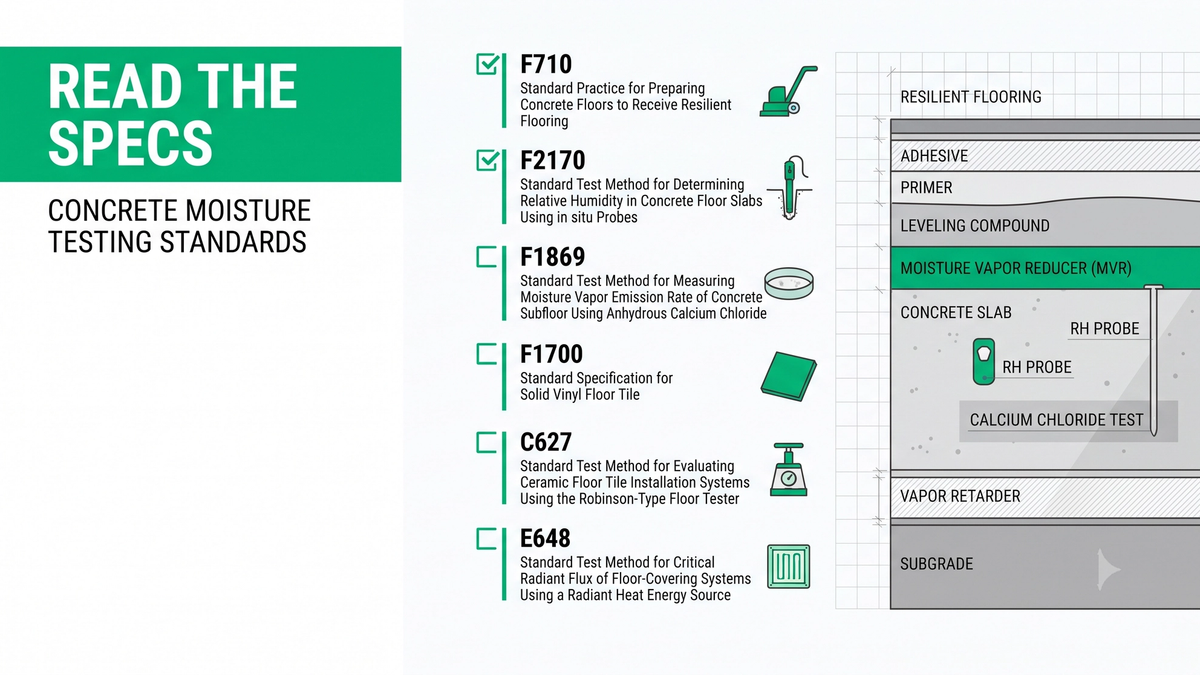
Every experienced flooring estimator has had this moment: you open a specification, see a line that reads "concrete substrate shall meet ASTM F710," and a small alarm goes off. You know the standard matters. You know it's tied to something the bid probably has to cover. What you may not know, in that exact moment, is whether the responsibility is yours, whether the testing has already happened, whether moisture mitigation is required, or how much scope just quietly entered the bid. That uncertainty is where a lot of flooring margin quietly walks off, because when in doubt, most estimators price only the visible flooring and hope for the best. Then construction starts, the slab fails an F2170 relative humidity test, moisture mitigation gets added, and the flooring contractor absorbs the entire prep cost.
ASTM standards are not just technical codes buried in a spec book. They are the language the specification uses to trigger substrate prep, moisture testing, product classification, and fire performance requirements without spelling out the dollar impact. Every one of them signals hidden scope that has to be priced separately, and every one of them is a warning sign for the estimator paying attention. The good news is that once you know how to read them, ASTM references become an early-warning system that catches expensive scope before the bid goes out instead of after award.
This guide walks through the ASTM flooring standards that matter most, what each one actually requires, how they change your estimate, and how a disciplined process reads the specifications the way they were meant to be read.
If you are looking at a spec heavy with ASTM references right now and you are not sure what they trigger, upload your plans and get a fast takeoff quote.
What ASTM Flooring Standards Actually Trigger in an Estimate
ASTM flooring standards are the technical performance and installation references (published by ASTM International) used across commercial flooring specifications to define concrete slab preparation, moisture testing, product classification, and fire and traffic performance requirements. In flooring bids, ASTM references most often trigger substrate prep, moisture testing, moisture mitigation, product classification verification, and fire-rated product selection, and each one carries a separate line item. Unicalibre Estimating is an architect-led firm that reads ASTM references during every commercial takeoff, and every deliverable is peer-reviewed before it goes out.
The reason these standards matter is that they change the answer to a fundamental question: what work is actually in this bid? If ASTM F710 is referenced, concrete floor preparation is likely in scope. If F2170 or F1869 is referenced, moisture testing is likely required, and if the slab fails, mitigation follows. If F1700 or F1303 is referenced, the product classification has to be verified against the specification. If C627 is referenced, the tile assembly has to hold up under traffic and load. If E648 or E662 is referenced, the flooring product has to meet fire and smoke performance criteria. None of this is automatic. Every one is a line item the estimator has to catch, price, and confirm responsibility for before submission.
A complete deliverable reads the specifications, not just the floor plan. Unicalibre Estimating provides peer-reviewed flooring quantity takeoffs delivered in native software formats including MeasureSquare, RFMS, Bluebeam, PlanSwift, Callidus, and Stack, with a BOQ that separates ASTM-triggered scope (prep, moisture, mitigation, testing) from finish flooring, marked-up plans showing where prep and moisture testing apply, scope notes flagging every ASTM reference and its cost implication, and a deliverable your team can import and adjust without re-entry.
Request a risk-free pilot takeoff on a spec-heavy set and see what an ASTM-aware review captures.
The ASTM Flooring Standards That Actually Matter
Ten standards drive the vast majority of commercial flooring scope decisions. Every one of them is a scope trigger, and every one belongs on your radar.
ASTM F710: Concrete Floor Preparation for Resilient Flooring
The most important standard for commercial flooring contractors. F710 defines how concrete floors should be prepared before resilient flooring installation, covering surface cleanliness, curing, cracks, adhesive residue, patching, and moisture-related conditions. If F710 appears in the specification, assume floor preparation is likely required (grinding, patching, cleaning, crack repair, or moisture evaluation) and verify what is included in the bid package. F710 commonly applies to sheet vinyl, LVT, LVP, rubber flooring, carpet tile, and some epoxy systems.
ASTM F2170: Relative Humidity Testing in Concrete Slabs
F2170 defines the in-slab moisture test performed by inserting a probe into the concrete to measure internal relative humidity. Concrete that looks dry on the surface often contains meaningful moisture inside, and F2170 is designed to catch that. If the slab fails, installation may be delayed or moisture mitigation may be required. When F2170 is referenced, make sure moisture testing is either in your estimate or clearly assigned to another party. F2170 commonly applies to sheet vinyl, LVT, LVP, carpet, rubber, wood flooring, and some tile assemblies.
ASTM F1869: Calcium Chloride Moisture Vapor Emission Test
F1869 measures moisture vapor emission at the concrete surface rather than internally. Some projects require F1869 instead of, or in addition to, F2170. Do not assume one moisture test covers everything. Review the specifications carefully to see whether F1869, F2170, or both are required, and price accordingly. If either test fails, moisture mitigation, special adhesives, or delayed installation typically follows.
ASTM F3010: Moisture Mitigation Systems
F3010 defines moisture vapor barrier and mitigation systems installed over concrete slabs when moisture testing results exceed acceptable limits. When F3010 appears, or when the specification requires it as a fallback, moisture mitigation is a separate scope with primers, moisture barriers, and testing coordination. On projects with tight schedules, newly poured slabs, or known moisture concerns, F3010 can become a major hidden cost.
ASTM F1700: Luxury Vinyl Tile Classification
F1700 classifies LVT products by performance requirements. Not every LVT is suited to every commercial environment, and the classification tells you whether the specified product meets the project's demands. Always verify that the LVT specified meets the classification required in the specification, not just the color and size the design team chose.
ASTM F1303: Sheet Vinyl Flooring Performance
F1303 defines sheet vinyl performance requirements. This standard shows up heavily in healthcare and hospital flooring specifications because sheet vinyl dominates hygiene-sensitive environments. When F1303 appears, confirm quantity, manufacturer classification, and installation requirements together, not just quantity.
ASTM F1066: Rubber Flooring Requirements
F1066 defines performance for rubber flooring materials, which appear in schools, hospitals, laboratories, and gyms. When F1066 is referenced, verify the exact product type, installation method, and whether special substrate prep or adhesives are required. Different rubber products carry different install profiles, and pricing them the same way is a common estimating error.
ASTM C627: Robinson Floor Test for Tile
C627 evaluates how a tile floor assembly performs under traffic and load conditions. It comes up on commercial tile projects in hospitals, airports, schools, and public buildings where rolling loads and heavy traffic dominate. When C627 is referenced, review whether the specified tile assembly actually meets the performance rating before pricing.
ASTM E648: Fire Performance of Flooring
E648 measures the critical radiant flux of flooring materials (fire spread performance). This matters heavily in schools, hospitals, airports, and other public buildings. If the specified product does not meet the required fire rating, it cannot be used on the project, even if the color and price look right. Verify fire rating on the product data sheet before pricing, not after.
ASTM E662: Smoke Density
E662 measures smoke development during combustion, particularly critical in healthcare, transportation, and public spaces where smoke performance drives life-safety decisions. Cross-check smoke and fire requirements against the product data sheet and the specification together.
Which ASTM Standards Apply to Which Materials
The pattern of ASTM references maps predictably to the flooring material. Understanding the pairings speeds up specification review and prevents missed scope.
Sheet vinyl typically carries F710 (prep), F2170 (moisture), F1869 (moisture), and F1303 (product performance). Almost always sits in healthcare, hospitality, or educational specs. LVT typically carries F710, F2170, and F1700 (classification). Confirm the specified product meets the F1700 classification. LVP typically carries F710 and F2170. Substrate moisture and installation conditions dominate. Carpet tile typically carries F710 and F2170. Floor prep and adhesive compatibility drive scope. Broadloom carpet typically carries F710 and F2170. Moisture and substrate condition matter more than most estimators realize. Rubber flooring typically carries F710 and F1066. Product performance and prep drive labor. Ceramic and porcelain tile typically carry C627. Traffic and load performance decide whether the assembly holds up. Epoxy flooring typically carries F710 and F3010. Moisture mitigation is central. Wood flooring typically carries F710 and F2170. Moisture, flatness, and substrate readiness dominate.
Common ASTM-Related Estimating Mistakes
Most ASTM-related pricing errors trace back to the same handful of habits:
- Reading the finish schedule and skipping the specifications section
- Ignoring moisture testing requirements referenced by F2170 or F1869
- Missing floor preparation triggered by F710
- Not confirming whether the specified LVT actually meets F1700 classification
- Skipping fire performance verification against E648 or E662
- Assuming the slab is installation-ready without confirming F710 requirements
- Failing to clarify who is responsible for testing and mitigation before award
Pro tip checklist before you lock a commercial flooring bid:
- Have I searched the specifications for every ASTM reference?
- Have I identified which standards apply to which materials in the bid?
- Have I confirmed whether moisture testing (F2170 or F1869) is included or by others?
- Have I included floor preparation triggered by F710 as its own line item?
- Have I verified the specified product meets classification standards like F1700 or F1303?
- Have I confirmed fire performance (E648) and smoke density (E662) where required?
- Have I priced moisture mitigation (F3010) as a contingent line where slab conditions are unknown?
- Have I clarified responsibility for testing, mitigation, and coordination in writing?
How the Estimating Models Compare on ASTM Scope
DIY (owner estimating): ASTM references get skimmed under deadline pressure, and the substrate prep and moisture scope get discovered after the slab fails a test.
In-house estimator: Better if trained on spec reading, but a single set of eyes still misses ASTM references buried across long specification sections.
Per-project outsourcing: Useful for overflow, but a rotating estimator may not consistently distinguish F710 prep from F3010 mitigation, or catch F1700 classification requirements against the specified product.
Dedicated FTE estimator: The same estimator every time, working an architect-led process, peer-reviewed before delivery, learning which ASTM patterns your GCs typically specify. Most reliable on healthcare, education, and commercial work where ASTM references dominate, typically at a 50 to 60 percent cost reduction versus a domestic in-house hire.
Request a risk-free pilot takeoff on a spec-heavy set and see what an ASTM-literate takeoff catches.
What Changes in the Real World
The pattern repeats across project types where ASTM references dominate the specifications.
A flooring subcontractor in Texas was bidding a hospital sheet vinyl corridor. The finish schedule showed the flooring, but the specifications referenced F710, F2170, and F1303. A spec-first review captured the concrete preparation, the moisture testing coordination, and confirmed the sheet vinyl met the F1303 classification, protecting an estimated 8 to 12 percent of margin that would otherwise have been absorbed as prep after award.
A commercial flooring contractor in Phoenix bidding an office LVT tenant improvement had priced only the finish. The specifications referenced F710 and F1700. Verifying the slab condition against F710 and confirming the specified LVT met the F1700 classification surfaced floor prep scope and a product substitution question before submission, avoiding an estimated 5 to 10 percent margin event on prep and a rebid on the product.
A tile contractor in Ontario bidding a school cafeteria in porcelain tile had missed C627 and E648 in the specification. Reviewing the specs and confirming both traffic performance and fire rating against the manufacturer data sheet caught a product mismatch before the bid went out and avoided a substitution and resubmission that a bid margin cannot absorb.
Same lesson every time: the ASTM references decide the scope. See how a dedicated estimator helps you bid more spec-heavy commercial work without absorbing hidden ASTM scope.
What to Send and What You Get Back
An ASTM-aware flooring takeoff does not require a perfect package. It needs the right inputs.
What you send: architectural plans, the finish schedule and finish legend, the full specifications section, any addenda, manufacturer product data sheets if available, existing-condition drawings, and your preferred brands or labor rates.
What you get back: a BOQ or Excel breakdown that separates ASTM-triggered scope (floor prep, moisture testing, mitigation, product verification) from finish flooring, marked-up plans showing where prep, moisture testing, and mitigation apply, scope notes flagging every ASTM reference and its cost implication, a material summary that verifies product classification against the spec, and native software files in your platform (MeasureSquare, RFMS, Bluebeam, PlanSwift, Callidus, or Stack) so your team can import and adjust without re-entry.
Timeline: standard turnaround is typically 24 to 48 hours for most trade packages, with same-day rush available when the deadline is closing. Communication runs over email, phone, and your preferred PM tools, and addenda are tracked as they land.
Want the specification-review checklist your team can run on every commercial flooring bid? Download the checklist.
Frequently Asked Questions
What are ASTM standards in commercial flooring?
ASTM standards in commercial flooring are technical performance and installation references published by ASTM International that define concrete slab preparation, moisture testing, product classification, and fire and traffic performance requirements. When they appear in a specification, they trigger scope items (prep, testing, mitigation, product verification) that must be priced separately from the finish flooring.
What is ASTM F710 and what does it require in a flooring estimate?
ASTM F710 is the standard practice for preparing concrete floors to receive resilient flooring, covering surface cleanliness, curing, cracks, adhesive residue, patching, and moisture conditions. When F710 appears in a specification, concrete preparation (grinding, patching, cleaning, crack repair, and moisture evaluation) is typically required and must be priced as its own scope. F710 commonly applies to sheet vinyl, LVT, LVP, rubber, carpet tile, and some epoxy systems.
What is the difference between ASTM F2170 and ASTM F1869?
ASTM F2170 measures internal relative humidity by inserting a probe into the concrete slab. ASTM F1869 measures moisture vapor emission at the concrete surface using calcium chloride. Some projects require F2170, some require F1869, some require both. Do not assume one covers the other. Review the specifications carefully to determine which tests are required and price accordingly.
What ASTM standard covers fire performance of flooring?
ASTM E648 measures critical radiant flux (fire spread performance) of flooring materials. ASTM E662 measures smoke density during combustion. Both are commonly referenced in schools, hospitals, airports, and public buildings where fire and smoke performance drive life-safety decisions. If the specified product does not meet the required rating, it cannot be used, even if the design team specified it.
Can an outsourced estimator read ASTM references in my flooring specifications?
Yes. Unicalibre Estimating is architect-led and reads full specification sections during every commercial takeoff, identifying ASTM references and flagging the scope they trigger. Every deliverable is peer-reviewed against the specifications, the finish schedule, and manufacturer data before it goes out, which is the discipline that catches ASTM-triggered scope reliably.
Read the Specs Before You Bid the Flooring
ASTM standards are not incidental. They are the language the specification uses to require substrate prep, moisture testing, moisture mitigation, product classification, and fire and traffic performance without spelling out the cost impact. Every reference is a warning sign, and every one belongs in the bid before submission. The estimators who consistently protect their margin on commercial work are the ones who search the specifications for F710, F2170, F1869, F1700, F1303, F1066, F3010, C627, E648, and E662, confirm what each triggers, and price accordingly.
Bid season does not wait, and healthcare, education, and public-building projects are exactly where ASTM references dominate the specifications and rushed takeoffs cost the most. A disciplined, peer-reviewed, spec-literate process reads every reference, coordinates responsibility, and puts the ASTM-triggered scope in the bid where it belongs.
Book a call and send your plans for turnaround and pricing. Read the ASTM references, price the real scope, and stop letting hidden spec requirements decide your profit.