
Mastering Carpet Estimating: Understanding Carpet Tile, Broadloom, Roll Widths & Seam Planning
Carpet tile vs broadloom is the call that quietly decides your carpet margin. Roll widths, seams, and patterns dictate the order before you measure.

Amruta Naik
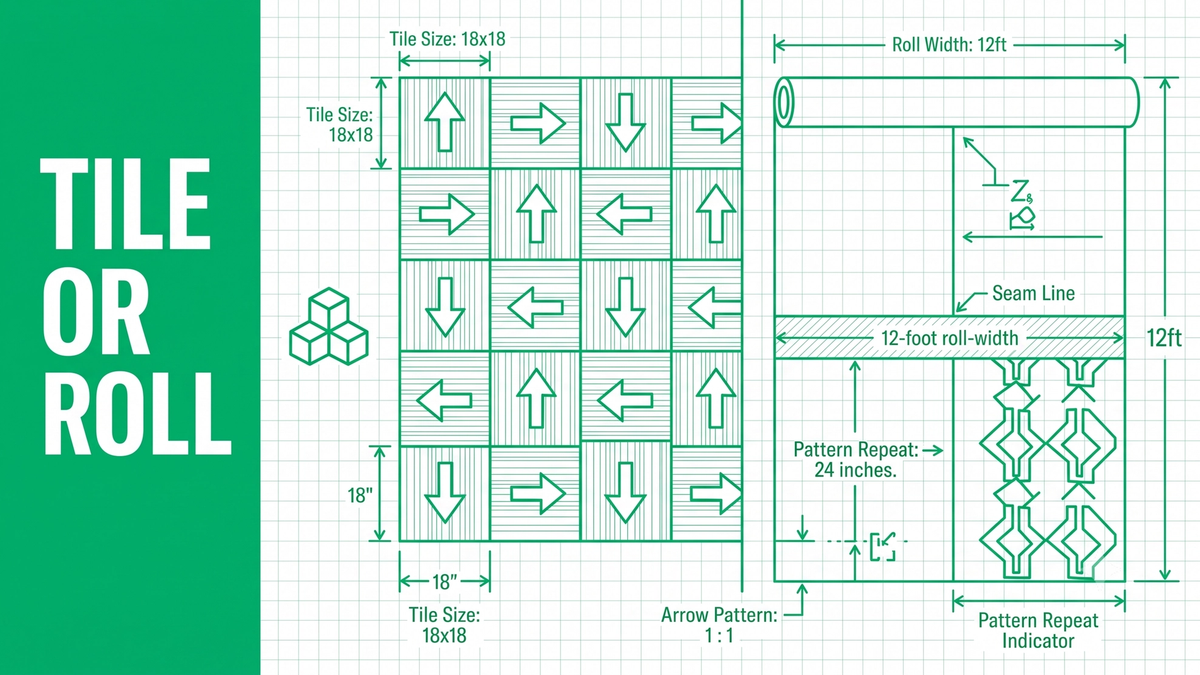
Carpet is one of the largest finish packages in most commercial buildings, and it is also one of the most consistently mispriced. The reason is simple. Most estimators run carpet the same way every time, measure the square footage, drop in a waste percentage, and order. That habit costs money on carpet tile and it costs even more on broadloom, because the two products are not variations of the same thing. They are manufactured differently, installed differently, and absolutely have to be estimated differently. Treating them as interchangeable is one of the fastest ways to over-order on offices and run short on a hotel corridor.
The carpet tile vs broadloom decision drives everything downstream: roll widths, seam locations, pattern repeats, installation direction, carton coverage, waste behavior, and labor productivity. Get the product math right and the bid holds. Skip it and the field finds out for you. On a hospitality or corporate build with thousands of yards of carpet, the difference between a disciplined takeoff and a sloppy one can swing material orders by 8 to 15 percent. That is the gap a real carpet takeoff process is built to close.
This guide breaks down what changes between carpet tile and broadloom, why roll width and seam planning decide your real waste, and how a disciplined estimator handles both without leaving margin on the table.
If you are pricing carpet on a hospitality or corporate set right now and the roll math is keeping you up, upload your plans and get a fast takeoff quote.
Carpet Tile vs Broadloom: What Actually Changes for the Estimator
Carpet tile is supplied as individual modular tiles, typically 18 by 18 inches, 24 by 24 inches, 50 by 50 centimeters, or 25 by 100 centimeter planks, packed by the carton and installed in defined patterns. Broadloom carpet is supplied in continuous rolls, commonly 12 feet, 13 feet 6 inches, or 15 feet wide, and requires seam planning, pattern matching, and roll-width optimization. Unicalibre Estimating runs each as a different scope, with cut and fit layout for broadloom and carton-based math for tile, every takeoff peer-reviewed before delivery.
The reason this distinction matters is that the bid does not respond to square footage. It responds to how the material gets cut and installed. Carpet tile is forgiving: modular, low-waste, easy to phase, easy to replace, friendly to logistics, and quick on labor. Broadloom is the opposite: luxurious, fewer joints, better acoustics, but seam-dependent, pattern-sensitive, harder to ship, harder to lay, and unforgiving on waste when the room geometry fights the roll width.
A complete deliverable accounts for both. Unicalibre Estimating provides peer-reviewed flooring quantity takeoffs delivered in native software formats including MeasureSquare, RFMS, Bluebeam, PlanSwift, Callidus, and Stack, with a BOQ broken out by carpet type and area, marked-up plans showing seam locations and roll-width layout, scope notes flagging pattern repeats and installation direction, a material summary in cartons and yards, and a deliverable your team can import and adjust without re-entry.
Request a risk-free pilot takeoff on a real carpet-heavy set and see the difference a product-aware process makes.
Carpet Tile: What to Verify Before You Measure
Carpet tile dominates commercial offices, schools, healthcare facilities, airports, and corporate buildings because the modular format absorbs phased construction, individual tile replacement, easier logistics, and faster installation. None of those advantages happen on their own. They show up in the takeoff if the estimator handles the right details and disappear if those details get skipped.
Before measuring anything on a carpet tile package, verify:
- Tile size and any plank dimensions
- Installation pattern (monolithic, quarter turn, ashlar, brick, herringbone)
- Carton coverage and pieces per carton
- Directional arrows on the backing
- Dye lot requirements per area
- Recommended waste percentage for the specified pattern
The carton math matters more than estimators expect. Carpet tile is ordered by the carton, not by individual tiles, and rounding to the next full carton on every area is what produces an accurate material order instead of a guess. The installation pattern matters even more. A monolithic install behaves differently from a quarter turn, and an ashlar or brick pattern adds cutting that flat waste percentages routinely miss.
Broadloom Carpet: Where the Real Risk Lives
Broadloom is supplied in continuous rolls, commonly 12 feet, 13 feet 6 inches, or 15 feet wide, and it shows up in hotels, convention centers, theaters, ballrooms, corridors, and high-end residential where the look demands continuity. The advantages are real: a luxurious finish, fewer visible joints, excellent acoustics, and a continuous surface. The estimating challenges are also real: higher waste, mandatory seam planning, harder transportation, pattern matching, and far more complex installation.
The most common broadloom mistake is pricing it off square footage alone. Roll width decides material consumption, not floor area. A 20 by 18 foot room in 12 foot rolls cannot be covered in a single piece, and the seam plan that follows changes both labor and yardage. An 11 by 18 foot room in the same 12 foot roll covers with virtually no seams. The rooms are not that different in size. The material orders are very different.
Always verify roll widths against the manufacturer's product data sheet. Never assume every carpet is supplied in the same width. Commercial broadloom and hospitality carpet typically come in 12 feet. Residential carpet often runs 12 or 15 feet. Specialty carpet may be 13 feet 6 inches. The wrong assumption here turns into either over-ordered yardage on the budget side or a shortage on installation day.
Seam Planning, Pattern Repeat, and Installation Direction
Seam planning is the single highest-impact skill in broadloom estimating. Every seam carries additional labor, additional adhesive, additional seam sealing, more installation time, and visual impact in the finished space. Good seam planning minimizes all of that. Lazy seam planning maximizes it. A 10 foot wide corridor and a 12 foot wide roll produce zero longitudinal seam. A 14 foot wide corridor and the same roll produces a seam that has to be planned, located out of high-traffic sightlines, and accounted for in the yardage.
Patterned carpet adds another layer. Hospitality work routinely specifies repeating patterns where every seam must align perfectly. That alignment costs material. Pattern repeat can add several percentage points to the order, and ignoring it is a guaranteed shortage. Always verify pattern repeat, pattern direction, and the manufacturer's installation recommendations before the order goes in.
Installation direction is the third quiet risk. Most carpet products carry directional arrows on the backing because pile direction creates visible shading even when the color is identical. Whether the spec calls for a monolithic, quarter turn, ashlar, or brick install changes both labor and the appearance of the finished floor. Each layout influences labor productivity, waste behavior, and layout complexity, and each one has to be reflected in the takeoff.
Common Carpet Estimating Mistakes
Most carpet ordering errors trace back to the same handful of habits:
- Pricing broadloom off square footage without checking roll width
- Placing seams in high-traffic areas or directly in front of doorways
- Ignoring pattern repeat on hospitality carpet
- Skipping installation direction and pile orientation
- Applying one waste percentage to every carpet type
- Ordering carpet tile by piece instead of by carton
- Treating tile and broadloom as the same takeoff workflow
Pro tip checklist before you lock a carpet order:
- Did I confirm whether the product is carpet tile or broadloom?
- Did I verify roll width or carton coverage against the manufacturer data sheet?
- Did I plan seams for sightlines and traffic flow, not just yardage?
- Did I account for pattern repeat where one is specified?
- Did I check installation direction and pile orientation?
- Did I apply a waste method that matches the install pattern, not a flat percentage?
- Did I round tile to full cartons and broadloom to roll-width-aware cuts?
- Did I verify dye lot requirements per area?
How the Estimating Models Compare on Carpet Work
DIY (owner estimating): Carpet tile is forgiving enough that DIY can survive it. Broadloom punishes the same approach. Seam planning and pattern repeat get glossed over, and orders swing 8 to 15 percent in the wrong direction.
In-house estimator: Better if trained on layout software, but a single set of eyes still loses precision under bid-day pressure, especially on hospitality and corridor-heavy work.
Per-project outsourcing: Useful for overflow, but a rotating estimator may not consistently plan seams the way your installers prefer, so quality varies bid to bid.
Dedicated FTE estimator: The same estimator every time, running cut and fit and seam planning in MeasureSquare or RFMS, peer-reviewed before delivery, learning your install patterns and your GCs' standards. Most reliable on hospitality and large corporate work, typically at a 50 to 60 percent cost reduction versus a domestic in-house hire.
Request a risk-free pilot takeoff on a broadloom-heavy package and see what disciplined seam planning does to your material order.
What Changes in the Real World
The pattern repeats across project types, and the financial swing is consistent.
A flooring subcontractor in Texas was bidding corporate office tenant improvements with carpet tile and ordering by raw square footage instead of rounding to full cartons. Tightening the takeoff to carton-based math and installation pattern brought material orders into a tight 3 to 7 percent waste band and cut leftover inventory across multiple phases.
A hospitality flooring contractor in Phoenix kept under-ordering broadloom on hotel corridors because roll width was not being checked against corridor geometry. A roll-width-aware cut and fit pass reduced reorders to nearly zero and protected an estimated 5 to 10 percent of margin per phase.
A flooring firm in Ontario bidding a convention center had been ignoring pattern repeat on a specified hospitality carpet. Running a pattern-aware layout caught the real waste exposure before the order went in and avoided a shortage that would have cost rush freight, an extra mobilization, and a dye lot risk on the recut.
Same lesson every time: the takeoff has to match the product. See how a dedicated estimator helps you bid more carpet-heavy work without over-ordering or running short.
What to Send and What You Get Back
A disciplined carpet takeoff does not require a perfect package. It needs the right inputs.
What you send: architectural plans, the finish schedule and finish legend, the carpet product spec and manufacturer data sheets if available, any addenda, the installation pattern called out in the spec, and your preferred brands or labor rates.
What you get back: a BOQ or Excel breakdown organized by carpet type and area, marked-up plans showing seam locations and roll-width layout for broadloom and tile-pattern layout for modular, scope notes flagging pattern repeats and installation direction, a material summary in cartons for tile and yards for broadloom, and native software files in your platform (MeasureSquare, RFMS, Bluebeam, PlanSwift, Callidus, or Stack) so your team can import and adjust without re-entry.
Timeline: standard turnaround is typically 24 to 48 hours for most trade packages, with same-day rush available when the deadline is closing. Communication runs over email, phone, and your preferred PM tools, and addenda are tracked as they land.
Want the pre-order checklist your team can run on every carpet package? Download the checklist.
Frequently Asked Questions
What is the difference between carpet tile and broadloom for estimating?
Carpet tile is supplied as modular tiles ordered by the carton and installed in defined patterns, with low waste and simple seam handling. Broadloom is supplied in continuous rolls, commonly 12 feet to 15 feet wide, and requires seam planning, pattern matching, and roll-width optimization. The two products demand different takeoff workflows, so treating them as interchangeable consistently produces inaccurate material orders.
Why does broadloom carpet roll width matter so much in a takeoff?
Roll width decides how broadloom carpet can be cut into a room, and it controls both seams and yardage. A 12 foot roll covers a 10 foot wide corridor with no longitudinal seam, but a 14 foot wide corridor in the same roll forces a seam and increases material. Pricing broadloom from square footage without checking the manufacturer's roll width is one of the most common causes of carpet ordering errors.
What is carpet seam planning and why does it affect the bid?
Carpet seam planning is the process of placing seams to minimize labor, adhesive, sealing, installation time, and visual impact, while keeping yardage efficient against the roll width and pattern. Poor seam placement in high-traffic areas or in front of doorways creates visible joints, and missed pattern repeat alignment can add several percentage points of waste that a flat percentage would never catch.
How should an estimator handle pattern repeat on hospitality carpet?
Patterned hospitality carpet requires additional material so every seam aligns perfectly with the pattern repeat. The estimator has to verify the pattern repeat dimensions, the pattern direction, and the manufacturer's recommended installation method before applying a waste factor, because a standard percentage will under-order patterned carpet. This is one reason a layout-driven cut and fit analysis beats a flat percentage on broadloom.
Can an outsourced estimator handle carpet tile and broadloom in my software?
Yes. Unicalibre Estimating works natively in MeasureSquare, RFMS, Bluebeam, PlanSwift, Callidus, and Stack, runs cut and fit and seam planning for broadloom, runs carton-based math for carpet tile, and peer-reviews every takeoff before delivery. Pattern repeat, installation direction, and roll-width optimization are part of the standard process, not an upgrade.
Order the Right Carpet the First Time
Carpet estimating is not measuring faster. It is reading the product before you reach for the takeoff software. Tile or broadloom, carton or roll, monolithic or quarter turn, plain or patterned, 12 foot or 13 foot 6 inch, in a sightline or out of it. Every one of those decisions changes the order, and every one of them gets quietly skipped when a single waste percentage gets stamped across the whole package.
Bid season does not wait, and hospitality and corporate sets are exactly where rushed carpet takeoffs cost the most. A disciplined, peer-reviewed process orders the right material the first time, plans seams the way the installer would, and protects the margin the bid was meant to deliver. The best estimators think like installers before they think like quantity surveyors, and the takeoff shows it.
Book a call and send your plans for turnaround and pricing. Order the right carpet the first time, and stop letting roll-width math decide your profit.