
Ceramic and Porcelain Tile Estimating: Installer Mindset
Ceramic and porcelain tile estimating is not square footage math. Flatness, large-format labor, movement joints, and leveling systems decide the bid.

Amruta Naik
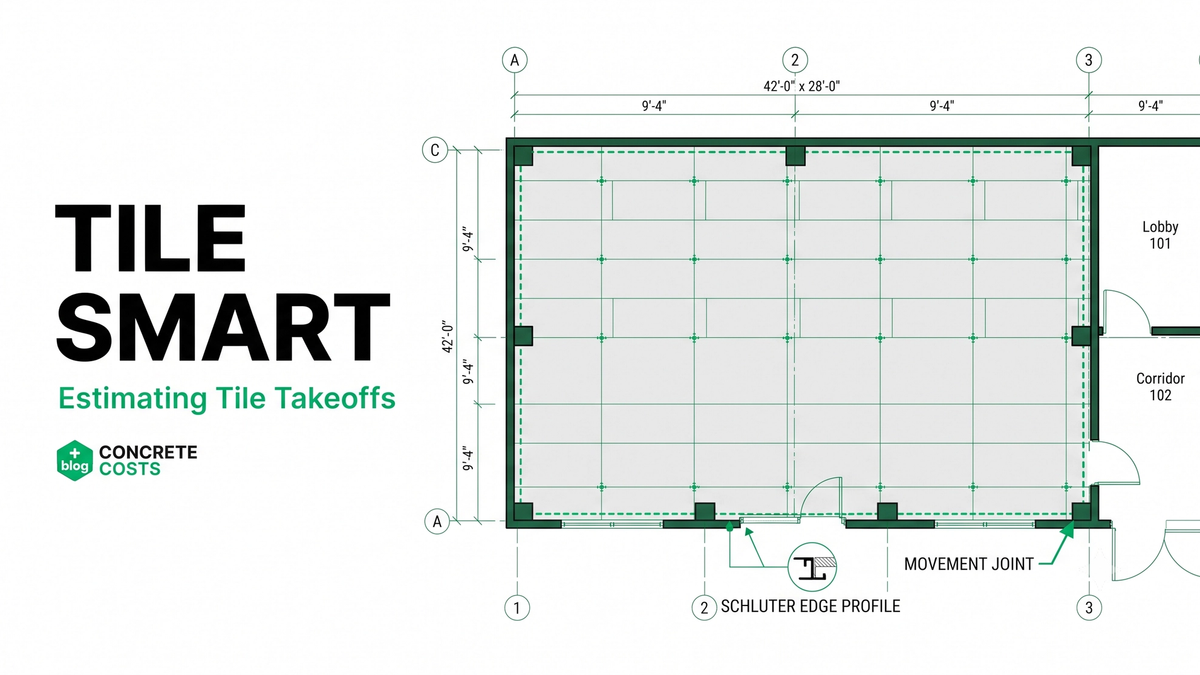
When most estimators receive a ceramic or porcelain tile package, the instinct is to calculate the floor area and apply a waste factor. That instinct is the reason so many commercial tile bids come back short on labor and short on scope. A professional tile installer never starts with square footage. Before opening the first box of tile, they walk the space and ask a completely different set of questions. Where do the movement joints go? Is the substrate flat enough for the specified tile size? Are these large-format tiles that need back-buttering and a leveling system? How wide are the grout joints? What type of thinset is specified? Where do the structural expansion joints run, and how do we keep tile off them? How do we balance the layout so we do not end up with narrow slivers at the walls?
Every one of those questions changes the bid. Together, they decide whether the tile package holds its margin or bleeds it in the field. The estimators who consistently protect margin on commercial ceramic and porcelain tile work are the ones who think like installers before they think like quantity surveyors. They price the labor for what the install actually requires, they capture the scope that lives in the details and the specs, and they refuse to let a single default waste factor decide their profit on a large-format porcelain job that behaves nothing like a small-format ceramic install.
This guide walks through what changes on ceramic and porcelain tile bids, why large-format tile is a completely different labor calculation, how movement joints and tile leveling systems drive both cost and quality, and how a disciplined process captures the full assembly before the bid goes out.
If you are pricing a commercial ceramic or porcelain tile package right now and the large-format labor is keeping you up, upload your plans and get a fast takeoff quote.
What Ceramic and Porcelain Tile Estimating Actually Requires
Ceramic and porcelain tile estimating is the quantity takeoff and cost breakdown for commercial tile installations, priced across tile surface area, substrate preparation, thinset and grout, movement joints, structural expansion joint coordination, tile leveling systems, edge profiles like Schluter, transitions, waterproofing in wet areas, and pattern-specific waste and labor. Unicalibre Estimating is an architect-led firm that reads the specifications, architectural details, and finish schedule before pricing tile, and every deliverable is peer-reviewed before it goes out. The result is a bid that reflects how the tile will actually be installed.
The reason this matters is that ceramic and porcelain do not behave the same way on a bid. Ceramic is softer and easier to cut, more economical, and suited to interior walls and light commercial floors. Porcelain is denser, harder, has lower water absorption, is more durable, and is preferred for commercial flooring, hospitals, airports, schools, and exterior applications. Because porcelain is harder, installers need better cutting equipment and spend more time making precise cuts. That directly changes labor productivity, and pricing porcelain at ceramic labor rates is a straight-line margin loss.
A complete deliverable captures all of it. Unicalibre Estimating provides peer-reviewed tile quantity takeoffs delivered in native software formats including Bluebeam, PlanSwift, Stack, MeasureSquare, RFMS, and Callidus, with a BOQ broken out by tile type and area, marked-up plans showing layout centering, movement joints, and expansion joint coordination, scope notes flagging large-format tile, leveling systems, and manufacturer requirements, a material summary that includes thinset, grout, edge profiles, and accessories, and a deliverable your team can import and adjust without re-entry.
Request a risk-free pilot takeoff on a real tile set and see the difference an installer-mindset takeoff makes.
Why Flatness and Large-Format Tile Change Everything
The biggest misconception in tile estimating is that tile can hide an uneven floor. It cannot. Large-format tile in particular demands a flat substrate, and installers verify slab flatness with long straightedges or laser levels before setting anything. When they find high or low spots, the correction is grinding or self-leveling underlayment, both of which are their own line items and both of which are commonly missed on tile bids because they live in the specifications rather than the floor plan.
Large-format tiles (typically 24 by 24 inches, 24 by 48 inches, or larger) have become the default for commercial buildings because they produce a clean, modern appearance with fewer grout joints. From the estimator's perspective, they also produce a completely different cost structure. Large-format tile requires flatter substrates (so more prep), is heavier and harder to handle (so slower installation), needs specialized suction lifters (so equipment cost), increases cutting time significantly (so labor productivity drops), often requires a tile leveling system (so additional material and labor), and demands improved mortar coverage (so more thinset per square foot). Two projects with identical square footage can have dramatically different labor and material costs solely because one specified 12 by 12 ceramic and the other specified 24 by 48 porcelain. Missing that distinction is one of the most consistent underbid patterns in commercial tile work.
Thinset Coverage, Lippage, and Leveling Systems
Poor mortar coverage is one of the biggest reasons tile installations fail, which is why professional installers do not simply spread thinset and place the tile. They pick the correct trowel size based on tile size, tile thickness, substrate, and manufacturer recommendations. For large-format porcelain, installers often use back-buttering, applying mortar to both the substrate and the back of the tile to hit the required coverage. Industry standards typically require approximately 80 percent mortar coverage on interior dry areas and approximately 95 percent on commercial, wet, and exterior areas. Better coverage improves adhesion and reduces hollow spots, and for estimators that means larger tiles require more mortar and additional labor.
Lippage is the other quiet cost. Lippage occurs when one tile edge sits higher than the adjacent tile, creating trip hazards, poor aesthetics, customer complaints, and failed inspections. It is one of the most common quality issues on commercial tile projects, and the risk goes up when the slab is uneven, when large-format tiles are used, when the tile itself has natural warpage, or when installers rush the install. Preventing lippage often means extra preparation and precision, and that costs time.
Tile leveling systems (clips and wedges that temporarily hold adjacent tiles at the same height while the mortar cures) reduce lippage, produce a flatter finished floor, improve alignment, speed installation for experienced crews, and improve appearance. They add material cost, but they typically reduce callbacks and improve quality on commercial work. Verify whether leveling systems are specified in the project or included in your standard installation practice, and price them as their own line item when they apply.
Movement Joints, Expansion Joints, and Layout Discipline
Tile expands and contracts with changes in temperature and moisture. Without space to move, the floor can crack, tent, or debond. Movement joints are flexible joints placed within the tile installation to accommodate that movement, commonly required around the room perimeter, at columns, at structural joints, between different flooring materials, and in large open areas. Movement joints are the single most commonly missed line item in commercial tile estimating because they show up in architectural details rather than the finish schedule. Read the details or price a callback later.
Structural expansion joints are a different problem entirely. Expansion joints let the building itself move, and tile should never bridge them. Cover a structural expansion joint with tile and the tile cracks the first time the building moves. Instead, installers use flexible movement joint systems that align with the structural joint below. Miss this on the takeoff and the field team either installs incorrectly or absorbs the cost of the correct flexible joint system. Always review structural and architectural drawings to identify expansion joints before the bid is locked.
Layout is where good installers earn their reputation. Professional layout centers the tile, balances cuts at opposite walls, avoids narrow slivers, aligns grout joints with architectural features, and coordinates transitions with doorways. Good layout reduces waste and improves appearance, and it also changes cutting time and material quantities. Estimators who ignore layout planning routinely under-price cutting labor and end up with either an ugly install or a shortage.
Tile Patterns Compound the Labor Change
Pattern choice on tile compounds every other cost driver on the bid. Straight lay runs 5 to 7 percent waste with low labor difficulty. Running bond runs 7 to 10 percent with medium labor. Basket weave runs 10 to 12 percent with high labor. Diagonal runs 12 to 15 percent with high labor. Herringbone and chevron both run 15 to 20 percent with very high labor. A decorative pattern on a large-format porcelain tile is where estimating errors compound the fastest, and where flat waste factors and default labor rates both fail simultaneously. Match the pattern math to the specified layout, and adjust labor productivity to reflect what the install actually requires.
Scope That Lives Outside the Floor Plan
Beyond the tile itself, an installer thinks about Schluter edge profiles, transition strips, stair nosings, waterproofing in wet areas, floor drains, grout type, sealants, and every movement joint and expansion joint detail. These accessories live in the architectural details, the door schedule, the interior elevations, and the specifications, and they are the difference between a complete bid and a partial one. Estimators who review every sheet routinely capture 5 to 10 percent of contract value that the floor-plan-only estimators leave in the field.
Common Ceramic and Porcelain Tile Estimating Mistakes
Most tile pricing errors trace back to the same handful of habits:
- Ignoring floor flatness requirements and skipping self-leveling underlayment
- Pricing porcelain at ceramic labor productivity
- Missing large-format tile labor, leveling systems, and back-buttering
- Forgetting movement joints because they live in the details
- Covering structural expansion joints with tile instead of coordinating flexible joint systems
- Using a single waste factor for every pattern
- Missing Schluter profiles, transitions, waterproofing, and grout accessories
Pro tip checklist before you lock a commercial tile bid:
- Have I verified the tile size and material (ceramic vs porcelain)?
- Have I confirmed floor flatness requirements from the specification?
- Have I included self-leveling underlayment where the tile size demands it?
- Have I priced thinset, grout, and back-buttering material for the specified tile?
- Have I identified every movement joint from the architectural details?
- Have I coordinated structural expansion joints with flexible joint systems?
- Have I priced a tile leveling system where required?
- Have I applied a pattern-specific waste factor, not a category default?
- Have I captured Schluter profiles, transitions, waterproofing, and accessories?
How the Estimating Models Compare on Tile Work
DIY (owner estimating): Square footage plus a flat percentage, and the flatness, movement joints, and large-format labor get discovered in the field.
In-house estimator: Better if trained on tile-specific scope, but a single set of eyes still misses movement joints in the details or under-prices large-format porcelain labor under deadline pressure.
Per-project outsourcing: Useful for overflow, but a rotating estimator may not consistently distinguish porcelain from ceramic labor or catch the flatness and joint scope from the specs.
Dedicated FTE estimator: The same estimator every time, working an architect-led process, peer-reviewed before delivery, learning your installers' preferred leveling systems and your GCs' typical spec patterns. Most reliable on hospitality, healthcare, and complex commercial tile work, typically at a 50 to 60 percent cost reduction versus a domestic in-house hire.
Request a risk-free pilot takeoff on a large-format porcelain or decorative-pattern package and see what an installer-mindset takeoff catches.
What Changes in the Real World
The pattern repeats across project types where tile scope dominates.
A tile contractor in Texas was bidding a hospitality lobby with 24 by 48 porcelain and had priced labor at standard tile productivity. Adjusting labor for large-format cutting time, back-buttering, and leveling clips protected an estimated 8 to 12 percent of the labor line that would have been absorbed in the field.
A commercial flooring contractor in Phoenix bidding a healthcare corridor with large-format porcelain missed the movement joints called out in the architectural details. Reading the details alongside the finish schedule surfaced the joint scope before the bid was locked and avoided a scope gap of an estimated 5 to 10 percent of the tile package.
A tile subcontractor in Ontario bidding an airport concourse in porcelain had priced the layout at standard flatness and skipped self-leveling. Reviewing the specifications caught the large-format flatness requirement and the SLU scope before submission, protecting an estimated 10 to 15 percent of contract value that would have gone straight to prep after award.
Same lesson every time: think like an installer, price like an estimator. See how a dedicated estimator helps you bid more commercial tile work without leaving scope in the field.
What to Send and What You Get Back
A tile-aware takeoff does not require a perfect package. It needs the right inputs.
What you send: architectural plans, the finish schedule and finish legend, interior elevations, architectural details (movement joints, expansion joints, edge profiles), reflected ceiling plans where wall or ceiling tile applies, structural drawings for expansion joint locations, specifications, any addenda, and your preferred brands or labor rates.
What you get back: a BOQ or Excel breakdown organized by area and tile type with pattern-specific waste and productivity, marked-up plans showing centered layout, movement joints, expansion joint coordination, and Schluter profile locations, scope notes flagging large-format tile, leveling systems, and manufacturer requirements, a material summary including thinset, grout, edge profiles, and accessories, and native software files in your platform (Bluebeam, PlanSwift, Stack, MeasureSquare, RFMS, or Callidus) so your team can import and adjust without re-entry.
Timeline: standard turnaround is typically 24 to 48 hours for most trade packages, with same-day rush available when the deadline is closing. Communication runs over email, phone, and your preferred PM tools, and addenda are tracked as they land.
Want the pre-bid tile checklist your team can run on every commercial ceramic and porcelain package? Download the checklist.
Frequently Asked Questions
What is included in a complete ceramic and porcelain tile estimate?
A complete ceramic and porcelain tile estimate includes tile surface area with pattern-specific waste, substrate preparation and self-leveling underlayment where required, thinset and grout with back-buttering material for large-format tile, movement joints, structural expansion joint coordination, tile leveling systems where specified, Schluter edge profiles, transitions and stair nosings, waterproofing in wet areas, and labor productivity adjusted for tile size, pattern, and installation method.
How does large-format tile change the estimate?
Large-format tile (24 by 24 inches and larger) requires flatter substrates, more thinset with back-buttering, tile leveling systems to control lippage, specialized handling equipment, and significantly more cutting time. Two projects with identical square footage can have dramatically different costs solely because one specified small-format ceramic and the other specified large-format porcelain. Pricing large-format tile at standard labor rates is one of the most common commercial tile underbid patterns.
What is the difference between movement joints and structural expansion joints in tile installations?
Movement joints are flexible joints placed within the tile installation to accommodate the tile's natural expansion and contraction, commonly required around the room perimeter, at columns, at material changes, and in large open areas. Structural expansion joints let the building itself move and should never be bridged by tile. Both must be identified from the architectural details and coordinated in the bid, and confusing the two causes cracked tile after handover.
Why does ceramic vs porcelain tile change the labor rate?
Porcelain tile is denser and harder than ceramic, so installers need better cutting equipment and spend more time making precise cuts. Ceramic tile is softer, easier to cut, and installs faster. Pricing porcelain at ceramic labor productivity underprices the installation, and the difference compounds fast on large-format porcelain projects where cutting time already accounts for a significant portion of the labor line.
Can an outsourced estimator handle commercial ceramic and porcelain tile takeoffs in my software?
Yes. Unicalibre Estimating works natively in Bluebeam, PlanSwift, Stack, MeasureSquare, RFMS, and Callidus, and every commercial tile takeoff includes movement joints, large-format labor adjustments, leveling systems, Schluter profiles, and pattern-specific waste as standard practice. Every deliverable is peer-reviewed against the specifications, architectural details, and finish schedule before it goes out.
Think Like an Installer, Price Like an Estimator
Great commercial tile bids are not built on square footage. They are built on installation reality. Substrate flatness, large-format handling, thinset coverage, lippage prevention, tile leveling systems, movement joints, structural expansion joint coordination, layout centering, and pattern-specific waste and labor. Every one of these decides whether the finished tile installation earns the reputation you want, and every one of them belongs in the takeoff before the material rate ever gets applied. The most valuable question an estimator can ask is not how many square feet of tile. It is how this tile will actually be installed.
Bid season does not wait, and hospitality, healthcare, airport, and high-end commercial projects are exactly where ceramic and porcelain tile scope dominates and rushed takeoffs cost the most. A disciplined, peer-reviewed process reads the specifications, the architectural details, and the finish schedule, and captures the installation reality in the bid.
Book a call and send your plans for turnaround and pricing. Price the install, not just the tile, and protect the margin on every ceramic and porcelain package.