Commercial Floor Preparation: Think Like an Installer
Commercial floor preparation is where flooring bids quietly lose margin. Grinding, self-leveling, and moisture mitigation are 10 to 25 percent of contract value

Amruta Naik
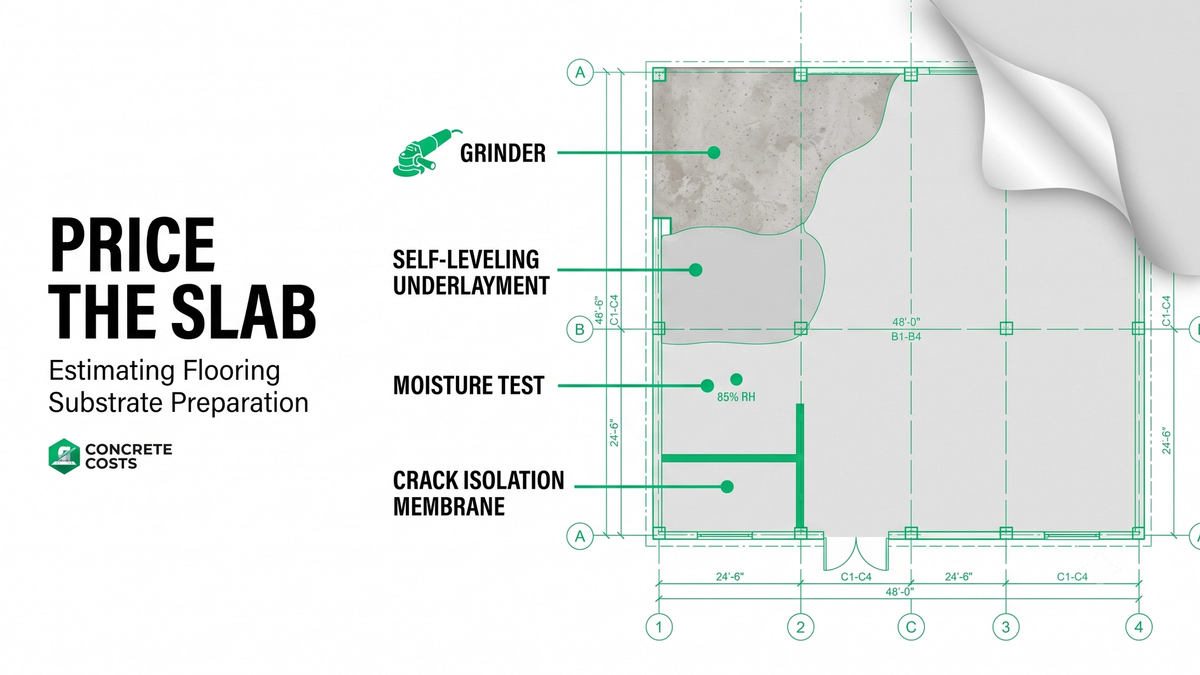
When a flooring contractor loses money on a project, the problem is almost never the finish flooring itself. It is what lies underneath. The finish is what the client sees. The substrate is what decides whether that finish performs for ten years or fails within twelve months. And on the vast majority of commercial projects, substrate work is where the bid quietly bled out during the takeoff. Grinding, patching, self-leveling underlayment, moisture mitigation, crack isolation. Every one of these items is expensive when it happens, and every one of them is easy to miss during a rushed square-footage takeoff.
The mindset shift that separates estimators who protect margin from estimators who absorb scope is straightforward: think like an installer. When a professional installer walks into a building, they do not think about the flooring material first. They walk the slab. They ask whether the concrete is flat enough, whether it holds excess moisture, whether cracks need repair, whether the cure was proper, whether old adhesive is present, whether the finish will telegraph imperfections. Every one of those questions is the difference between a floor that lasts and a floor that fails, and every one of them belongs in the takeoff before the material rate ever gets applied.
This guide walks through the types of commercial floor preparation, why moisture mitigation is not optional on concrete slabs, how prep requirements vary by finish material, and how a disciplined process reads the specifications and existing-condition drawings so the substrate scope makes it into the bid instead of the field cost.
If you are pricing a commercial flooring set right now and the substrate condition is a question mark, upload your plans and get a fast takeoff quote.
What Is Commercial Floor Preparation and Why Does It Matter?
Commercial floor preparation is the substrate work required before finish flooring installation, including concrete grinding, floor patching, self-leveling underlayment, moisture testing, moisture mitigation systems, crack repair, and crack isolation membranes. Unicalibre Estimating reads specifications, architectural notes, existing-condition drawings, and manufacturer installation requirements to capture floor prep as its own scope in every commercial takeoff, and every deliverable is peer-reviewed before it goes out. The result is a bid that reflects the true cost of installing the flooring correctly, not the fantasy that the slab is ready.
The reason this matters is the math. Floor preparation is not a small percentage on top of the finish material. On many commercial projects it runs 10 to 25 percent of contract value, and missing it in the bid means the flooring contractor absorbs the entire prep cost after award. Every flooring manufacturer publishes substrate installation standards. Adhesives fail on unprepared slabs. Cracks telegraph through resilient flooring. Moisture destroys adhesive bonds and voids warranties. A finish material that costs a lot of money will only perform as well as the substrate beneath it, which is why the substrate scope has to be estimated with the same discipline as the finish itself.
A complete deliverable captures the substrate work as its own scope. Unicalibre Estimating provides peer-reviewed flooring quantity takeoffs delivered in native software formats including MeasureSquare, RFMS, Bluebeam, PlanSwift, Callidus, and Stack, with a BOQ that separates floor preparation from finish flooring, marked-up plans showing prep zones and moisture-tested areas, scope notes flagging manufacturer requirements and specification-driven prep, a material summary tied to real substrate conditions, and a deliverable your team can import and adjust without re-entry.
Request a risk-free pilot takeoff on a set where the substrate condition is unclear and see what a full-assembly takeoff catches.
What Professional Installers Actually Look At
Before touching a takeoff, walk the project the way an installer walks it. The questions that shape the bid are not measurement questions. They are condition questions. Is the concrete flat enough for the specified finish material? Does the slab contain excess moisture, and has anyone actually tested it? Are there cracks that require repair, and if so, which kind? Has the concrete been properly cured, or is it still off-gassing water vapor? Is old adhesive residue still bonded to the substrate from a prior floor? Will the specified finish telegraph imperfections through the surface? Is moisture mitigation required, and at what performance level? Does the slab need grinding to remove high spots, paint, or curing compounds?
An estimator who asks these questions before pricing produces a bid that reflects the real project. An estimator who skips them produces a bid that reflects only the finish, and the field team pays for the difference. This is why the phrase "think like an installer" is not a slogan. It is an estimating method.
The Four Categories of Floor Preparation
Substrate work falls into four categories, and every commercial takeoff has to make an explicit decision about each one.
Concrete Grinding
Grinding removes high spots, paint, adhesive residue, curing compounds, and surface contamination, creating a clean surface that lets adhesives and underlayments bond correctly. It shows up on sheet vinyl, LVT, rubber flooring, ceramic tile, porcelain tile, and epoxy installations. On renovation work, grinding is nearly always required to remove residual adhesive from the prior floor, and it is one of the most consistently underpriced line items on commercial bids.
Floor Patching and Self-Leveling Underlayment
Small defects become highly visible beneath resilient flooring, so installers use patching compounds to repair holes, chips, surface voids, minor depressions, and joint imperfections. When the slab contains larger dips or uneven areas, self-leveling underlayment (SLU) creates a smooth, level surface. SLU is commonly specified before sheet vinyl, LVT, large-format porcelain tile, rubber flooring, and engineered wood, and on flatness-sensitive projects it can become one of the largest cost items on the entire flooring package. Missing SLU in the bid is one of the most consistent margin events in commercial flooring estimating.
Moisture Testing and Moisture Mitigation
Concrete continues releasing moisture long after it looks dry. Before installation, contractors typically perform relative humidity (RH) testing or calcium chloride testing to measure moisture emission. If levels exceed manufacturer limits, moisture mitigation systems are installed before the flooring goes down. Ignoring this requirement can result in complete flooring failure, and many manufacturers require documented moisture testing before honoring their warranties. For estimators, moisture mitigation is not an optional add-on. It is a required line item on any slab that has not been tested and cleared, and pretending otherwise is how field failures get born.
Crack Repair and Crack Isolation Membranes
Concrete cracks are common. Depending on the flooring system, installers repair cracks with epoxy, use crack isolation membranes, or apply flexible patching compounds. On tile installations, crack isolation membranes prevent existing slab cracks from transferring through to the finished floor. Miss this scope and the finished floor tells the story of the substrate a few months after the project closes.
How Prep Requirements Change by Finish Material
The finish material dictates what the substrate has to become. The most common commercial materials each carry their own prep profile.
Sheet vinyl typically requires grinding, patching, self-leveling underlayment, and moisture mitigation, and every imperfection telegraphs through the finished surface. Luxury vinyl tile requires a smooth substrate, patching, and moisture testing. Luxury vinyl plank typically requires self-leveling, moisture barrier, and crack repair, particularly on renovation slabs. Carpet tile requires cleaning, patching, and adhesive removal on renovation work. Broadloom carpet requires cleaning, patching, and moisture testing where specified. Ceramic tile requires crack isolation, leveling, and substrate repair. Porcelain tile requires flatness correction, crack isolation, and waterproofing in wet areas. Natural stone requires premium substrate preparation, leveling, and crack isolation because the finished material is unforgiving of any substrate movement. Rubber flooring requires grinding, moisture mitigation, and a smooth substrate. Epoxy flooring typically requires shot blasting or grinding, crack repair, and moisture testing.
The pattern is consistent: every finish material has a substrate prescription, and the takeoff has to price against that prescription rather than against the finish alone.
Where Floor Prep Scope Actually Lives on the Drawings
The single biggest reason floor prep gets missed is that it does not live on the floor plan. It lives inside specifications, architectural notes and general notes, existing-condition drawings, the finish schedule, and manufacturer installation instructions. Reading the floor plan and stopping there is the fastest way to under-bid a commercial flooring package. Every one of those documents has to be reviewed together, cross-referenced against the specified finish material, and reflected in the takeoff.
Common Floor Prep Estimating Mistakes
Most floor prep omissions trace back to the same handful of habits:
- Assuming the slab is installation-ready without reading the existing-condition drawings
- Ignoring moisture testing requirements in the specification
- Forgetting moisture mitigation on slabs with unknown or high RH readings
- Missing self-leveling underlayment on flatness-sensitive finishes
- Not pricing crack repair or crack isolation membranes
- Skipping adhesive removal scope on renovation projects
- Ignoring manufacturer installation requirements for the specified finish
Pro tip checklist before you submit any commercial flooring bid:
- Have I read the specifications for substrate requirements per finish?
- Have I reviewed the existing-condition drawings for slab issues?
- Have I confirmed whether moisture testing has been performed or is required?
- Have I priced moisture mitigation on any slab that has not been cleared?
- Have I identified grinding, patching, and self-leveling scope per area?
- Have I priced crack repair and crack isolation membranes where required?
- Have I checked the manufacturer's installation instructions for the specified finish?
- Have I accounted for adhesive removal on renovation projects?
How the Estimating Models Compare on Floor Prep Scope
DIY (owner estimating): Floor prep gets stamped as a lump-sum guess or skipped entirely under bid pressure, and the field team absorbs the difference.
In-house estimator: Better if trained on substrate reading, but a single set of eyes still misses spec-driven moisture mitigation or manufacturer-required prep under deadline pressure.
Per-project outsourcing: Useful for overflow, but a rotating estimator may not consistently read the specifications and existing-condition drawings the way substrate scope requires.
Dedicated FTE estimator: The same estimator every time, working an architect-led process, peer-reviewed before delivery, learning your GCs' typical spec habits and your installers' preferred prep methods. Most reliable on renovation and complex commercial work where substrate scope dominates, typically at a 50 to 60 percent cost reduction versus a domestic in-house hire.
Request a risk-free pilot takeoff on a renovation or spec-heavy set and compare it against a finish-only estimate.
What Changes in the Real World
The pattern repeats across project types where substrate reality collides with square-footage assumptions.
A flooring subcontractor in Texas was bidding a corporate renovation and had priced only the LVP finish, missing adhesive removal, self-leveling underlayment, and moisture mitigation called out across the specifications. A substrate-first re-take captured the full prep scope and protected an estimated 10 to 15 percent of contract value that the field team would have absorbed.
A commercial flooring contractor in Phoenix bidding a hospitality build was underpricing floor prep on the guest room LVT because moisture testing had not been reviewed and the RH reading, when it came in, required mitigation. Adding a mandatory moisture-scope review to the workflow surfaced the mitigation line item before the bid was locked and protected an estimated 8 to 12 percent of the flooring package.
A flooring firm in Ontario bidding a healthcare renovation had priced the sheet vinyl finish but missed grinding, patching, and crack isolation across the operating room and sterile areas. Reading the specifications and manufacturer installation requirements together caught the substrate scope before the bid went out and avoided a failure that a bid margin cannot survive.
Same lesson every time: the substrate is the bid. See how a dedicated estimator helps you bid more commercial work without absorbing prep scope.
What to Send and What You Get Back
A substrate-aware flooring takeoff does not require a perfect package. It needs the right inputs.
What you send: architectural plans, the finish schedule and finish legend, existing-condition drawings, interior elevations, specifications, any addenda, moisture testing reports if available, and your preferred brands or labor rates.
What you get back: a BOQ or Excel breakdown that separates floor preparation from finish flooring, marked-up plans showing prep zones, moisture-tested and moisture-mitigation areas, crack isolation zones, and self-leveling coverage, scope notes flagging manufacturer requirements and specification-driven prep, a material summary that reflects real substrate conditions, and native software files in your platform (MeasureSquare, RFMS, Bluebeam, PlanSwift, Callidus, or Stack) so your team can import and adjust without re-entry.
Timeline: standard turnaround is typically 24 to 48 hours for most trade packages, with same-day rush available when the deadline is closing. Communication runs over email, phone, and your preferred PM tools, and addenda are tracked as they land.
Want the substrate-scope checklist your team can run on every commercial flooring bid? Download the checklist.
Frequently Asked Questions
What is included in commercial floor preparation?
Commercial floor preparation includes concrete grinding, floor patching, self-leveling underlayment, moisture testing, moisture mitigation systems, crack repair, crack isolation membranes, and adhesive removal on renovation work. Every one is a distinct line item in a professional takeoff, and every one is required by manufacturer installation standards on the finishes that need them.
How much of a commercial flooring contract is floor preparation?
Floor preparation typically runs 10 to 25 percent of contract value on commercial flooring projects, depending on the substrate condition, the finish material, and whether the work is new construction or renovation. Renovation slabs with residual adhesive, moisture concerns, or cracking routinely land at the higher end. Pricing a bid without a real prep line item is a direct margin event.
What is moisture mitigation and when is it required?
Moisture mitigation is a system installed on concrete slabs where moisture vapor emission exceeds manufacturer limits, protecting the flooring adhesive and finish from failure. Testing methods include relative humidity (RH) testing and calcium chloride testing. Mitigation is required when readings exceed spec, when the slab has not been cured long enough, or when manufacturer warranties depend on documented moisture control. Ignoring it can cause complete flooring failure.
What items are most commonly missed in a floor prep takeoff?
The most commonly missed items are moisture testing and moisture mitigation, self-leveling underlayment on flatness-sensitive finishes, crack repair and crack isolation membranes, adhesive removal on renovation projects, and manufacturer-required substrate prep specific to the finish material. Every one of these lives in the specifications, notes, and existing-condition drawings rather than on the floor plan.
Can an outsourced estimator capture full floor prep scope in my software?
Yes. Unicalibre Estimating works natively in MeasureSquare, RFMS, Bluebeam, PlanSwift, Callidus, and Stack, and every commercial takeoff reads specifications, existing-condition drawings, and manufacturer installation requirements before pricing. Floor preparation is captured as its own scope, separate from finish flooring, and every deliverable is peer-reviewed before it goes out. That is the discipline that catches substrate scope reliably.
The Substrate Is the Bid
Great flooring estimates do not start with the finish material. They start with the substrate. Concrete condition, moisture, cracks, adhesive residue, flatness, manufacturer installation standards. Every one of these decides whether the specified finish will perform for a decade or fail within a year, and every one of them belongs in the takeoff before a rate ever gets applied. The estimators who protect their margin on commercial flooring understand that the substrate work is 10 to 25 percent of contract value, price it as its own scope, and refuse to guess at what should be a documented, spec-driven line item.
Bid season does not wait, and renovation and spec-heavy commercial projects are exactly where sloppy substrate takeoffs cost the most. A disciplined, peer-reviewed process reads the specifications, the existing-condition drawings, the finish schedule, and the manufacturer requirements before the bid leaves the desk. That is the difference between winning a job and inheriting a prep problem.
Book a call and send your plans for turnaround and pricing. Price the substrate, protect the finish, and stop letting floor prep decide your profit.