
Commercial Flooring Bid Summary Template: Complete Guide
Build a commercial flooring bid summary template that catches missed scope, protects margin, and gives your team a bid-ready decision snapshot.

Amruta Naik
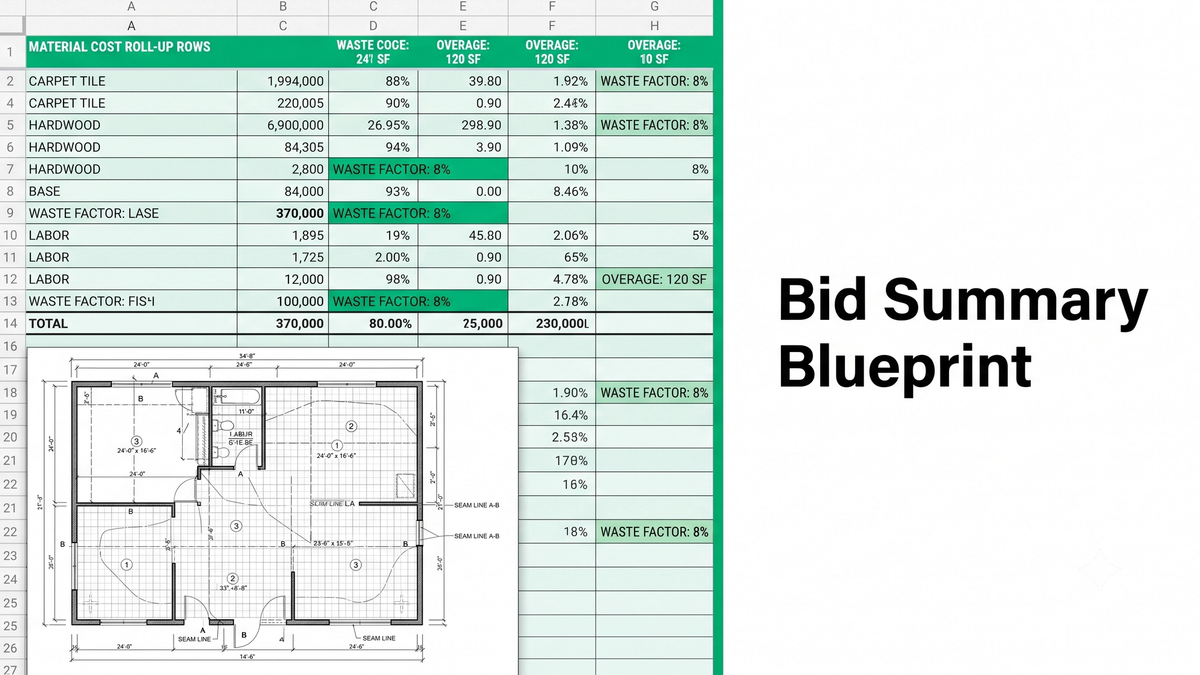
The moment before you hit submit on a commercial flooring bid is the most expensive moment in the entire estimating process. Days of takeoff work, vendor pricing chases, labor calculations, addenda revisions, and scope clarifications all converge into one final number that goes out the door. In that moment, most flooring contractors are staring at eight different spreadsheets, three vendor emails, a marked-up PDF, and a scribbled note about moisture mitigation.
That is exactly how margin gets lost.
A missing accessory line, an outdated vendor quote, a floor prep exclusion nobody remembered to add, or an unreviewed waste factor on a herringbone LVT install: any one of these can turn a profitable bid into a losing job the day it is awarded. Commercial flooring work in healthcare, hospitality, retail, and multifamily punishes disorganization. Owners and general contractors expect bid-day precision, and they compare your proposal line-by-line against three other subcontractors.
The problem is not that flooring estimators cannot do the math. The problem is that no matter how sharp your quantities are, if the pre-submission review lives across a dozen tabs and PDFs, mistakes slip through. Human memory is not a QA system.
This is why a well-built commercial flooring bid summary template matters. It is the one document that consolidates every material, labor, waste, and vendor decision into a single, scannable dashboard. It is the last chance to catch a scope gap before it turns into a change order dispute or an absorbed cost. It is also what separates flooring contractors who bid confidently from those who bid nervously.
In this guide, we walk through exactly how to build a bid summary sheet that protects your margin, supports your project managers, and gives leadership the information they need to make a real go or no-go decision. Every section comes from what our estimators use daily across tile, LVT, carpet tile, broadloom, sheet vinyl, and specialty flooring projects. If you want to see what the finished output looks like on your own work, start at Unicalibre Estimating.
What Is a Commercial Flooring Bid Summary Template?
A commercial flooring bid summary template is a structured, one-page dashboard that consolidates every cost, assumption, waste factor, vendor quote, exclusion, and risk item in a flooring estimate into one bid-ready view before submission. Unicalibre Estimating provides these summaries as a standard deliverable with every commercial flooring takeoff, alongside marked-up plans and a full BOQ, so contractors can approve or revise a bid in minutes instead of hours. The template is the final QA gate between takeoff and proposal.
Think of it as the pilot's pre-flight checklist. The plane may be perfectly maintained, but nobody takes off without a formal walk-through of every system. The bid summary plays that role for your estimating team. Owners, chief estimators, and project managers get one page that answers every important question: is scope complete, is waste calibrated, are vendor prices current, is floor prep accounted for, and does the final number protect margin.
A strong bid summary template includes:
- Project header (project name, GC, sector, addenda log, estimator, revision)
- Flooring scope summary (each material system with total quantity and units)
- Material cost roll-up by category
- Installation cost roll-up separated from material
- Floor preparation section with included, excluded, and allowance flags
- Accessories block (Schluter transition profiles, stair nosings, cove stick, weld rod, entrance mats, reducers)
- Waste assumption per material, with pattern layouts flagged separately
- Vendor pricing block with quote validity and lead times
- Procurement risks
- Clarifications and exclusions written in your own language
- Risk register with severity ratings
- Profitability review showing material, labor, overhead, contingency, and profit
- Final QA checklist signed off before submission
A summary built this way does two things at once. It gives leadership a clean decision surface, and it forces the estimator to confront every assumption before hitting send. Nothing hides in a linked cell three tabs deep.
Unicalibre Estimating is the architect-led construction estimating partner for US and Canadian flooring contractors, and every commercial flooring deliverable includes a peer-reviewed bid summary as a standard part of the package. Our team builds these in Excel, MeasureSquare, or RFMS depending on the client's preferred software, and delivers native files that your PM can hand straight to purchasing.
Upload your plans and get a fast takeoff quote at our contact page if you want a sample commercial flooring bid summary built on your next project.
How Do You Build a Commercial Flooring Bid Summary Template?
Building a bid summary sheet that actually protects margin is a process, not a form. Here is how our estimators build one from scratch, and the mistakes most in-house teams make when they try to do it under bid-day pressure.
The Build Order That Works
Start with the header block. Project name, general contractor, sector (healthcare, hospitality, retail, multifamily, education, corporate), bid date, estimator name, revision, and every addendum you have incorporated. This is not administrative filler. Six months from now, when a change order dispute lands on your desk, this header tells everyone which drawings and addenda your bid was priced against.
Next, build the scope summary. Every flooring system gets a line: carpet tile, broadloom, LVT, sheet vinyl, porcelain tile, ceramic tile, rubber, epoxy. Each line shows quantity in the correct unit (SF for field materials, LF for base and nosings, EA for accessories). This is the plain-language answer to "what are we bidding."
Then roll up material and labor separately. Never bury installation cost inside material pricing. When labor sits in its own block, you can spot when a labor rate is off, when a specialty install (herringbone, diagonal, pattern-matched) is underpriced, and when a phased project should carry a premium. For a deeper look at layout-specific waste that drives labor, our team follows the trade practices detailed on our flooring estimating service page.
Floor preparation gets its own section for one reason: it is the single most common cause of change orders on commercial flooring jobs. Grinding, patching, moisture mitigation per ASTM F2170 in-situ relative humidity testing, self-leveling underlayment, adhesive removal, crack isolation. Every line item gets a status flag: included, excluded, or allowance. If the spec is silent, that is a clarification, not an assumption.
Accessories deserve the same discipline. Weld rod for sheet vinyl, Schluter transition profiles, stair nosings and cove base returns, reducers, cap strip, inside and outside corners, entrance mats. Forgetting one accessory line rarely tanks a job, but forgetting three or four adds up to real money. If your team is still calibrating waste factors by material, our waste factor glossary entry breaks down the ranges we use across pattern types.
Seven Common Mistakes to Avoid
- Burying labor inside material pricing so nobody can audit the install cost independently.
- Applying a blanket waste percentage across every material instead of calibrating by pattern and roll geometry.
- Skipping the floor prep section entirely and pricing it as one lump sum with no allowance flag.
- Using vendor quotes that expire before the project starts without recording quote validity dates.
- Writing exclusions in generic legalese instead of specific, project-referenced language.
- Not including an addenda log, so nobody can prove which revisions were priced.
- Submitting the bid without a peer review sign-off line on the QA checklist.
Pro Tips From Our Estimators
- Color-code the summary. Red for excluded, green for included, yellow for allowance. Leadership can scan status in seconds.
- Add a cost per SF installed row at the bottom of the material roll-up. It is your fastest sanity check against historical projects.
- Include a long-lead items flag on the vendor block. Ten weeks on a custom carpet order is a procurement risk, not a footnote.
- Attach the peer review comments directly under the QA checklist. It is proof of process for both leadership and future disputes.
DIY vs In-House vs Per-Project vs Dedicated FTE
DIY (owner-estimator): Cheapest on paper. In practice, the owner is bidding at 10 PM after a full day on site, using a spreadsheet that has never been peer-reviewed. Consistency is low, turnaround is slow, and margin fade is common.
In-House Estimator: Consistent voice and standards, but expensive. Bureau of Labor Statistics data (see the Cost Estimators occupational profile) shows commercial estimator salaries in a range that, once burden, benefits, PTO, software, and training are loaded, typically runs into six figures per year fully loaded.
Per-Project Outsourcing: Flexible and useful for overflow, but consistency varies estimator to estimator. Bid summary formats often need to be rebuilt to match your standards each time. Fine for occasional support, not ideal for high bid volume.
Dedicated FTE Model: Same estimator every time, learns your standards, uses your template, delivers native files in your software, and includes a mandatory peer review. Costs 50 to 60 percent less than a fully loaded in-house hire. This is the model our team is built around.
Request a risk-free pilot takeoff at our contact page if you want to see the FTE model applied to your next commercial flooring project.
What Contractors See When They Adopt a Structured Bid Summary Template
Anonymous examples from commercial flooring contractors who moved from ad-hoc bid reviews to a structured summary template.
A commercial flooring contractor in Texas was bidding six to eight healthcare and multifamily projects a month with no standardized summary. The owner reviewed bids by scrolling through the master estimate spreadsheet the night before submission. After moving to a peer-reviewed bid summary sheet built by a dedicated estimator, bid volume climbed roughly 40 to 60 percent within six months, and the win rate on healthcare projects improved by around 20 percent. Scope was being caught during pre-submission review, not after award.
A multifamily specialist in the Southeast struggled with pattern-yield miscalculations on LVT plank layouts and inconsistent floor prep pricing across projects. The summary template forced every project to carry the same floor prep breakdown, waste calibration per material, and vendor validity check. Waste-driven material overages dropped by an estimated 5 to 10 percent, and the team stopped absorbing prep costs the GC assumed were included.
A regional flooring contractor working corporate interiors and healthcare was losing 10 to 15 hours a week to bid-day chaos. Estimators were rebuilding summaries from scratch every project, purchasing was chasing quote dates, and the owner was re-verifying scope during proposal review. Once a dedicated estimator standardized the summary template across every project, that time dropped to under three hours a week.
The pattern is the same in all three cases. Structured summary review does not just protect the numbers. It changes the psychology of bid submission. Confident bids get submitted on time, at the right margin, without last-minute panic.
See how a dedicated estimator helps you bid more at our services hub.
What to Send and What You Get Back
What we need from you:
- Drawings (architectural, finish plans, RCP if relevant)
- Finish schedule and flooring specifications
- All issued addenda
- Bid due date
- Any preferred vendor pricing, labor rates, or historical project data your team wants applied
- Your existing bid summary format if you have one, or a blank slate if you want us to build it
What you receive:
- Complete BOQ in Excel or your preferred software (MeasureSquare, RFMS)
- Marked-up plans with quantity callouts
- Waste breakdown by material with pattern-specific factors
- Floor prep quantities with included, excluded, and allowance flags
- Accessory schedule
- Vendor pricing block with lead times and quote validity
- Full bid summary sheet, peer-reviewed and ready for leadership sign-off
- Native software files so your PM can hand it straight to purchasing
Typical turnaround:
- Small projects, 24 to 48 hours
- Mid-size commercial, two to four days
- Large healthcare, hospitality, or multifamily projects, four to six days
- Same-day rush available on capacity
Communication runs by email, phone, or your PM tool. The same dedicated estimator handles the project from takeoff through addenda revisions and final submission, so you are not re-explaining scope every time.
Download the commercial flooring pre-bid checklist from our resources hub and pair it with the bid summary template on your next project.
Frequently Asked Questions
What is a commercial flooring bid summary template?
A commercial flooring bid summary template is a one-page structured document that consolidates every cost, waste factor, floor prep line, accessory, vendor quote, exclusion, and risk item in a flooring estimate. It functions as the final QA gate before proposal submission and gives leadership a scannable snapshot to approve or revise the bid.
How is a bid summary different from a takeoff or BOQ?
A takeoff or BOQ lists quantities. A bid summary aggregates the takeoff, vendor pricing, labor, waste, floor prep, exclusions, and risk into a single decision-ready view. The BOQ answers "how much material." The bid summary answers "should we submit this bid at this number." Both are needed, and they serve different audiences.
Who on our team should review the bid summary before submission?
At minimum, the estimator who built it and a second peer reviewer. On larger commercial projects, the project manager and the owner or chief estimator should also sign off. The value of the summary is that it lets each reviewer scan the same document quickly instead of digging through separate spreadsheets and PDFs.
Should the bid summary include profit and overhead?
Yes. A useful bid summary shows material, labor, equipment, subcontracts, overhead, contingency, and profit as separate lines feeding the total bid number. Without visibility into how markup was applied, leadership cannot make an informed go or no-go decision at the moment of submission.
Can Unicalibre Estimating build a commercial flooring bid summary template using our existing format?
Yes. Unicalibre Estimating is software-agnostic and delivers commercial flooring bid summaries in Excel, MeasureSquare, or RFMS depending on the format your team already uses. If your firm does not have a template, we build one to your standards during the first project and maintain it across every bid after that.
Stop Submitting Bids You Cannot Fully Review
Commercial flooring bids fail for two reasons: bad quantities, and unreviewed assumptions. A well-built bid summary sheet solves the second problem and forces the first one into the open where it can be corrected. It is the single most valuable QA artifact your estimating team can adopt, and it costs almost nothing to implement.
The contractors who submit the calmest bids are not smarter than the ones who scramble. They just have a better summary sheet. Every scope item, every waste factor, every vendor quote, every exclusion is on one page, reviewed by two sets of eyes, before the proposal leaves the office.
Bid season does not slow down. Q4 and Q1 volumes will spike, and the estimating desks that are already stretched will get stretched further. This is the right time to standardize the bid summary template across your projects, or hand it to a dedicated estimator who runs the same discipline on every job.
Book a call and send your plans for turnaround and pricing at our contact page.