
Commercial Flooring Expansion Joints: Installer's Guide
Commercial flooring expansion joints stop tile cracks and LVT tenting. Learn the 5 joint types every estimator and installer must know.

Amruta Naik
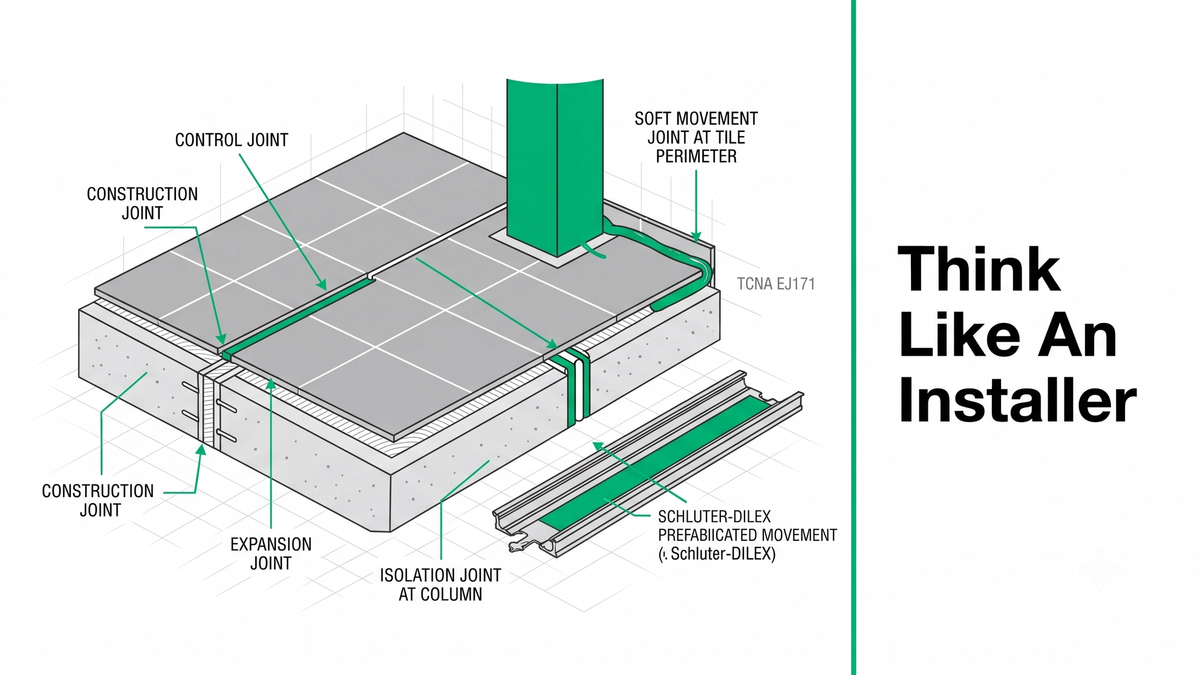
The most expensive flooring detail on a commercial project is usually the one nobody measures. You can install the best porcelain tile. You can specify the correct thinset. You can level the substrate perfectly and follow every line of the manufacturer's installation instructions. And the floor can still fail. Not because of workmanship. Because the building moved, and the flooring assembly had nowhere to move with it.
Concrete shrinks as it cures. Steel expands with heat. Wood swells with humidity. Slabs deflect under load. Buildings settle for years after occupancy. Every one of those forces has to go somewhere. If the finished floor cannot accommodate that movement, it will find its own relief, and it will do that by cracking, tenting, debonding, or lifting. This is why understanding commercial flooring expansion joints is not an installer-only skill. It is an estimator's skill. A takeoff that skips over movement joint requirements looks accurate on paper and still puts the contractor on the hook for a callback.
This piece is the next entry in our Think Like an Installer series, and it is written for the estimators, project managers, and owners who want to catch these details on the drawings, not on the punch walk. You will get a clean breakdown of the five joint types that show up on commercial flooring projects, why tile floors crack and why LVT floors tent, how the TCNA EJ171 movement joint guideline governs tile work, where prefabricated profiles like the Schluter DILEX family fit in, and the specific line items an estimator should be pricing on every commercial tile and resilient flooring bid.
Skipping movement joints is one of the fastest ways to lose margin on a commercial floor. Start here at Unicalibre Estimating if you want a takeoff that catches every one of them before the bid goes out.
What Are Commercial Flooring Expansion Joints?
Commercial flooring expansion joints are engineered gaps in the finished flooring assembly that allow separate sections of the floor, substrate, or building to expand and contract independently without transferring stress into the tile, grout, or resilient surface. Unicalibre Estimating treats every commercial tile and resilient flooring takeoff as a movement joint review, cross-referencing structural drawings, architectural details, and specifications against TCNA EJ171 and ANSI A108 movement joint requirements so nothing gets bridged rigidly and nothing gets missed on the bid.
The industry uses several terms that are often confused: construction joints, control joints, expansion joints, isolation joints, and movement (soft) joints. They are not interchangeable. Each does a different job, and each requires a different response from the flooring assembly.
The reference standard for tile is the TCNA Handbook for Ceramic, Glass, and Stone Tile Installation, specifically detail EJ171. It calls perimeter and field movement joints in a tile installation "essential and required," sets a maximum interior spacing of 25 feet in each direction, and drops that to 8 to 12 feet for exterior work and interior areas exposed to direct sunlight. Joint width is never less than 1/8 inch. Perimeter joints are preferred at 1/4 inch. Sealant must meet ASTM C920 traffic grade. ANSI A108 uses the term "movement joints" rather than "expansion joints" to reflect that these joints accommodate both expansion and contraction.
The estimator's job is to identify every location where a movement joint is required, price the assembly correctly, and price the accessory profiles that make the joint function. Miss any of that, and the flooring contractor either eats the scope or ends up back on the job replacing tile.
Upload your plans and get a fast takeoff quote at our contact page if you want a movement-joint-aware bid on your next tile or resilient flooring project.
The Five Joint Types Every Estimator Should Recognize
Here is how each joint type behaves and how a disciplined estimator prices it.
1. Construction Joints
Construction joints in concrete slabs are the seams where one concrete pour ends and the next begins. On a hospital floor or a warehouse slab that cannot be poured in a single day, these joints run through the entire structural assembly and continue to move for the life of the building. Flooring installed over them must accommodate that movement, not bridge it rigidly. Always identify construction joints on structural drawings before finalizing tile or resilient scope.
2. Control Joints
Control joints, also called contraction joints, are saw-cut or formed weakened planes that force concrete to crack in a planned location instead of a random one. Concrete control joints are the most misunderstood joint type on commercial jobs. Installers and estimators regularly assume tile can bridge them. It cannot. Per EJ171, all structural joints in the substrate must continue uninterrupted through the tile installation, or a crack isolation membrane must be used to relocate the joint to the nearest grout line.
3. Expansion Joints
Expansion joints in commercial flooring are large structural gaps designed to let building sections move independently under thermal or seismic load. You find them between wings, in long corridors, in parking structures, in airports, and in shopping malls. They must remain fully functional. Rigid tile, grout, or resilient flooring across an expansion joint is a guaranteed failure.
4. Isolation Joints
Isolation joints separate structural elements, columns, elevator pits, stair towers, machinery pads, from the surrounding slab so movement in one does not transfer into another. Flooring around these elements often needs careful detailing with a movement joint profile or a compressible perimeter joint.
5. Movement (Soft) Joints
Movement joints, also called soft joints, are flexible joints built into the finished tile assembly. Instead of grout, they are filled with an ASTM C920 traffic-grade sealant over a closed-cell backer rod, or fitted with a prefabricated movement profile. They are the joints installers add to satisfy EJ171: at perimeters, at every change in plane, over structural joints, at columns, at long tile runs, and at material transitions.
Why Tile Floors Crack
Most tile crack investigations lead back to the same three causes: a structural joint bridged by tile, a missing perimeter movement joint, or an under-spaced movement grid in the field. The tile did nothing wrong. The assembly had nowhere to move. Common symptoms include cracked grout, cracked tiles, hollow-sounding tiles, and debonding. Every one of these traces back to movement the design or the takeoff failed to accommodate.
Why LVT Floors Tent
LVT expands and contracts differently than ceramic tile. When LVT is restrained at walls, columns, or transitions without adequate perimeter movement space, compressive force builds up until the floor lifts, buckles, or pushes against transitions. That failure mode is called tenting. Installers often blame the adhesive. In most cases the real cause is inadequate perimeter movement accommodation and missing expansion allowance at long runs.
Schluter DILEX and Prefabricated Movement Joint Profiles
Traditional movement joints rely on sealant over backer rod. Modern commercial projects increasingly specify prefabricated Schluter DILEX movement joint profiles instead. The DILEX family protects tile edges, absorbs movement, holds up to industrial traffic, and produces a cleaner finished appearance than field-tooled sealant. Product selection depends on location (surface vs. perimeter), expected movement range, and traffic conditions. An estimator pricing a project without cross-checking the specification for a DILEX callout will miss both the profile line item and the labor to set it, and both are real money on a 20,000 square foot corridor.
Common Estimating Mistakes on Movement Joints
- Measuring square footage without reviewing the structural drawings for construction joints
- Assuming tile can bridge a concrete control joint
- Ignoring perimeter movement joints at the room boundary
- Missing prefabricated movement profiles specified in the tile section
- Skipping the specification check for EJ171 or ANSI A108 references
- Assuming LVT does not need perimeter expansion space
- Pricing sealant labor without a length quantity for movement joints
DIY vs In-House vs Per-Project vs Dedicated FTE
DIY: Movement joints get missed on the drawing review because the owner is bidding late and only reading the finish schedule.
In-House Estimator: Consistent, but expensive once salary, benefits, PTO, software, and training are fully loaded.
Per-Project Outsourcing: Movement joint awareness varies estimator to estimator. Fine for overflow, weak on repeatable standards.
Dedicated FTE Model: Same estimator on every project, learns your specifications, prices EJ171 movement joints and Schluter profiles consistently, and includes mandatory peer review. Costs 50 to 60 percent less than a fully loaded in-house hire. Unicalibre Estimating is the architect-led flooring estimating partner our clients use to run this discipline across every commercial tile and resilient job.
Request a risk-free pilot takeoff at our contact page if you want an EJ171-aware takeoff on your next tile project.
What Movement-Joint-Aware Estimating Looks Like in the Field
Anonymous examples from commercial flooring contractors who tightened their movement joint review.
A commercial tile contractor in Texas was absorbing callbacks on healthcare corridors from cracked grout and hollow tiles. Root cause on every job was the same: control joints in the slab were being bridged by tile without a crack isolation membrane. Once a dedicated estimator built an EJ171 checklist into every commercial tile takeoff and flagged structural joints on the marked-up plans, warranty callbacks dropped by an estimated 40 to 60 percent over two bid seasons.
A multifamily specialist in the Southeast was fielding tenting complaints on LVT installs across garden-style buildings. The team was pricing LVT with no perimeter movement allowance and no expansion strip at long corridor runs. The estimator added a perimeter movement line item and cross-checked the specification for expansion requirements on every bid. Tenting warranty issues dropped by roughly 30 to 50 percent within a year.
A regional flooring contractor bidding corporate interiors and airport work was missing Schluter DILEX profiles on the takeoff because the profiles were only called out in the specification, not the finish schedule. Once a dedicated estimator was assigned to cross-reference the tile spec section against the finish schedule and drawings on every bid, missed profile scope on award dropped by 90 percent or more, and bid margins on tile work improved by 5 to 10 percent.
Movement joint scope is not exotic. It is on the drawings, in the spec, and in the TCNA Handbook. It just does not get caught unless someone is looking for it.
See how a dedicated estimator helps you bid more at our services hub.
What to Send and What You Get Back
What we need from you:
- Architectural drawings, finish plans, RCP, elevations, and enlarged tile details
- Structural drawings showing construction and control joints
- Complete specification, especially the tile section (typically 09 30 00) and the joint sealant section
- Manufacturer installation instructions if referenced
- All issued addenda
- Bid due date
What you receive:
- Complete BOQ in Excel or your preferred software (MeasureSquare, RFMS)
- Marked-up plans with movement joint locations called out
- Perimeter movement joint linear footage
- Field movement joint linear footage per EJ171 spacing
- Prefabricated movement profile counts by type (Schluter DILEX or equivalent)
- Sealant and backer rod quantities where applicable
- Crack isolation membrane quantities where movement joints are relocated
- Peer-reviewed bid summary with movement joint scope broken out separately
Typical turnaround runs 24 to 48 hours for small projects, two to four days for mid-size commercial, and four to six days for large healthcare, hospitality, or transportation work. The same dedicated estimator handles the project from takeoff through addenda and final submission.
Pair this joint walkthrough with our commercial flooring installation sequence guide and the pre-bid checklist on our resources hub.
Frequently Asked Questions
What is the difference between a control joint and an expansion joint?
A control joint is a saw-cut or formed weakened plane in a concrete slab that forces the slab to crack in a planned location as it shrinks. An expansion joint is a structural gap that allows separate sections of a building to expand and contract independently. Both must be honored through the flooring, not bridged rigidly.
What is TCNA EJ171 and why does it matter for commercial flooring expansion joints?
TCNA EJ171 is the movement joint guideline in the TCNA Handbook for Ceramic, Glass, and Stone Tile Installation. It sets required locations, spacings, and widths for movement joints in commercial tile installations. Interior spacing is a maximum of 25 feet each direction. Exterior and sun-exposed spacing drops to 8 to 12 feet. Joint width is never less than 1/8 inch.
Why do commercial tile floors crack even when installation looks perfect?
Tile floors crack when the assembly has nowhere to accommodate movement. The most common causes are bridging a structural or control joint with tile, missing perimeter movement joints, and under-spacing field movement joints. The workmanship can be flawless and the floor will still fail if EJ171 movement joint requirements were not designed and priced into the project.
Why does LVT floor tent or buckle after installation?
LVT tenting is usually the result of inadequate perimeter movement space or missing expansion allowance at long runs. When compressive force builds up as the material expands, the floor lifts against restraining walls, columns, or transitions. Adhesive is often blamed, but the underlying cause is a movement accommodation failure that should have been priced in the estimate.
Do Schluter DILEX profiles eliminate the need for perimeter movement joints?
No. Schluter DILEX and other prefabricated movement joint profiles satisfy the movement requirement at their installed location, but they do not remove the requirement for perimeter joints and field movement joints elsewhere in the tile assembly. EJ171 spacing and perimeter requirements still apply.
Start Pricing Movement, Not Just Square Footage
Commercial flooring expansion joints are not a detail. They are a scope item. Every tile project has them. Every resilient project needs perimeter movement allowance. And the estimators who catch them on the drawing review are the estimators whose contractors are not standing on a jobsite six months later cutting out cracked tile at their own expense.
Think like an installer on the takeoff. Read the structural drawings alongside the finish plan. Cross-reference the tile specification against EJ171. Flag every construction joint, every control joint, every expansion joint, every isolation joint, and every perimeter condition that needs a movement joint. Price the sealant, price the backer rod, price the Schluter DILEX profile, and price the labor to set them all.
Do that on every bid and the margin protects itself.
Book a call and send your plans for turnaround and pricing at our contact page.