
Commercial Flooring Failures: What Caused This and Why
Commercial flooring failures rarely happen because materials are bad. They happen because substrate, moisture, or scope was missed at bid time.

Amruta Naik
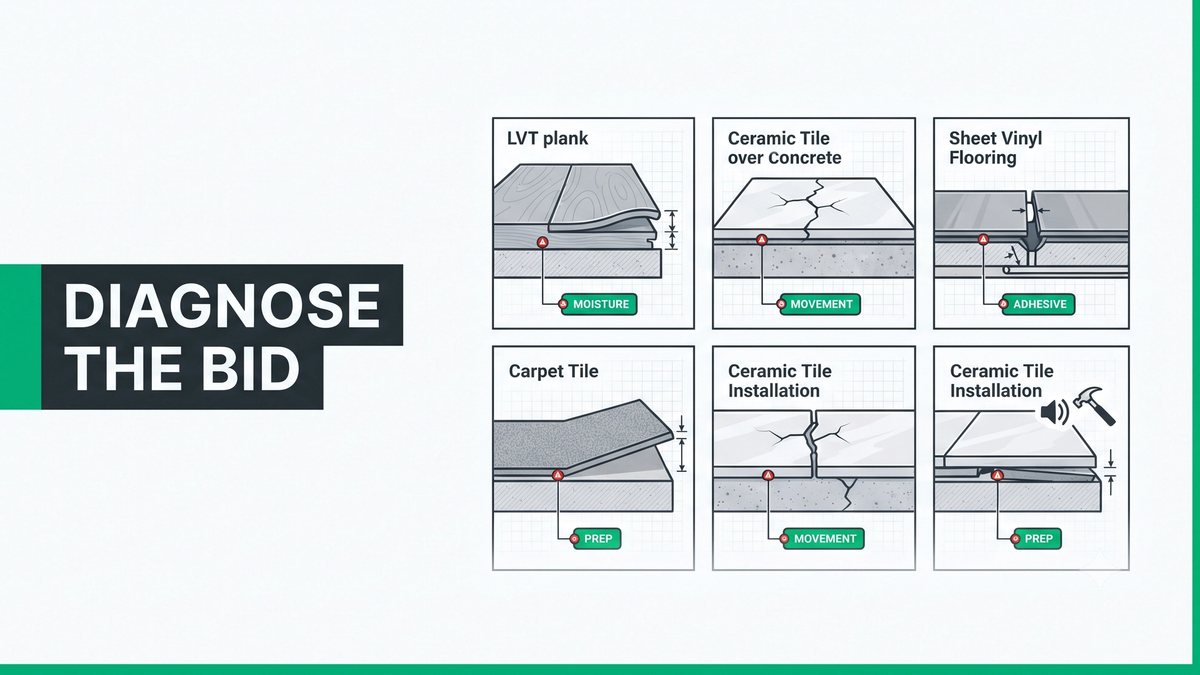
Walk into a hospital corridor twelve months after installation and see sheet vinyl seams pulling apart along the wall of a busy patient wing. Walk through an airport terminal a year after the tile is set and count the diagonal cracks running through the porcelain. Walk down a multifamily corridor two years in and watch the LVT plank edges curling up at every doorway. Every one of these is a story with a beginning, and the beginning is almost never "the material was bad." It is almost always that something got missed at bid time. Substrate condition. Moisture. Movement joints. Manufacturer-required assemblies. Waste factors on the wrong pattern. Adhesive selection. Prep scope that was never priced. The material got blamed after the fact, but the actual cause traces back to a takeoff that did not capture what the install required.
That is the uncomfortable truth about commercial flooring failures. Manufacturers publish products that will last their advertised service life. Installers know how to install them correctly. Design teams specify assemblies that work when they are executed as designed. The gap between all of that and the failed floor a year later is almost always something specific and identifiable: a missed line item, an unread specification, a substrate that was never tested, a movement joint that was never priced, a moisture reading that never happened, or an adhesive that was mismatched to the substrate condition. Every one of these is preventable at bid time. Every one of them starts with what the estimator did or did not read before the bid was submitted.
This guide walks through the five most common commercial flooring failures (curling LVT, cracked tile, open sheet vinyl seams, loose carpet, and cracked grout), what actually causes each one, real vertical examples from hospitals, airports, and multifamily projects, and how a disciplined bid process catches the underlying scope before the installation ever begins.
If you are pricing a project where the substrate, prep, or manufacturer requirements are keeping you up, upload your plans and get a fast takeoff quote before the field discovers the gap.
Why Flooring Fails: The Estimator's Diagnosis
Commercial flooring failures are the visible defects (curling, cracking, seam separation, delamination, grout failure, adhesive failure) that appear in installed flooring after handover, and they almost always trace back to five root causes: substrate preparation failures, uncontrolled slab moisture, wrong material specification for the environment, adhesive selection or cure failures, and missing movement joints or manufacturer-required assemblies. Every one of these root causes is a scope item the estimator can price, verify, and coordinate before submission. Unicalibre Estimating is architect-led, reads specifications, manufacturer requirements, and ASTM references during every commercial takeoff, and every deliverable is peer-reviewed before it goes out.
The reason failure diagnosis matters to estimators is that most flooring failures are estimating failures wearing a different label. Every one of the failures below has a physical mechanism, and every mechanism has a corresponding line item that either was or was not in the original bid. Curling LVT is usually a moisture story that a moisture test would have caught. Cracked tile is usually a movement joint story that ASTM C627 and TCNA Method EJ171 would have flagged. Open sheet vinyl seams are usually a heat welding or substrate flatness story that a specification review would have surfaced. Loose carpet is usually an adhesive or moisture story that a manufacturer requirement review would have prevented. Cracked grout is usually a substrate movement story that would have been captured with a proper crack isolation membrane call. In every case, the estimator's job was not to install the flooring correctly. The estimator's job was to price the scope that would let the installation succeed.
A complete deliverable does that. Unicalibre Estimating provides peer-reviewed flooring quantity takeoffs delivered in native software formats including MeasureSquare, RFMS, Bluebeam, PlanSwift, Callidus, and Stack, with a BOQ that separates substrate prep, moisture testing, mitigation, movement joints, and manufacturer-required assemblies as their own scope, marked-up plans identifying every failure-risk condition, scope notes flagging every ASTM reference and manufacturer requirement, and a deliverable your team can import and adjust without re-entry.
Request a risk-free pilot takeoff on a spec-heavy set and see what a failure-aware review captures before the bid closes.
The Five Common Failures and What Actually Caused Them
Five failure modes account for the vast majority of commercial flooring problems. Each one has a specific physical cause, and each one is preventable through a specific scope item the estimator either prices or misses.
Curling LVT in a Multifamily Corridor
The failure looks like plank edges lifting off the substrate at doorways, along corridor walls, and near exterior entries, sometimes within twelve months of installation. It is one of the most consistent failure modes in multifamily LVT work.
The root cause is almost always moisture. Concrete slabs release moisture for months and years after pour, and a slab that looked dry on the day of install was pushing vapor upward through the adhesive layer. That moisture undermined the adhesive bond, and the planks released at their weakest point (the edges). Contributing causes include adhesive selection mismatched to the substrate condition, insufficient adhesive cure time before traffic, direct sunlight causing thermal expansion in floating LVT, and substrate irregularities creating tension beneath the tiles.
The estimator's prevention is specific: moisture testing scope (ASTM F2170 relative humidity or ASTM F1869 calcium chloride), moisture mitigation contingency (ASTM F3010) on newly-poured or unknown-history slabs, substrate flatness prep for floating and glue-down LVT, adhesive specification matched to the exact substrate condition, and manufacturer installation requirement review for cure times and environmental conditions. Skip any of these at bid time and the field absorbs the failure cost.
Cracked Porcelain Tile in an Airport Concourse
The failure looks like linear cracks running through porcelain tile, often following grout joints before crossing tile faces, sometimes in stair-step patterns across a wide area. In an airport, the cracks appear under the highest-traffic corridors within a few years of opening.
The root cause is usually substrate movement combined with missing movement accommodation. TCNA Method EJ171 governs movement joint placement, requiring joints at maximum 20 to 25 foot intervals in interior installations, at all changes of plane, at transitions, and at perimeter edges. Miss the movement joints and accumulated compressive stress causes tenting, delamination, and cracking. Contributing causes include substrate deflection under heavy rolling loads (baggage carts, wheelchairs, maintenance equipment), missing crack isolation membrane, and point-load impact from dropped equipment.
The estimator's prevention: identify every ASTM C627 (Robinson Floor Test) reference in the specification (which signals traffic and load performance requirements), price movement joints and Schluter Dilex profiles as distinct linear-footage line items, price crack isolation membranes where the specification requires them, and confirm that the specified tile assembly matches the actual traffic conditions the airport concourse will see.
Open Sheet Vinyl Seams in a Hospital Patient Wing
The failure looks like heat-welded sheet vinyl seams pulling apart, cracking, or lifting at high-traffic doorways and along corridor walls, usually within eighteen months of installation. In hospitals, this is a clinical failure because open seams collect moisture and bacteria.
The root cause is a combination of substrate flatness issues, moisture-driven adhesive failure, and heat weld quality problems. FGI Guidelines mandate monolithic flooring in high-acuity clinical spaces specifically because seams are infection-control liabilities, and the assembly has to be perfect. A slab that failed a proper F2170 test but was installed anyway will produce moisture-driven seam separation. A substrate that was not ground flat will produce stress concentrations at the seams that eventually crack the weld. A weld rod that was not fully fused or was rushed will fail under cleaning traffic.
The estimator's prevention: verify moisture testing scope and assign responsibility explicitly, price substrate grinding and self-leveling underlayment where flatness matters, price weld rod as a distinct material line item, price heat welding labor as a distinct labor line item, and read the FGI clinical zone assignments in the specification so the monolithic assembly requirements land in the bid.
Loose Carpet Tile in a Hospitality Lobby
The failure looks like carpet tiles lifting at corners or edges, shifting under rolling loads, or completely delaminating in high-traffic paths and at entry mats. In hotels and lobbies, this failure shows within the first year of guest traffic.
The root cause is usually adhesive failure driven by substrate moisture or the wrong adhesive for the environment. Commercial carpet tile installations use pressure-sensitive adhesives (PSAs), release adhesives, or full-spread adhesives depending on the application, and the wrong choice for the substrate and traffic condition fails predictably. Contributing causes include moisture from an untested slab (very common in newly-built hospitality), inadequate substrate cleaning before installation, and rolling equipment exceeding the carpet tile's rated traffic tolerance.
The estimator's prevention: identify the specified carpet tile adhesive system in the manufacturer data sheet, verify that the substrate moisture and cleaning scope match the adhesive's requirements, price substrate cleaning and prep as distinct scope, and confirm that the rated traffic tolerance of the specified product actually matches the lobby traffic profile.
Cracked Grout in a Multifamily Bathroom or Healthcare Restroom
The failure looks like grout lines cracking, crumbling, or washing out, sometimes accompanied by tile that sounds hollow when tapped. The failure shows up within one to two years of installation, and in wet areas it accelerates because moisture penetrates the cracked grout and attacks the substrate below.
The root cause per the Tile Council of North America is almost always substrate movement or improper grout mixing and installation. Substrate deflection under load bends grout lines that have no tolerance for bending. Missing or undersized movement joints at perimeters, changes of plane, and long uninterrupted runs allow compressive stress to concentrate at grout lines. Wrong grout selection (cement grout where epoxy is required) fails under moisture and chemical exposure common in bathrooms and healthcare.
The estimator's prevention: verify substrate assembly against TCNA specifications (particularly for wood-framed multifamily where deflection is a chronic issue), price movement joints per TCNA EJ171 requirements, confirm grout type matches the specification (cement vs. epoxy), and price crack isolation membrane where the assembly requires it.
Common Failure-Prevention Estimating Mistakes
Most preventable failures trace back to the same handful of habits at bid time:
- Skipping moisture testing scope and letting the field discover slab moisture the hard way
- Missing movement joints per TCNA EJ171 in tile assemblies
- Not pricing substrate grinding and self-leveling where flatness matters
- Assuming standard adhesive when the specification requires a specific system
- Missing crack isolation membrane where the tile assembly requires it
- Ignoring FGI Guidelines for monolithic assemblies in high-acuity clinical zones
- Failing to match the specified product's rated traffic performance to the actual environment
Pro tip checklist before you commit to any commercial flooring bid:
- Have I identified every ASTM reference and the scope it triggers?
- Have I verified moisture testing responsibility and priced mitigation contingency?
- Have I priced substrate grinding, patching, and self-leveling where required?
- Have I priced movement joints per TCNA EJ171 in tile assemblies?
- Have I confirmed adhesive selection matches the substrate and manufacturer requirements?
- Have I read FGI Guidelines for healthcare monolithic assembly requirements?
- Have I confirmed the specified product's traffic performance matches the actual conditions?
- Have I documented all substrate assumptions and exclusions in writing?
How the Estimating Models Compare on Failure Prevention
DIY (owner estimating): Substrate scope and manufacturer requirements get missed under deadline pressure, and the field absorbs the failure cost after handover.
In-house estimator: Better if trained on failure diagnostics, but a single set of eyes still misses ASTM references and TCNA requirements under bid pressure.
Per-project outsourcing: Useful for overflow, but a rotating estimator may not consistently distinguish moisture testing from mitigation or catch movement joint requirements in tile specifications.
Dedicated FTE estimator: The same estimator every time, working an architect-led process, peer-reviewed before delivery, learning which failure patterns your regional slab conditions and GC specifications typically produce. Most reliable on complex commercial work where failure risk is highest, typically at a 50 to 60 percent cost reduction versus a domestic in-house hire.
Request a risk-free pilot takeoff on a set where substrate or manufacturer scope worries you, and see what a failure-aware review catches.
What Changes in the Real World
The pattern repeats across contractors who reviewed their bids against real field conditions.
A flooring subcontractor in Texas was bidding a multifamily LVT package on a newly-poured slab and had not priced any moisture mitigation contingency. Post-award F2170 readings came back over 85 percent, mitigation costs consumed an estimated 15 to 20 percent of contract value the flooring contractor absorbed, and edge curling appeared in the first year on the units where mitigation was skipped for schedule. Adding a moisture-first review to subsequent multifamily bids captured mitigation scope in the bid where it belonged.
A commercial flooring contractor in Phoenix bidding a healthcare corridor renovation had priced sheet vinyl and heat welding correctly but missed the FGI monolithic assembly requirements in a sterile processing area. Cross-referencing the specification against FGI Guidelines caught the assembly scope before submission and avoided both a clinical compliance issue and a scope gap of an estimated 5 to 10 percent of the flooring package.
A tile contractor in Ontario bidding an airport concourse in large-format porcelain had priced tile and thinset but missed movement joints per TCNA EJ171. Reading the tile specification and TCNA guidance caught the movement joint scope before submission and avoided a cracking pattern that would have emerged within two years of installation.
Same lesson every time: failures are estimating problems in disguise. See how a dedicated estimator helps you bid more commercial work with the substrate and manufacturer scope that prevents field failures.
What to Send and What You Get Back
A failure-aware flooring takeoff does not require a perfect package. It needs the right inputs.
What you send: architectural plans, the finish schedule and finish legend, Division 09 specifications, tile specifications and TCNA references, interior elevations, architectural details, existing-condition drawings if a renovation, moisture testing reports if available, manufacturer product data sheets, and your preferred brands or labor rates.
What you get back: a BOQ or Excel breakdown that separates substrate prep, moisture testing and mitigation, movement joints, crack isolation, and manufacturer-required assemblies from finish flooring, marked-up plans identifying every failure-risk condition, scope notes flagging every ASTM reference, TCNA method, FGI requirement, and manufacturer standard, a material summary tied to the specified assembly, and native software files in your platform (MeasureSquare, RFMS, Bluebeam, PlanSwift, Callidus, or Stack) so your team can import and adjust without re-entry.
Timeline: standard turnaround is typically 24 to 48 hours for most trade packages, with same-day rush available when the deadline is closing. Communication runs over email, phone, and your preferred PM tools, and addenda are tracked as they land.
Want the failure-prevention checklist your team can run on every commercial flooring bid? Download the checklist.
Frequently Asked Questions
What causes commercial flooring failures?
Commercial flooring failures are almost always caused by five root issues: substrate preparation failures, uncontrolled slab moisture, wrong material specification for the environment, adhesive selection or cure failures, and missing movement joints or manufacturer-required assemblies. The material itself is rarely the cause. The scope gap at bid time typically is.
Why does LVT curl at the edges?
LVT curls at the edges primarily because of moisture from the concrete substrate undermining the adhesive bond, causing planks to release at their weakest point. Contributing causes include adhesive selection mismatched to the substrate condition, insufficient adhesive cure time before traffic, thermal expansion in floating installations, and substrate irregularities. Moisture testing (ASTM F2170 or F1869) and moisture mitigation (ASTM F3010) are the primary prevention scope.
Why does commercial tile crack?
Commercial tile cracks primarily because of substrate movement combined with missing movement accommodation. TCNA Method EJ171 requires movement joints at maximum 20 to 25 foot intervals in interior installations, at all changes of plane, and at perimeters. Missing these joints allows compressive stress to concentrate at grout lines and tile faces. Substrate deflection under heavy loads and missing crack isolation membranes are also common contributors.
Why do sheet vinyl seams open up in hospitals?
Sheet vinyl seams in hospitals typically open because of substrate flatness issues, moisture-driven adhesive failure, or heat weld quality problems. FGI Guidelines require monolithic flooring in high-acuity clinical spaces because open seams are infection-control liabilities. Prevention scope includes moisture testing, substrate grinding and self-leveling, weld rod material, and heat welding labor as distinct line items.
Can an outsourced estimator help prevent flooring failures?
Yes. Unicalibre Estimating is architect-led and reads specifications, ASTM references, TCNA methods, FGI Guidelines, and manufacturer requirements during every commercial takeoff, capturing substrate prep, moisture scope, movement joints, and manufacturer-required assemblies as distinct line items. Every deliverable is peer-reviewed against the full failure-prevention checklist before it goes out.
The Failure Started at the Bid
Walk through any facility with visible flooring failures and the diagnostic conversation always ends in the same place. The material was capable of lasting. The installer knew how to install it. The design team specified an assembly that would have worked. Something got missed between the specification and the field, and the something is almost always a scope item that could have been priced at bid time and was not. Substrate prep. Moisture testing. Movement joints. Adhesive matching. Manufacturer-required assemblies. Every one is a line item. Every one is preventable. Every one lives in a document the estimator either opened or did not.
Bid season does not wait, and healthcare, airport, hospitality, and multifamily projects are exactly where failure-prevention scope decides who eats the field cost. A disciplined, peer-reviewed, architect-led process reads specifications, ASTM standards, TCNA methods, FGI Guidelines, and manufacturer requirements, prices substrate and assembly scope explicitly, and delivers a bid that protects the installation from failing in the first place.
Book a call and send your plans for turnaround and pricing. Price the prevention, protect the installation, and stop letting a missed line item decide your next callback.