
Commercial Flooring Waste Percentages by Material
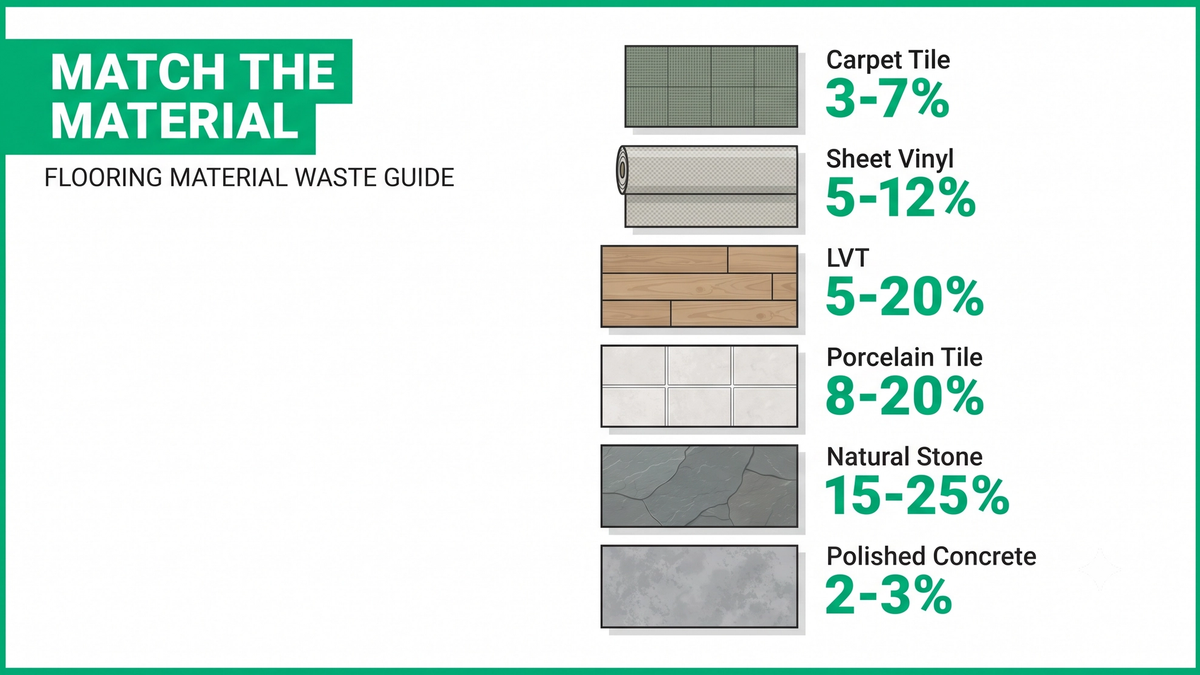
Commercial flooring waste percentages swing from 2 percent to 25 percent by material. Stamping one number across every job is where profit disappears.

Amruta Naik
The single most expensive question in commercial flooring estimating sounds harmless: how much extra should I order? Order too little and the install stops mid-job while the reorder ships, and rush freight, a second mobilization, and dye lot risk walk onto the project. Order too much and cash gets tied up in inventory that may never be returned. Both outcomes come out of the same margin. Both come from the same habit: applying one waste percentage across every material and every layout because the finish schedule looked routine and the deadline was too close to think about it properly.
The reality is that commercial flooring waste percentages are not a single number. They are a range that swings from 2 percent on polished concrete to 25 percent on natural stone with veining requirements, and everything in between depends on the material, the layout, the roll width or tile size, the pattern, and the estimating method. Carpet tile with a straight lay can hold at 3 percent. Herringbone LVP can push past 18 percent. Patterned broadloom in a room the wrong shape for a 12 foot roll can burn 15 percent before the installer even starts. These are not exotic edge cases. They are the material realities of the projects your team bids every week.
This guide is the reference. It breaks down typical waste percentages by flooring material, explains when each of the three estimating methods (Waste Add-On, Cut and Fit, and Half Reuse) is the right call, and gives you the ranges that keep you from either over-ordering or running short.
If you are pricing a mixed-material commercial set right now and the waste math is keeping you up, upload your plans and get a fast takeoff quote.
What Commercial Flooring Waste Percentages Actually Represent
Commercial flooring waste percentages are the additional material added above measured floor area to cover cuts, seams, layout, material direction, pattern matching, offcuts, jobsite damage, and attic stock, and they vary by material from 2 percent on seamless systems to 25 percent on natural stone. Unicalibre Estimating calculates waste against three methods (Waste Add-On for simple layouts, Cut and Fit for layout-driven work, and Half Reuse for modular products where offcuts recover value), and every takeoff is peer-reviewed before it goes out. The result is a bid that orders the right amount, not the safe amount or the cheap amount.
The reason this matters is that waste is not always material that gets thrown away. On modular products (carpet tile, LVT, ceramic tile), a lot of cut pieces get reused elsewhere in the project. On roll goods (sheet vinyl, broadloom) and pattern layouts (herringbone, chevron, natural stone), most of the waste is committed and unrecoverable. Understanding which calculation method matches which material is the difference between a bid that reflects reality and a bid that guesses.
For the underlying method comparison (Waste Add-On versus Cut and Fit, when to use each), the earlier deep-dive at Unicalibre Estimating explains the mechanics of the two methods in detail. This guide focuses on the third method (Half Reuse) and the material-by-material ranges you need to price accurately.
A complete deliverable applies the right method per material. Unicalibre Estimating provides peer-reviewed flooring quantity takeoffs delivered in native software formats including MeasureSquare, RFMS, Bluebeam, PlanSwift, Callidus, and Stack, with a BOQ that reflects material-specific waste, marked-up plans showing layout, scope notes flagging pattern and geometry risk, a material summary that separates attic stock from waste, and a deliverable your team can import and adjust without re-entry.
Request a risk-free pilot takeoff on a mixed-material commercial set and see the difference material-specific waste math makes.
The Three Methods: When to Use Each
Three methods, three use cases, and the estimator has to pick the right one per material rather than defaulting to one across the whole bid.
Waste Add-On applies a fixed percentage on top of measured area. Fastest, simplest, best for simple layouts, early budgeting, and modular predictable products. Fine for conceptual pricing. Wrong for layout-driven work.
Cut and Fit simulates the actual layout and material placement in the software, calculating real material requirements after cuts and reusable offcuts. Most accurate. Best for sheet vinyl, broadloom carpet, patterned LVT, herringbone, chevron, natural stone, and complex tile layouts where geometry drives everything.
Half Reuse is the middle-ground method. It assumes some cut pieces can be reused but not all, giving a more realistic result than a flat percentage without the full layout simulation of Cut and Fit. Best for modular products in repetitive spaces: carpet tile, ceramic and porcelain tile, LVT, some wood layouts. This is where a lot of commercial takeoffs quietly lose or gain accuracy, because the reuse assumption has to match the room geometry rather than a category default.
Waste Percentages by Material
The ranges below reflect what disciplined commercial takeoffs typically land on, and the estimating method that fits each material best.
Carpet Tile
Common sizes: 24 by 24 inches, 50 by 50 centimeters, plank formats. Straight layout: 3 to 5 percent. Ashlar: 4 to 6 percent. Quarter turn: 3 to 5 percent. Complex layouts: 5 to 7 percent. Best method: Half Reuse, because offcuts frequently get reused across the project.
Broadloom Carpet
Common roll widths: 12 feet, 13 feet 6 inches, 15 feet. Plain broadloom: 5 to 8 percent. Patterned broadloom: 10 to 15 percent. Heavy pattern repeat or difficult layout: 15 percent or more. Best method: Cut and Fit, because roll width, seam planning, and pattern repeat drive the real quantity.
Sheet Vinyl
Common roll widths: 6 feet, 6 feet 7 inches, 12 feet. Simple rooms: around 5 percent. Healthcare or corridor work: 8 to 10 percent. Flash cove or complex layout: 10 to 12 percent or more. Best method: Cut and Fit, because seam direction, roll width, and room geometry all move the number.
Luxury Vinyl Tile (LVT)
Common sizes: 12 by 24 inches, 18 by 36 inches, 24 by 24 inches, 6 by 48 inch planks. Straight lay: 5 to 7 percent. Running bond: 7 to 10 percent. Diagonal: 10 to 12 percent. Herringbone: 15 to 20 percent. Best method: Half Reuse for standard layouts, Cut and Fit for decorative patterns and complex floor plans.
Luxury Vinyl Plank (LVP)
Common sizes: 6 by 36 inches, 7 by 48 inches, 9 by 60 inches, 9 by 72 inches. Straight plank: 7 to 10 percent. Staggered: 8 to 12 percent. Herringbone or chevron: 15 to 18 percent or more. Best method: Half Reuse or Cut and Fit depending on layout complexity.
Ceramic Tile
Common sizes: 12 by 12 inches, 12 by 24 inches, 24 by 24 inches. Straight layout: 8 to 10 percent. Diagonal: 10 to 12 percent. Decorative or complex: 12 to 15 percent. Best method: Half Reuse for standard layouts, Cut and Fit for complex patterns.
Porcelain Tile
Common sizes: 12 by 24 inches, 24 by 24 inches, 24 by 48 inches, 48 by 48 inches. Straight layout: 8 to 10 percent. Large format: 10 to 15 percent. Decorative: 15 to 20 percent. Best method: Half Reuse for standard, Cut and Fit for large format and decorative.
Natural Stone
Common sizes: 12 by 12 inches, 18 by 18 inches, 24 by 24 inches, plus slab work. Standard layouts: 10 to 15 percent. Slab matching or veining concerns: 15 to 25 percent. Best method: Cut and Fit, because slab direction, matching, and visual consistency dominate.
Rubber Flooring
Common sizes: 4 foot rolls, 6 foot rolls, tiles. Roll goods: 5 to 8 percent. Tile layouts: 5 to 10 percent. Best method: Waste Add-On for simple work, Cut and Fit for corridors and complex spaces.
VCT (Vinyl Composition Tile)
Common size: 12 by 12 inches. Standard: 5 to 7 percent. Diagonal or special: 8 to 10 percent. Best method: Half Reuse.
Laminate Flooring
Common sizes: 7 by 48 inches, 8 by 60 inches. Standard planks: 8 to 10 percent. Complex layouts: 10 to 12 percent. Best method: Half Reuse or Waste Add-On.
Engineered Wood
Random length planks. Standard: 8 to 10 percent. Complex layouts: 10 to 15 percent. Best method: Half Reuse or Cut and Fit.
Solid Hardwood
Random length boards. Standard: 10 to 12 percent. Complex layouts: 12 to 15 percent. Best method: Cut and Fit or Half Reuse, because grain, grading, and board length drive the layout.
Epoxy Flooring
Seamless system. Typical waste: 2 to 5 percent. Best method: Waste Add-On.
Polished Concrete
In-place finish. Typical waste: 2 to 3 percent. Best method: Waste Add-On, though prep and labor still drive project cost.
How Installation Method Changes the Waste Approach
The material sets the range. The installation method decides the top or bottom of it. Straight lay pairs with Waste Add-On or Half Reuse across carpet tile, VCT, and LVT. Running bond pairs with Half Reuse for LVT, LVP, and tile. Diagonal, herringbone, and chevron all pair with Cut and Fit because they punish geometry. Broadloom carpet pairs with Cut and Fit whether the pattern is plain or decorative. Sheet vinyl in healthcare, corridors, and wet areas pairs with Cut and Fit because seam direction and roll width control the outcome.
The one lesson to internalize: never let a category default carry a decorative pattern. Herringbone LVP is not "LVP with a bigger number." It is a different math problem, and it needs Cut and Fit or an experienced Half Reuse operator to price correctly.
Common Waste Estimating Mistakes
Most waste ordering errors trace back to the same handful of habits:
- Applying one percentage across every material regardless of geometry
- Using Waste Add-On on layout-driven work like sheet vinyl and broadloom
- Skipping Half Reuse on modular products where reuse is real
- Stamping category defaults on herringbone, chevron, and natural stone
- Burying attic stock inside the waste percentage instead of listing it separately
- Ignoring roll width on broadloom and sheet vinyl
- Trusting one estimating platform's number without understanding what it assumes
Pro tip checklist before you lock a mixed-material bid:
- Have I identified each material's typical waste range?
- Have I picked the right method (Add-On, Cut and Fit, or Half Reuse) per material?
- Have I verified roll widths on sheet vinyl and broadloom?
- Have I applied pattern-specific waste on herringbone, chevron, and diagonal work?
- Have I broken out attic stock separately from waste?
- Have I checked whether reusable offcuts are actually reusable given the room geometry?
- Have I confirmed manufacturer installation recommendations for large-format and natural stone?
How MeasureSquare, RFMS, and Callidus Handle Waste Differently
Same project, three platforms, three different numbers. The gap is not a bug. It reflects the different philosophies built into each tool.
MeasureSquare calculates waste based on room geometry, roll width, tile size, pattern, layout optimization, and reusable offcuts. Its output tracks closely with a Cut and Fit approach and often produces lower quantities on modular products where reuse is meaningful.
RFMS gives estimators more control to adjust waste manually based on material type, project complexity, installation method, and company standard waste rules. That flexibility rewards a trained estimator and punishes an untrained one.
Callidus is generally more conservative because contractors using it often apply broader waste assumptions to protect against shortages. On complex clinical or hospitality work, that conservatism is often what saves the bid.
None of these is universally right. The estimator's job is to know which platform is producing which philosophy on which material, and to override it when the geometry and material demand a different call.
How the Estimating Models Compare on Waste Accuracy
DIY (owner estimating): Fastest, but usually a flat percentage across every material, which over-orders modular products and runs short on decorative patterns.
In-house estimator: Better on category-typical work, but a single set of eyes under bid pressure often defaults to one method rather than picking per material.
Per-project outsourcing: Useful for overflow, but a rotating estimator may not consistently pair the right method with the right material or know your reuse standards.
Dedicated FTE estimator: The same estimator every time, applying Waste Add-On, Cut and Fit, or Half Reuse per material, peer-reviewed before delivery, learning your crews' reuse conventions. Most reliable on mixed-material commercial packages, typically at a 50 to 60 percent cost reduction versus a domestic in-house hire.
Request a risk-free pilot takeoff on a mixed-material set and see what a method-per-material takeoff catches.
What Changes in the Real World
The pattern repeats across project types where multiple materials share the same bid.
A flooring subcontractor in Texas was stamping 10 percent across every material on a hospitality tenant improvement (LVT, carpet tile, and porcelain). Splitting the takeoff to Half Reuse on carpet tile, Cut and Fit on the herringbone LVT lobby, and Half Reuse on the standard porcelain reduced over-ordering by an estimated 5 to 10 percent across the modular products and prevented a shortage on the herringbone at the same time.
A commercial flooring contractor in Phoenix bidding a healthcare package with sheet vinyl in corridors and porcelain in restrooms was using Waste Add-On on both. Moving the sheet vinyl to Cut and Fit and the porcelain to Half Reuse produced a materially more accurate order and protected an estimated 5 to 8 percent of margin across the phase.
A flooring firm in Ontario bidding a multifamily package with LVP in units and natural stone in the lobby had a single 12 percent waste factor across both. Cut and Fit on the veined stone (which the visual consistency requirement demanded) surfaced the real waste exposure at closer to 18 percent and protected an estimated 5 to 15 percent of contract value on the stone alone.
Same lesson every time: material-specific method, not universal percentage. See how a dedicated estimator helps you bid more mixed-material work without over-ordering or running short.
What to Send and What You Get Back
A method-per-material takeoff does not require a perfect package. It needs the right inputs.
What you send: architectural plans, the finish schedule and finish legend, the specified installation pattern per material, product specs and manufacturer data sheets, any addenda, and your preferred brands or labor rates.
What you get back: a BOQ or Excel breakdown organized by material with the waste method noted per area, marked-up plans showing seam locations, roll-width layout, and pattern origin, scope notes flagging where a material's typical range needed adjustment for room geometry, a material summary that separates attic stock from calculated waste, and native software files in your platform (MeasureSquare, RFMS, Bluebeam, PlanSwift, Callidus, or Stack) so your team can import and adjust without re-entry.
Timeline: standard turnaround is typically 24 to 48 hours for most trade packages, with same-day rush available when the deadline is closing. Communication runs over email, phone, and your preferred PM tools, and addenda are tracked as they land.
Want the material-by-material waste checklist your team can run on every commercial takeoff? Download the checklist.
Frequently Asked Questions
What is the standard waste percentage for commercial flooring?
There is no single standard waste percentage for commercial flooring. Commercial flooring waste percentages range from 2 to 3 percent on polished concrete to 15 to 25 percent on natural stone, depending on material, installation pattern, roll width, tile size, and room geometry. Carpet tile typically runs 3 to 7 percent, sheet vinyl 5 to 12 percent, LVT 5 to 20 percent, and porcelain tile 8 to 20 percent. The right number depends on the specific material and layout.
What flooring materials have the highest waste percentage?
Herringbone and chevron layouts (15 to 20 percent), large-format porcelain tile (10 to 20 percent), patterned broadloom carpet with pattern repeat (10 to 15 percent or more), and natural stone with slab matching or veining requirements (15 to 25 percent) typically have the highest waste. All of these are layout-driven materials that punish flat waste factors and reward Cut and Fit analysis.
What is the Half Reuse waste method?
Half Reuse is a middle-ground waste calculation that assumes some offcuts can be reused elsewhere in the project but not all of them. It sits between Waste Add-On (a flat percentage) and Cut and Fit (a full layout simulation). Half Reuse works well for modular products like carpet tile, ceramic and porcelain tile, LVT, and repetitive multifamily layouts where reuse is real but geometry does not require full layout modeling.
Why do MeasureSquare, RFMS, and Callidus produce different waste percentages?
Each platform uses a different philosophy. MeasureSquare simulates the actual installation using geometry, roll width, and reusable offcuts, so its output often tracks Cut and Fit. RFMS gives estimators more manual control over waste allowances based on material and installation method. Callidus tends toward conservative estimator-defined waste that protects against shortages. Same project, three different answers, all defensible depending on the material and the geometry.
Can an outsourced estimator match waste method to material in my software?
Yes. Unicalibre Estimating works natively in MeasureSquare, RFMS, Bluebeam, PlanSwift, Callidus, and Stack, and every commercial takeoff picks Waste Add-On, Cut and Fit, or Half Reuse per material rather than stamping one method across the bid. Every deliverable is peer-reviewed before it goes out, and attic stock is broken out separately from calculated waste.
Order the Right Amount for Every Material on the Bid
There is no universal waste percentage. Every commercial flooring bid carries multiple materials, and every one of those materials has its own range, its own layout sensitivity, and its own best method. Carpet tile at 3 percent shares the same bid with herringbone LVP at 18 percent, and treating them the same way is how estimators end up either over-ordering the easy materials or running short on the hard ones. The professional move is to know the range, pick the method that matches the material, adjust for pattern and geometry, and break out attic stock as its own line.
Bid season does not wait, and mixed-material commercial packages are exactly where category-default waste factors cost the most. A disciplined, peer-reviewed process orders the right amount for every material on the bid, protects margin on both ends, and stops letting a single percentage decide the profit on a job with fifteen different material realities.
Book a call and send your plans for turnaround and pricing. Match the method to the material, and stop letting a category default decide your profit.