
Concrete Moisture Testing for Flooring: How It's Done
Concrete moisture testing for flooring is where warranties, adhesive bonds, and margins are made or broken. Here's how each method actually works.

Amruta Naik
A commercial flooring contractor wins a $600,000 hospital corridor project. The sheet vinyl arrives on schedule, the substrate looks clean and dry to the eye, and the crew starts installation Monday morning. Six weeks later the flooring is bubbling in seven separate locations, seams are pulling apart, and the manufacturer refuses the warranty claim because there is no documentation of moisture testing on the slab. The concrete looked dry. It was not dry. Concrete slabs release moisture for months and even years after they appear finished, and the moisture that was still in that slab destroyed the adhesive bond, delaminated the flooring, and generated mold conditions in areas the facility now has to close for remediation. Total cost of remediation and replacement: an amount that consumed the entire project margin and then some.
This is the story concrete moisture testing exists to prevent. Every flooring manufacturer publishes moisture limits for their products because moisture in the substrate is one of the single most reliable ways to cause a total installation failure. And unlike a lot of flooring failures, moisture failures usually cannot be repaired: bubbled sheet vinyl has to come out, damaged carpet has to be replaced, delaminated LVT is a total loss. The financial exposure is enormous, the warranty exposure is complete, and the mold liability is a conversation nobody in the industry wants to have. All of it is preventable with 24 to 72 hours of testing before flooring is installed.
This guide walks through why concrete moisture testing is non-negotiable, the four testing methods actually used on commercial jobs, what each result means for your bid, and how a disciplined estimator handles moisture scope in the takeoff so testing responsibility, mitigation contingency, and warranty coverage all end up where they belong.
If you are pricing a slab-on-grade or newly-poured commercial set right now and the moisture scope is a question mark, upload your plans and get a fast takeoff quote.
Why Concrete Moisture Testing Is Non-Negotiable
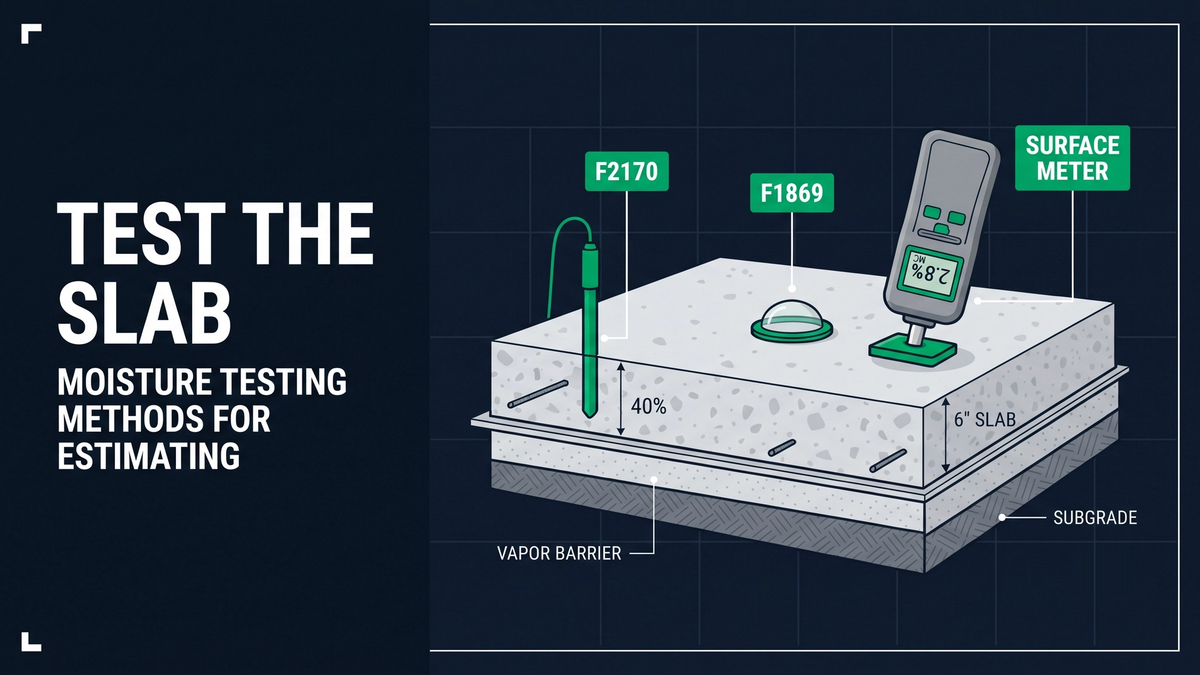
Concrete moisture testing is the set of standardized procedures used to verify that a concrete slab is dry enough to receive flooring installation, most commonly ASTM F2170 (in-slab relative humidity), ASTM F1869 (calcium chloride vapor emission), surface moisture meter readings, and ASTM F3191 (adhesive bond testing). Manufacturer warranties, adhesive performance, flooring longevity, and mold prevention all depend on moisture being below specified limits before installation begins. Unicalibre Estimating is architect-led, reads moisture testing specifications during every commercial takeoff, and every deliverable is peer-reviewed before it goes out.
The reason moisture testing is non-negotiable comes down to how concrete actually cures. Concrete releases moisture for months and, on newly-poured slabs, sometimes years. A slab that looks and feels dry on the surface routinely holds meaningful moisture internally, and that moisture will migrate upward through the slab and attack adhesive bonds after flooring is installed. The results include adhesive failure and flooring detachment, bubbling and warping of sheet vinyl and resilient flooring, mold and bacterial growth in the assembly, warranty voids from the manufacturer, and complete flooring replacement that no bid margin can absorb. Ignoring moisture is not a shortcut. It is a decision to accept the entire financial and liability exposure of a failed installation.
A complete deliverable prevents that. Unicalibre Estimating provides peer-reviewed flooring quantity takeoffs delivered in native software formats including MeasureSquare, RFMS, Bluebeam, PlanSwift, Callidus, and Stack, with a BOQ that separates moisture testing and mitigation from finish flooring, marked-up plans identifying test-required areas, scope notes flagging manufacturer requirements and responsibility clauses, and a deliverable your team can import and adjust without re-entry.
Request a risk-free pilot takeoff on a slab-heavy set and see what a moisture-aware review captures.
The Four Moisture Testing Methods Used on Commercial Jobs
Four testing methods handle almost every commercial flooring project. Understanding how each works, when it applies, and what the result means is what separates estimators who price moisture scope correctly from those who guess at it.
ASTM F2170: In-Slab Relative Humidity Test
The most reliable and most commonly specified moisture test in commercial flooring today. F2170 measures moisture inside the slab rather than only at the surface, which is critical because concrete releases moisture from the interior upward for months after pour. The test is straightforward in principle and specific in execution: a hole is drilled into the concrete to approximately 40 percent of the slab depth for slabs drying from one side only, or 20 percent for slabs drying from both sides. A sleeve is inserted and sealed. The slab is allowed to equilibrate for at least 24 hours before the first reading. An RH probe is inserted into the sleeve, and the relative humidity, temperature, and dew point are recorded.
Interpretation matters. RH under 75 percent is typically acceptable for most flooring systems. RH between 75 and 85 percent may require moisture mitigation depending on the manufacturer's specification. RH over 85 percent almost always requires a mitigation system before installation can proceed. F2170 requires environmental conditions to be stable during testing (typically service conditions), and rushing the equilibration period is the most common way this test produces unreliable results.
ASTM F1869: Calcium Chloride Vapor Emission Test
An older method still specified on many projects, particularly older-spec or renovation work. F1869 measures moisture vapor emission at the surface of the slab rather than internal RH. The procedure: an area of concrete is cleaned to remove contaminants, a plastic dome is placed over a pre-weighed dish of calcium chloride and sealed to the slab, the assembly is left in place for 60 to 72 hours, and the dish is weighed again. The weight gain indicates moisture vapor emission rate in pounds per 1,000 square feet per 24 hours.
Because F1869 measures only surface moisture, it does not detect deep moisture the way F2170 does. F1869 typically fails a slab that F2170 would clear, and F2170 sometimes flags a slab that F1869 would pass. For that reason, many current commercial specifications now require F2170 as the primary test, with F1869 either supplementary or replaced entirely. Read the specification carefully before pricing, because assuming one test covers the other is a common estimating error.
Surface Moisture Meters (Preliminary Screening)
Handheld capacitance and pinless surface moisture meters give estimators, PMs, and installers a quick preliminary check on a slab's condition. These tools are not a substitute for F2170 or F1869 and are not accepted as compliance testing by any flooring manufacturer, but they are extremely useful in the field for identifying whether a formal test is likely to pass or fail, comparing wet versus dry zones across a slab, deciding whether to trigger formal testing at all, or scanning renovation slabs for surprise moisture concerns during walkthroughs. Treat surface meters as a screening tool, not as documentation.
ASTM F3191: Adhesive Bond Testing
The final field verification before flooring goes down. F3191 confirms that the specified adhesive will actually bond to the substrate under the actual conditions of the project, which is not the same question as whether the slab meets the manufacturer's moisture limit. The procedure: adhesive is applied to a small area of the substrate, flooring material is placed for the manufacturer's specified duration, the sample is peeled up, and the bond quality is evaluated. Strong adhesion means the flooring is ready to install. Weak adhesion means further prep, moisture mitigation, or specification revision before installation can proceed. Bond testing is common on high-risk substrates, renovation slabs with unknown history, and any project where a manufacturer wants field verification before authorizing warranty.
The Testing Process on a Real Project
A well-run moisture testing sequence follows a repeatable process, and estimators who understand it produce better bids because they price responsibility, mitigation contingency, and coordination cost correctly.
The process starts with pre-test preparation. The concrete surface is cleaned of dust, adhesive residue, curing compounds, and any coatings that would affect readings. The building's environmental conditions are stabilized to expected service conditions per ASTM protocol (typically 24 to 48 hours before RH testing begins).
Test locations are then determined. ASTM guidance is at least three tests for the first 1,000 square feet, plus one additional test per 1,000 square feet after that, distributed across the slab to capture variability. Perimeter areas, low spots, and areas exposed to moisture during construction all warrant additional testing.
Testing then executes according to the method specified. F2170 requires 24 hours of equilibration after sleeve insertion before the first reading. F1869 requires 60 to 72 hours of dome exposure before the dish is reweighed. Both methods require documentation of test date, technician, environmental conditions, location, and result for every measurement.
Analysis compares results against the flooring manufacturer's published limits. If readings fall within limits, the slab is cleared for installation. If readings exceed limits, mitigation options include installing a moisture vapor reduction system such as an epoxy moisture barrier, waiting longer for the slab to cure and retesting, choosing a flooring product with higher moisture tolerance, or in some cases removing and repouring the slab entirely.
Documentation is the final step, and it is where warranties get protected. Every flooring manufacturer requires written moisture test results with pass/fail interpretation, and inadequate documentation is one of the most common warranty denial reasons in the industry.
Where Moisture Testing Scope Actually Lives in the Bid
Moisture testing scope hides across five sources in the bid documents. The specifications (typically Division 09 sections for resilient flooring, carpet, and tile) name the required test method, the acceptable limits, the number of tests, and the responsibility. The general notes may assign moisture testing to a specific party or require documentation before installation. The manufacturer's product data sheet publishes the moisture limits the flooring product will tolerate and the assembly that must be verified. The demolition drawings on renovation work signal what substrate is coming out and what may need testing after removal. The responsibility matrix assigns testing and mitigation to specific trades, and skipping this document is where scope disputes begin.
Common Moisture Testing Estimating Mistakes
Most moisture-related bid problems trace back to the same handful of habits:
- Assuming moisture testing has been done by another party without written confirmation
- Skipping moisture mitigation as a contingent line item on newly-poured or unknown-history slabs
- Confusing surface moisture meters with F2170 or F1869 compliance testing
- Ignoring the environmental conditioning requirement (48 hours at service conditions)
- Pricing one test method when the specification requires another
- Missing the responsibility matrix and pricing scope that belongs to another party
- Not documenting moisture-related bid assumptions and exclusions in writing
Pro tip checklist before you submit any commercial flooring bid:
- Have I identified the required test method from the specification?
- Have I confirmed responsibility for moisture testing in writing?
- Have I priced moisture mitigation as a contingent line item where slab conditions are unknown?
- Have I verified the manufacturer's moisture limits against the specified product?
- Have I distinguished surface moisture screening from ASTM compliance testing?
- Have I flagged renovation slabs and newly-poured slabs as elevated risk?
- Have I documented every moisture-related assumption and exclusion in the bid?
- Have I included time in the schedule for equilibration and testing?
How the Estimating Models Compare on Moisture Scope
DIY (owner estimating): Moisture testing gets guessed at or skipped under deadline pressure, and the field team absorbs the mitigation cost after slab failure.
In-house estimator: Better if trained on specification reading, but a single set of eyes still misses responsibility matrix clauses and manufacturer requirements under bid pressure.
Per-project outsourcing: Useful for overflow, but a rotating estimator may not consistently distinguish F2170 from F1869 or catch mitigation triggers hidden in the general notes.
Dedicated FTE estimator: The same estimator every time, working an architect-led process, peer-reviewed before delivery, learning which ASTM patterns your GCs typically specify and where regional slab conditions create the most risk. Most reliable on renovation and complex commercial work where moisture scope dominates, typically at a 50 to 60 percent cost reduction versus a domestic in-house hire.
Request a risk-free pilot takeoff on a slab-heavy set and see what a moisture-aware review captures.
What Changes in the Real World
The pattern repeats across contractors who reviewed their bids against actual field conditions.
A flooring subcontractor in Texas was bidding a healthcare renovation and assumed moisture testing had been handled by the GC. Post-award, testing had never been performed, F2170 readings came back over 85 percent, and mitigation costs consumed an estimated 15 to 20 percent of contract value the flooring contractor had to absorb. Adding a mandatory responsibility-matrix review to the workflow on subsequent healthcare bids captured moisture scope where it belonged and eliminated post-award mitigation absorption.
A commercial flooring contractor in Phoenix bidding an office LVT tenant improvement on a newly-poured slab had priced no moisture mitigation contingency. Cross-referencing the manufacturer's moisture limits against the slab's expected 60-day RH profile surfaced likely mitigation scope before bid, and pricing it as a contingent line protected an estimated 10 to 15 percent of contract value from post-award exposure.
A flooring firm in Ontario bidding a multifamily renovation had priced surface moisture meter readings as compliance testing. The specification required F2170. Reading the specification carefully before submission caught the substitution and avoided a warranty denial that would have cost the entire flooring package.
Same lesson every time: moisture testing is written scope, not verbal assumption. See how a dedicated estimator helps you bid more commercial work with moisture scope priced correctly.
What to Send and What You Get Back
A moisture-aware flooring takeoff does not require a perfect package. It needs the right inputs.
What you send: architectural plans, the finish schedule and finish legend, Division 09 specifications, general notes, the responsibility matrix if available, existing-condition drawings, demolition drawings, any moisture testing reports the GC has already provided, manufacturer product data sheets, and your preferred brands or labor rates.
What you get back: a BOQ or Excel breakdown that separates moisture testing and mitigation from finish flooring, marked-up plans identifying test-required areas and mitigation zones, scope notes flagging every ASTM reference, manufacturer requirement, and responsibility clause, contract-language warnings on any nebulous moisture scope assignments, and native software files in your platform (MeasureSquare, RFMS, Bluebeam, PlanSwift, Callidus, or Stack) so your team can import and adjust without re-entry.
Timeline: standard turnaround is typically 24 to 48 hours for most trade packages, with same-day rush available when the deadline is closing. Communication runs over email, phone, and your preferred PM tools, and addenda are tracked as they land.
Want the moisture-scope review checklist your team can run on every commercial flooring bid? Download the checklist.
Frequently Asked Questions
What is concrete moisture testing for flooring?
Concrete moisture testing is the set of standardized procedures used to verify that a concrete slab is dry enough to receive flooring installation, primarily ASTM F2170 (in-slab relative humidity), ASTM F1869 (calcium chloride vapor emission), surface moisture meters for preliminary screening, and ASTM F3191 (adhesive bond testing). Manufacturer warranties, adhesive performance, and installation longevity all depend on moisture being below specified limits before installation begins.
How is ASTM F2170 relative humidity testing performed?
ASTM F2170 is performed by drilling a hole into the slab to approximately 40 percent depth for slabs drying from one side (20 percent for slabs drying from both sides), inserting and sealing a sleeve, allowing at least 24 hours of equilibration under service conditions, then inserting an RH probe to record relative humidity, temperature, and dew point. Results below 75 percent are typically acceptable, 75 to 85 percent may require mitigation depending on the flooring specification, and over 85 percent almost always requires a mitigation system before installation.
What is the difference between ASTM F2170 and ASTM F1869?
ASTM F2170 measures moisture inside the slab by probe, giving a picture of internal moisture conditions across the full thickness. ASTM F1869 measures only surface moisture vapor emission by weighing a calcium chloride dish under a sealed dome after 60 to 72 hours. F2170 is more accurate for identifying deep moisture problems, F1869 measures only surface conditions, and many current specifications require F2170 as the primary test. Read the specification carefully because assuming one covers the other is a common estimating error.
Who is responsible for concrete moisture testing?
Responsibility depends on the contract documents. Some projects assign moisture testing to the flooring contractor, some to the general contractor, some to the concrete contractor. Always confirm in writing before the bid closes, because the cost impact is meaningful and the ambiguity is where scope disputes are born. If the specifications reference F2170 or F1869 and do not assign the cost, price the testing and mitigation as contingent and document the assumption.
What happens if concrete moisture testing is skipped?
Skipping concrete moisture testing usually voids the flooring manufacturer's warranty, exposes the installer to complete-replacement liability if the flooring fails, and creates mold and health hazards if moisture leads to bacterial growth in the assembly. Moisture failures cannot usually be repaired: bubbled sheet vinyl, delaminated LVT, and adhesive-failed carpet typically have to be removed and reinstalled entirely. The financial and liability exposure is enormous relative to the 24 to 72 hours moisture testing actually requires.
The Test Protects the Bid
Concrete moisture testing is not overhead. It is the documented insurance that protects the manufacturer warranty, the adhesive bond, the flooring longevity, and the margin on every commercial bid. ASTM F2170 and F1869 are the standardized methods that catch moisture the eye cannot see, and surface meters and F3191 bond testing round out the field verification workflow. Every one belongs in the bid conversation, and every one requires the estimator to read the specifications, general notes, responsibility matrix, and manufacturer data sheets together. Skip that reading and the field absorbs the mitigation cost, the warranty denial, and the remediation liability.
Bid season does not wait, and slab-on-grade, renovation, and newly-poured commercial projects are exactly where moisture testing scope decides who eats the failure risk. A disciplined, peer-reviewed, architect-led process reads every specification, prices moisture testing and mitigation as their own scope, documents responsibility and assumptions, and delivers a bid that protects the margin instead of exposing it.
Book a call and send your plans for turnaround and pricing. Price the test, protect the warranty, and stop letting moisture decide your profit.