Construction Takeoff Peer Review: Why One Set of Eyes Fails
You are the worst person to check your own takeoff. Learn why a construction takeoff peer review catches the scope gaps self-review always misses.

Amruta Naik
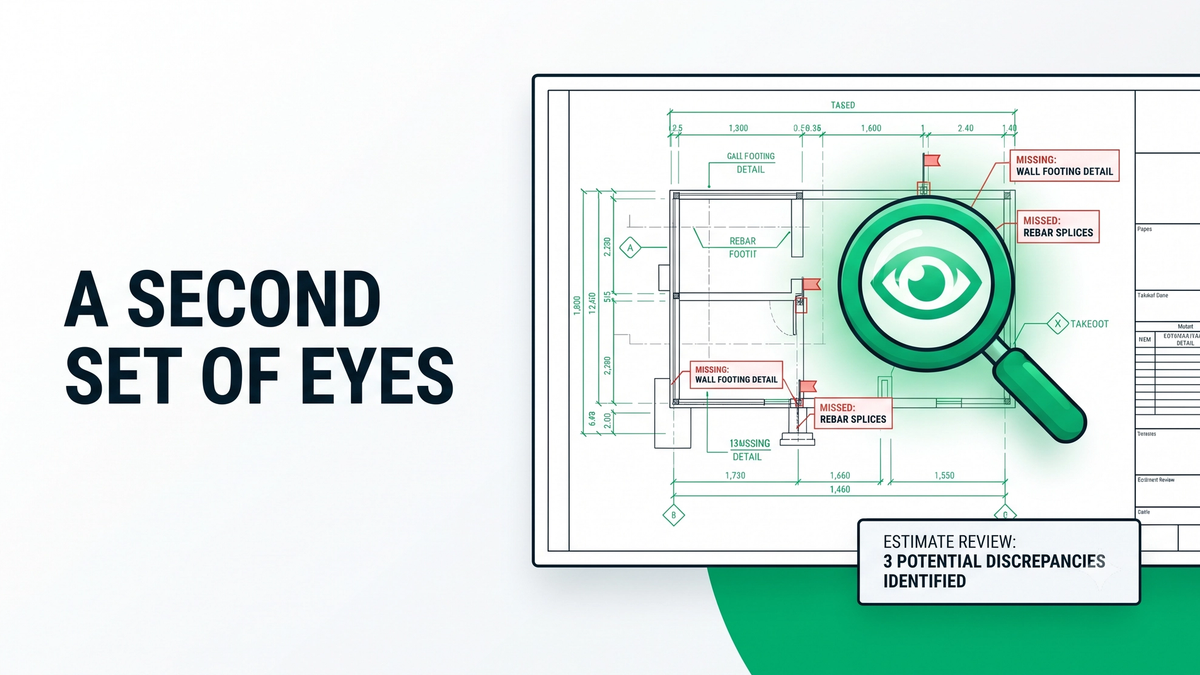
You Are the Worst Person to Check Your Own Takeoff
That is not an insult. It is how your brain is wired. When you build a takeoff, you know what you meant to capture, so when you review it, your mind fills in the scope you intended even when it never actually made it onto the sheet. You are not reading what is there. You are reading what you meant to put there. That single blind spot is the strongest argument for a construction takeoff peer review, and it is the reason a second estimator catches what you never will.
It is the same reason you can reread your own email five times and still miss the typo a coworker spots in two seconds. Cognitive scientists who study this describe it simply: your brain sees what it expects to see, not what is on the page. Estimating, like writing, is a high-level task about meaning, so the mind skips the small details it assumes are already handled.
That is exactly where scope gaps hide, and they are rarely dramatic. They are the quiet ones:
- The transition nobody assigned at a material change
- The floor prep marked "by others" that was actually yours
- The weld rod lumped as one color on a multi-color job
- The addendum that never got carried through to the affected rooms
- The moisture mitigation buried in a Division 09 note
None of these are carelessness. Each one is the direct result of the estimator knowing what they meant. They read past the gap because their brain already filled it in. And because the miss is invisible to the person who made it, no amount of the same person rechecking their own work will surface it. The fix is not "look harder." The fix is a different set of eyes.
This is why every high-stakes field refuses to let one person be the final check, and why the best estimating operations build the same discipline in on purpose. This guide explains the cognitive reason self-review fails, what an independent takeoff review actually catches, and how to build a second set of eyes into your process before the bid goes out.
What a Construction Takeoff Peer Review Is
A construction takeoff peer review is a mandatory second-estimator check of a completed takeoff before it reaches the contractor. Because the estimator who built it reads the scope they intended rather than what is on the sheet, an independent reviewer catches missed transitions, prep, and addenda that self-review cannot. Unicalibre Estimating peer-reviews every takeoff before delivery.
The key word is independent. The reviewer is not smarter than the original estimator and does not need to be. They are simply seeing the takeoff for the first time, with no memory of what was intended, so they read what is actually on the page. That is the entire mechanism, and it is why the reviewer's fresh perspective outperforms the original estimator's tenth pass.
High-stakes fields learned this a long time ago. Surgery builds a mandatory verification step into every operation, formalized in the World Health Organization surgical safety checklist. Aviation runs on independent checklist verification and crew cross-checks, structured by the Federal Aviation Administration. Finance separates the person who prepares from the person who reviews. In none of these cases is the reviewer assumed to be more capable. They are valued because they are seeing it fresh. Construction estimating carries the same kind of risk, dollars instead of lives, but the same principle: the person who built it is the wrong person to certify it.
Unicalibre Estimating is an architect-led firm that treats peer review as a required step, not a favor done when there is time. Our flooring estimating services run every takeoff through an independent second-estimator review before it reaches the contractor, which is precisely where a lumped accessory line or a missed scope gap gets caught and corrected. If you want a genuine second set of eyes on a live bid, upload your plans and get a fast takeoff quote.
Why Self-Review Fails, and What a Real Review Catches
Understanding the failure is what makes the fix obvious.
When you built the takeoff, you created a mental model of the whole job: the products, the rooms, the accessories, the scope. When you review your own work, you are not comparing the sheet against the drawings. You are comparing the sheet against that mental model, and the model is complete even when the sheet is not. Your brain reconciles the two by quietly inserting what it expects. The transition you meant to count feels counted. The addendum you meant to carry through feels carried through. Experience does not remove this. If anything, a seasoned estimator's mental model is more confident, which makes the blind spot stronger, not weaker.
An independent reviewer has no mental model to protect. They build their understanding from the sheet and the documents in front of them, so a gap between the two is visible instead of invisible.
What an independent reviewer actually checks
A real peer review is not a math pass. The reviewer works through scope and documents the way a fresh estimator would. Are we on the latest drawings and did every addendum carry through. Does the finish schedule reconcile with the plans. Was the responsibility matrix checked, or did we price something that is not ours. Are the accessories complete: base, transitions, weld rod by color, stairs, floor prep. Does the waste reflect the layout. Can this quantity actually be ordered and installed as written. Those are the questions the original estimator's brain already answered in its head, which is exactly why someone else has to ask them against the page.
The mistakes that leave a takeoff on one set of eyes
- Letting the estimator who built the takeoff be the only reviewer.
- Treating "I double-checked it myself" as estimating quality control.
- Reviewing for arithmetic instead of scope and completeness.
- Skipping the second review first whenever the deadline gets tight.
- Assuming experience removes the blind spot, when it deepens it.
- Never independently verifying that addenda carried through to every affected area.
- Confusing a quick spell-check-style pass with a true independent review.
The discipline that makes review work
- Build a second set of eyes into the process, not as an occasional favor.
- Have the reviewer check scope and documents, not just the numbers.
- Make sure the reviewer did not build the original takeoff.
- Review independently against the latest drawings and addenda.
- Make peer review mandatory, so it is not the first thing cut under deadline.
Who provides your second set of eyes
DIY (owner reviewing your own work). This is the exact trap the cognitive science describes. You cannot be the fresh reviewer of a takeoff you built, no matter how carefully you look.
In-house estimator. A true second reviewer if you have a second estimator with capacity, but a fully loaded domestic hire is a heavy fixed cost, and cost estimator market data shows why most shops cannot staff two estimators just to check each other.
Per-project outsourced takeoff. Delivers an independent takeoff with built-in review on the bids that matter, turned on when you need it.
Dedicated remote estimator (FTE model). A consistent estimator whose work always passes a second-estimator review before it reaches you, typically a 50 to 60 percent cost reduction versus a fully loaded in-house hire.
Want to see what a genuinely independent review surfaces on your project type? Request a risk-free pilot takeoff and compare it to a single-pass takeoff.
What a Second Set of Eyes Changes
The value shows up as scope gaps caught before submission instead of costs absorbed after award. A few anonymized patterns.
A commercial flooring subcontractor was running every bid on one estimator with a self-check and kept absorbing missed transitions and prep after award. After adding a mandatory independent review, post-award scope surprises fell sharply and closeout margin recovered by an estimated 5 to 15 percent, because the second reviewer caught what the first estimator's mental model had smoothed over.
A drywall sub bidding fast under deadline had been skipping its own second pass whenever the clock got tight, which was exactly when errors slipped through. Moving review to a required, independent step, rather than an optional one, removed the deadline-driven gaps and steadied the bids that closed.
A commercial fabricator found that a recurring addendum-carryover miss, changes that never reached every affected room, disappeared once an independent reviewer verified addenda separately on every takeoff. The fix protected a meaningful percentage of margin that single-pass review had been leaking. See how a dedicated estimator helps you bid more.
None of these are guarantees, and every project differs. The pattern holds: the reviewer is not catching mistakes because the estimator was careless. They are catching what the estimator was never going to see.
What Independent Review Looks Like in Practice
A peer review only works when it is structured and genuinely independent.
What you send. The drawing set, specifications, finish schedule, responsibility matrix, addenda, and bid due date. The more complete the documents, the more the reviewer can verify against the page instead of against assumptions.
What you get. A takeoff that has cleared an independent second-estimator review before delivery, with scope, documents, quantities, and accessories checked against the drawings, delivered in your native software (MeasureSquare, RFMS, Bluebeam, PlanSwift, or Callidus) with marked-up plans and scope notes. Where the reviewer catches a gap, it is corrected before you ever see it.
Timeline. Most trade packages turn in 24 to 48 hours, review included, with same-day rush available near a deadline.
Communication. Email, phone, and your PM tools, with drawing discrepancies, RFIs, and addendum impacts flagged as they surface.
Want the scope checklist an independent reviewer runs before a bid ships? Download the checklist and apply it across every project type you bid.
Frequently Asked Questions
Why should a construction takeoff be peer reviewed?
Because the estimator who built the takeoff reads the scope they intended rather than what is on the sheet, so their own review cannot see the gaps. A construction takeoff peer review uses an independent second estimator who is seeing the work fresh, which is why they catch missed transitions, prep, weld rod, and addenda that self-review reliably misses.
What is a peer-reviewed takeoff?
A peer-reviewed takeoff is one that a second, independent estimator has checked against the drawings, specifications, and addenda before it reaches the contractor. The reviewer verifies scope completeness and document accuracy rather than just arithmetic, catching the errors a single-estimator workflow leaves in place. It is considered best practice in professional quantity surveying.
Can't an experienced estimator just check their own work?
Not effectively. Experience does not remove the blind spot, and it can deepen it, because a seasoned estimator's mental model of the job is more confident. When they review their own takeoff, they compare it against that model rather than against the page, so the scope they intended feels present even when it is missing. A fresh reviewer has no such model to protect.
What does a second estimator actually check?
A second estimator verifies the latest drawings and addenda carried through, reconciles the finish schedule with the plans, checks the responsibility matrix, confirms accessories like base, transitions, and weld rod, reviews waste against the layout, and confirms the quantities can be ordered and installed as written. The goal is scope and document completeness, not just correct math.
Does outsourced estimating include peer review?
It depends on the provider. Top-tier services build a mandatory independent review into every deliverable, while lower-cost shops often ship single-pass takeoffs. Unicalibre Estimating peer-reviews every takeoff before delivery, which is where lumped accessory lines, missed scope, and addenda gaps get caught and corrected before the bid goes out.
The Reviewer Is Not Smarter. They Are Seeing It Fresh.
You are the worst person to check your own takeoff, and that is not a knock on your skill. It is how the mind works. You read what you meant to put on the sheet, not what is actually there, and the scope gaps hide in precisely that space: the unassigned transition, the prep by others, the weld rod lumped as one color, the addendum that never carried through. No tenth pass by the same person fixes it, because the miss is invisible to the person who made it.
Surgery, aviation, and finance all built a second set of eyes into their process on purpose, not because the reviewer is smarter, but because the reviewer is seeing it for the first time and reads what is on the page. Construction estimating carries the same kind of risk and deserves the same discipline. That is why every takeoff at Unicalibre Estimating clears a second estimator's review before it reaches the contractor, not to find mistakes, but to catch what the first set of eyes was never going to see.
So the honest question for estimators: who checks your numbers before they go out, or do they go out on one set of eyes? If it is the second, that is the gap to close. Book a call and send your plans for turnaround and pricing with Unicalibre Estimating, the architect-led, peer-reviewed estimating partner built to catch what self-review cannot.