
Countertop Takeoff vs Fabrication Estimate: The Difference
Countertop takeoff vs fabrication estimate: learn how takeoff, fabrication, installation, and the final bid differ, and where the margin gets lost.

Amruta Naik
The Two Words Fabricators Use Interchangeably and Lose Money On
Ask ten countertop shops for a "takeoff" and half will hand you a price. Ask for an "estimate" and half will hand you a measurement. That blur between countertop takeoff vs fabrication estimate is not a vocabulary problem. It is a margin problem, because when you price a job off raw square footage and call it an estimate, you skip the two things that actually decide whether the job makes money: slab yield and fabrication labor.
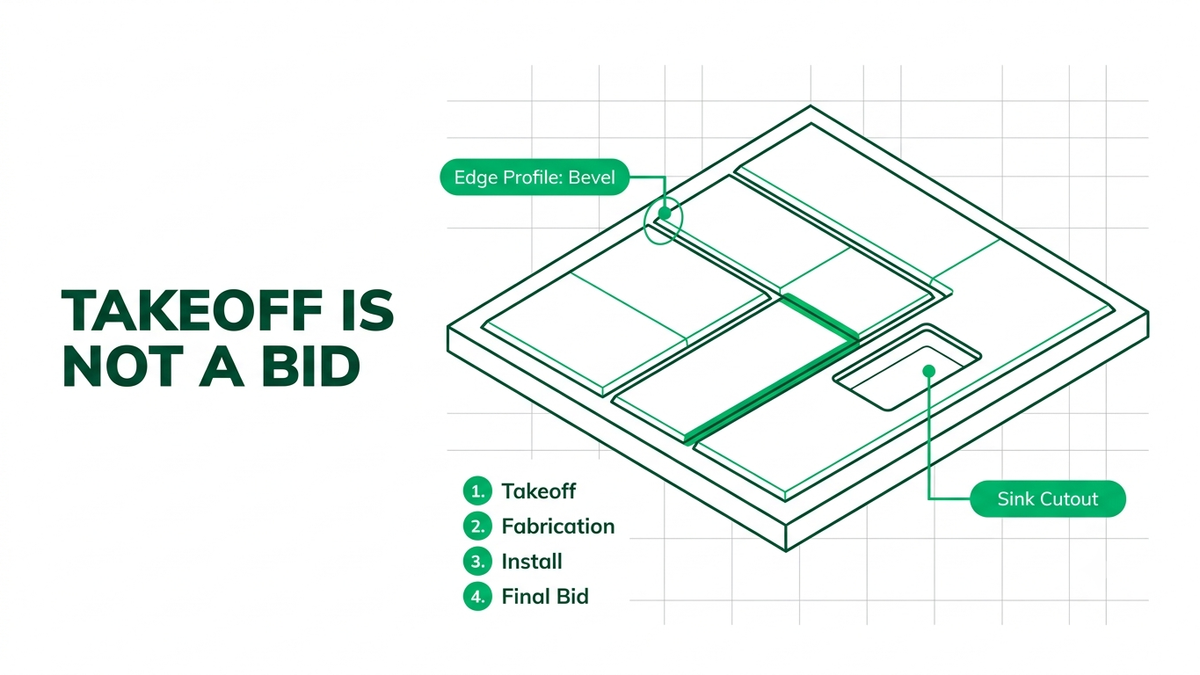
A countertop bid is not one number. It is four distinct exercises stacked on top of each other, and each answers a different question. The takeoff asks how much material and how many pieces. The fabrication estimate asks what it costs to make them. The installation estimate asks what it costs to set them on site. The final estimate combines all of it into the number that goes to the customer or the general contractor. Collapse those four into one and you will underbid the hard jobs and overbid the easy ones.
Here is what gets lost when the stages get blurred:
- Slabs under-ordered because square footage was priced without a nesting and seam plan
- Mitered edges, waterfalls, and radius work priced as if they were straight polished edge
- Sink, cooktop, and faucet cutouts uncounted, so shop labor is guessed
- Seam placement ignored, which makes both material and labor wrong at once
- Templating, delivery, and site setting left out of the install number entirely
- Fabrication and installation mashed into one vague labor line nobody can defend
Any one of those quietly eats the margin on a job that looked profitable on the spreadsheet. This guide breaks the four stages apart, shows how they build on each other, and explains where a disciplined, fabrication-aware takeoff protects the bid before a single slab is cut.
Countertop Takeoff vs Fabrication Estimate, Defined
A countertop takeoff is the measured quantity of material and pieces shown on the drawings: slab square footage, linear feet of edge and backsplash, cutouts, and seams by material. A fabrication estimate prices what it costs to make those pieces, factoring slab yield and shop labor. Unicalibre Estimating delivers fabrication-aware countertop takeoffs so fabricators price accurately.
That is the core distinction. A takeoff is a quantity document. A fabrication estimate is a cost document. The takeoff feeds the estimate, not the other way around, and treating them as the same thing is where mispriced countertop bids begin.
A useful takeoff is more than a square-footage total. It should break down countertop area by material and location, linear feet of each edge profile, backsplash linear feet, finished ends, radius and mitered conditions, and a count of every sink, cooktop, faucet, and outlet cutout, along with a preliminary seam layout. That is the raw information a fabricator turns into a real cost. Without it, the shop is pricing on assumptions, and assumptions do not survive a slab with directional veining or a defect that forces a re-nest.
Unicalibre Estimating is an architect-led firm that builds takeoffs the way a fabricator would, not the way a generic measuring service would. Our countertop estimating services deliver slab yield analysis, seam plans, cutout counts, and edge-profile linear feet, so the fabrication and installation estimates that follow are built on quantities you can defend. Industry bodies like the Natural Stone Institute publish the fabrication and installation standards those quantities have to respect.
If you are pricing a countertop package and want the quantities done right first, upload your countertop drawings and get a fast takeoff quote.
The Four Stages, and Why Each One Is Separate
The countertop takeoff vs fabrication estimate distinction is only the first split in a four-stage sequence. A countertop bid moves through four stages, each answering its own question and each depending on the one before it.
Stage 1: The countertop takeoff, what and how much
The takeoff quantifies what the drawings show. Countertop square footage by material and room, edge-profile linear feet by type, backsplash linear feet, finished ends, radius and miter conditions, and a full cutout count for sinks, cooktops, faucets, and outlets. It also establishes a preliminary seam plan, because where the seams fall changes everything downstream. This stage produces no price. It produces the defensible quantity foundation the rest of the bid stands on.
Stage 2: The fabrication estimate, what it costs to make
The fabrication estimate converts the takeoff into shop cost. This is where slab yield matters most. You are not multiplying square footage by a flat waste percentage. You are nesting the pieces onto actual slab sizes, accounting for grain and vein direction, defects, offcuts, and the seams the takeoff located. Then you add fabrication labor: cutting, edge polishing, cutout work, miters, waterfalls, and any special detailing. A job with 200 square feet of straight polished quartz and a job with 200 square feet of book-matched marble with mitered waterfalls carry wildly different fabrication costs off the same takeoff square footage. The International Surface Fabricators Association exists because countertop fabrication is a craft and a discipline of its own.
Stage 3: The installation estimate, what it costs to set
The installation estimate prices the site work: field templating, material handling and delivery, setting the pieces, on-site seaming, attachment and support, plumbing and appliance coordination, and final caulk. Site conditions drive this number. A ground-floor residential kitchen and a fourth-floor commercial break room with a tight freight elevator can share an identical takeoff and fabrication estimate while their installation costs diverge sharply. Leaving templating and delivery out of this stage is one of the most common ways install labor gets under-priced.
Stage 4: The final estimate, the number that goes out
The final estimate is the complete bid. It combines the takeoff quantities, the fabrication estimate, and the installation estimate with material cost, overhead, margin, and clearly stated inclusions, exclusions, and qualifications. This is the only stage that produces the number the customer or GC sees, and it is only as reliable as the three stages beneath it. A clean final estimate on a flawed takeoff is a confident wrong answer.
How they stack
Read the chain in one line: the takeoff quantifies, the fabrication estimate prices the making, the installation estimate prices the setting, and the final estimate assembles the bid. Break any link and the whole number is suspect.
The mistakes that blur the stages and bleed margin
- Pricing off square footage without a slab yield and seam plan, which under-orders material.
- Treating the takeoff as the estimate and skipping fabrication labor for miters, waterfalls, and cutouts.
- Ignoring seam placement, which makes material and labor wrong at the same time.
- Leaving templating, delivery, and site setting out of the installation number.
- Mashing fabrication and installation into one undefendable labor line.
- Failing to count edge-profile linear feet and cutouts explicitly.
- Skipping peer review on the quantities the entire bid depends on.
The discipline that keeps the number honest
- Keep the takeoff and the estimate as separate documents.
- Quantify slab yield with a nesting and seam plan, never a flat waste percentage.
- Count cutouts, edge linear feet, finished ends, and miters explicitly.
- Hold fabrication and installation as distinct labor buckets.
- Peer-review the quantities before anyone applies a price.
Who should produce your countertop quantities
DIY (owner measuring and pricing in one pass). Fast and free, but combining takeoff and estimate in your head is exactly how slab yield and cutout labor get skipped. The least defensible number.
In-house estimator. Reliable with a fabrication-literate estimator on staff, but a fully loaded domestic hire is a heavy fixed cost, and cost estimator market data shows why most shops cannot justify one for takeoff production alone.
Per-project outsourced takeoff. Flexible capacity that delivers a fabrication-aware takeoff you price yourself, turned on only when you need it, ideal for bid spikes.
Dedicated remote estimator (FTE model). The same estimator producing consistent, seam-planned takeoffs on every job, typically a 50 to 60 percent cost reduction versus a fully loaded in-house hire.
Want the quantity stage handled so your team can price fabrication and install with confidence? Request a risk-free pilot takeoff.
What a Fabrication-Aware Takeoff Changes on Real Bids
The payoff is fewer surprises between the bid and the finished job. A few anonymized patterns.
A quartz and granite fabricator was pricing commercial work off square footage and repeatedly ordering short on directional material. After moving to takeoffs with real slab yield and seam plans, material overages and re-orders fell by an estimated 10 to 20 percent, because the nesting was done before the bid, not discovered at the saw.
A countertop shop bidding multifamily kept underpricing fabrication on units with mitered edges and waterfall islands, because the takeoff never separated straight edge from miter work. Once edge-profile linear feet and miter conditions were counted explicitly, fabrication labor was priced correctly and margin on those units recovered by a meaningful range.
A commercial fabricator bidding a healthcare project caught that its install number omitted templating and freight-elevator handling on upper floors. Separating the installation estimate from fabrication protected an estimated 5 to 15 percent of margin that a single blended labor line had been hiding. See how a dedicated estimator helps you bid more.
None of these are guarantees, and every slab package differs. The pattern holds: when the takeoff is fabrication-aware and the four stages stay separate, the final estimate stops absorbing costs that should have been priced.
What You Send and What You Get Back
The handoff is what makes the four-stage discipline work.
What you send. Countertop and cabinet drawings, elevations, finish schedule, material selections or target stone, specifications, and any addenda. If you have preferred edge profiles or a standard unit package, tell us up front. Countertop scope often rides with cabinet scope, and our cabinet estimating services can cover both in one handoff.
What you get. Our countertop takeoff services return a takeoff with area by material, edge-profile linear feet, backsplash, finished ends, cutout counts, and a preliminary seam and slab yield plan, plus marked-up plans, scope notes, and native files (MeasureSquare and Excel) your team prices without re-entry. Every package clears an independent peer review first.
Timeline. Most trade packages turn in 24 to 48 hours, with same-day rush available near a deadline.
Communication. Email, phone, and your PM tools, with drawing discrepancies and material questions flagged as they surface.
Want the checklist your team can run before pricing any countertop package? Download the checklist and apply it across every project type you bid.
Frequently Asked Questions
What is the difference between a countertop takeoff and a fabrication estimate?
A countertop takeoff is a quantity document: slab square footage, edge and backsplash linear feet, cutouts, seams, and finished ends by material. A fabrication estimate is a cost document that prices what it takes to make those pieces, factoring slab yield, nesting, and shop labor. The takeoff feeds the estimate, so accurate quantities have to come first.
What is slab yield in countertop estimating?
Slab yield is how efficiently the finished pieces nest onto actual slab sizes after accounting for grain and vein direction, defects, seams, and offcuts. It is the reason square footage alone cannot price a countertop job. A flat waste percentage misses directional material and complex layouts, while a real nesting and seam plan tells you how many slabs the job truly needs.
Does a countertop takeoff include fabrication and installation?
No. A takeoff quantifies what the drawings show. Fabrication and installation are separate estimating stages that price the making and the setting of those pieces. A complete countertop bid layers the fabrication estimate and installation estimate on top of the takeoff, then adds material, overhead, and margin to reach the final estimate.
Why should fabrication and installation be estimated separately?
Because they respond to different cost drivers. Fabrication cost is driven by slab yield, edge work, miters, and cutouts in the shop. Installation cost is driven by templating, delivery, site access, seaming, and coordination in the field. Two jobs with an identical takeoff can carry very different fabrication and installation costs, so blending them into one labor line hides risk.
Can I outsource countertop takeoffs but keep control of pricing?
Yes. A fabricator can outsource the countertop takeoff, including slab yield and seam planning, while retaining full control of fabrication rates, installation labor, material pricing, overhead, margin, and the final bid. The outsourced estimator supplies defensible quantities. Your shop owns the commercial decision.
Think Like a Fabricator, Then Bid Like One
A countertop bid fails when takeoff and estimate become the same word. The takeoff tells you what and how much. The fabrication estimate tells you what it costs to make. The installation estimate tells you what it costs to set. The final estimate assembles all of it into the number you submit. Keep them separate and each one stays defensible. Blur them and the margin leaks out through slab yield, miters, cutouts, and forgotten templating.
That is the whole idea behind thinking like a fabricator: the number is only as good as the quantities beneath it, and the quantities are only as good as the seam plan and yield analysis behind them. Bid season rewards the shop that prices the hard jobs correctly and does not leave the easy ones on the table.
If your team is strong on fabrication and installation but stretched on the takeoff that feeds them, that is exactly the stage to hand off. Book a call and send your plans for turnaround and pricing with Unicalibre Estimating, the architect-led, peer-reviewed countertop estimating partner built to protect the bid from slab to setting.