
Flooring Change Order Documentation: Protect the Sequence
Flooring change order documentation is more than a price adjustment. See what a change order is, how to document it correctly, and how it moves the sequence.

Amruta Naik
A Change Order Does Not End When the Price Is Approved
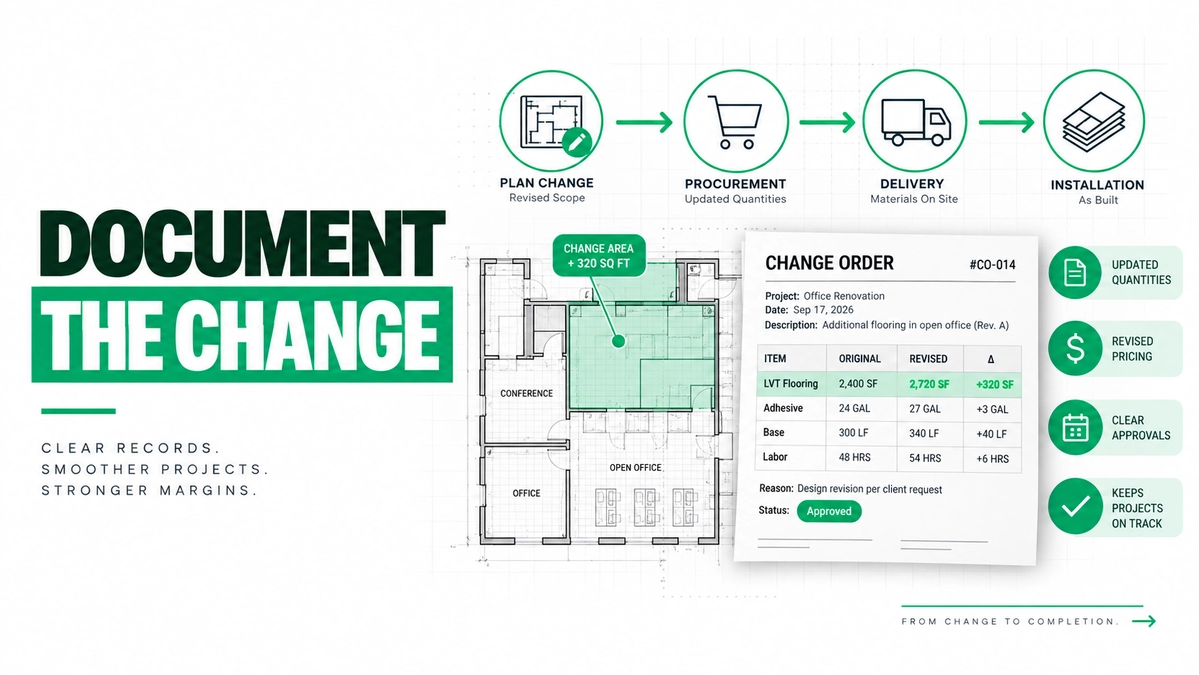
A flooring change order can look like a simple adjustment. A product changes, an area gets added, a finish is deleted, or the owner picks a different material. The price is negotiated, the change is approved, and everyone moves on. That is exactly where the expensive mistakes start, because strong flooring change order documentation is not a price adjustment, it is a record of a scope change that ripples through purchasing, delivery, installation, and the schedule.
A construction change order that touches the drawings can change the quantity, the product, the color, the SKU, the waste factor, the accessories, the lead time, the delivery schedule, and even material that has already been ordered. Treating the change as a number on a form, rather than a scope revision that has to travel through the whole workflow, is how a fifteen-minute documentation task becomes a multi-day procurement problem.
Here is the chain a poorly documented change order can break:
- The quantity changes, but the net change against material already purchased is never calculated
- The product or SKU changes while procurement orders the original item
- The waste factor is carried over from a material it no longer fits
- A new lead time appears that nobody flagged to the schedule
- Material already on site is now obsolete, and the return window is closing
- Accessories, adhesives, and transitions that moved with the material get missed
None of these are pricing errors. They are documentation and sequencing failures, and they surface after the change is approved, when the wrong material is on the truck or the specified product is on a six-week lead time the schedule cannot absorb. This guide covers what a change order is, how to document it correctly so the whole team works from the same revised scope, and how the change moves the procurement and installation sequence. The relationship between change orders and material procurement is the part most flooring change order estimating gets wrong.
What a Change Order Is, and Why Documentation Controls the Sequence
A change order is a documented modification to the contracted scope: added or deleted work, product substitutions, quantity changes, or revised installation requirements. Correct flooring change order documentation records the original scope, the revised scope, and the procurement and schedule impact, not just the price. Unicalibre Estimating documents each change against the original takeoff.
The reason documentation matters more than the price line is that a change order is a scope change that touches multiple departments in sequence: drawing, estimating, procurement, delivery, installation, and billing. If the change is not captured cleanly at the start, the error travels the whole chain. A finish changes from LVT to carpet, the estimator updates the quantity but not the material record, procurement orders the LVT, it arrives on site, and the crew discovers carpet is now required. The formal change-order instruments that govern this, such as the standard forms published by the American Institute of Architects and the specification practices of the Construction Specifications Institute, exist precisely so a change is recorded as a traceable modification rather than a verbal agreement.
That is the difference between documentation that protects the job and a note that creates rework. A change order should never live as an isolated email or a single spreadsheet line. It should trace back to the original scope so anyone can answer why a quantity changed and which document caused it.
Unicalibre Estimating is an architect-led firm that treats a change order as a scope revision with downstream consequences, not a renamed line item. Our commercial flooring estimating services connect every change back to the original takeoff, recalculate the waste factor and accessories, and flag the procurement and lead-time impact, so the revised scope is complete before it reaches purchasing. If you have a change to price and document, upload your plans and get a fast takeoff quote.
How to Document a Change Order Correctly
Correct documentation answers five questions and follows one sequence, so nothing downstream gets missed.
The five questions every change order must answer
A useful change-order record states what changed, where it changed (the specific rooms, areas, or floors), what the original scope was (product and quantity), what the revised scope is (new product, quantity, and installation requirements), and the procurement impact. That last question is the one most records skip, and it is where the money is: material to add, material to delete, material already purchased, material to return, the new product and SKU, lead-time impact, freight impact, accessories affected, and the price difference.
Connect the change to the original takeoff
A change order should be traceable, not free-floating. Run it through a set sequence: confirm the original scope, identify the change, review the current documents, identify the affected areas, confirm the original quantity, calculate the new quantity, verify the material and SKU, reassess waste, review accessories, check material already purchased, identify the procurement impact, calculate the price impact, and document all of it. That audit trail is what lets procurement, project management, and accounting reconstruct the change months later.
Calculate the net change, not just the added quantity
The revised procurement quantity is never simply the original plus the change. If the original scope required a quantity and material was already purchased against it, the additional procurement requirement depends on what is genuinely net-new after accounting for what is on hand and what a deleted area freed up. Document the net change so purchasing does not order material the job already has.
Treat a product change as bigger than a quantity change
Sometimes the square footage stays identical and only the material changes, and that is the harder case. A different product line, size, or wear layer resets manufacturer, SKU, color, carton quantity, lead time, availability, adhesive, and installation requirements. A substitution is never just a note on a drawing, it has to flow into the estimating and procurement record as a full material change.
The mistakes that make a change order fail downstream
- Documenting the change as a price adjustment instead of a scope revision.
- Adding the change quantity to the original instead of calculating the net.
- Carrying the old waste factor onto a new material or tile size.
- Missing the new lead time and never notifying the schedule.
- Ordering new material while obsolete purchased material sits in inventory.
- Updating flooring quantity but missing transitions, adhesive, and base.
- Leaving the change as an isolated email with no link to the original takeoff.
The flooring change order documentation checklist
- Current drawing revision and change-order number recorded
- Affected rooms and areas identified
- Original scope documented (product, quantity)
- Revised scope documented (product, SKU, color, quantity)
- Quantity recalculated as a net change
- Waste reassessed for the revised material
- Adhesive, transitions, and accessories reviewed
- Material already purchased checked, with return or restocking implications
- Lead time and freight impact checked against the schedule
- Pricing updated and the revised takeoff saved for future reference
Who should document your change orders
DIY (owner documenting after hours). Fast, but tracing net quantity, purchased material, and lead time at 10 PM is exactly when the procurement impact gets skipped.
In-house estimator. Reliable with capacity, but a fully loaded domestic hire is a heavy fixed cost, and cost estimator market data shows why carrying one through slow periods is hard to justify.
Per-project outsourced takeoff. Delivers each change documented against the original takeoff with the procurement impact spelled out, turned on when revisions spike.
Dedicated remote estimator (FTE model). The same estimator tracking every change, its net quantity, and its sequence impact consistently, typically a 50 to 60 percent cost reduction versus a fully loaded in-house hire.
Buried in change orders on an active job? Request a risk-free pilot takeoff and see how the documentation traces back to the original scope.
How a Change Order Moves the Sequence
The price is the smallest part of a change order. The sequence is where it actually costs money. A few anonymized patterns show how documentation protects the schedule.
A commercial flooring subcontractor approved a product substitution quickly and never flagged that the revised material was a special-order item on a long lead time. The install date arrived before the material did. After adding a lead-time and availability check to every change order, those schedule collisions largely disappeared, protecting an estimated 5 to 15 percent of margin that expedited freight and delays had been eating.
A multifamily flooring contractor kept ordering new flooring after a change while obsolete purchased material sat in storage, because the change record never asked what happened to the original order. Documenting material-already-purchased on every change removed that double-buying and recovered the restocking window on returnable goods.
A healthcare flooring specialist found that a carpet-to-LVT change quietly altered the substrate prep and transition scope, which the crew discovered on install day. Once change orders triggered a prep, adhesive, and transition review, the team reclaimed an estimated 10 to 15 hours a week previously lost to field surprises and rework. See how a dedicated estimator helps you bid more.
None of these are guarantees, and every job differs. The pattern holds: a change order documented as a scope revision protects the sequence, while one documented as a price line hands a surprise to procurement or the field.
What You Send and What You Get Back
Change-order documentation depends on having the original record and the current documents.
What you send. The current drawing revision, the change directive or request, the original takeoff and contract scope, prior change orders, the finish schedule, specifications, and any record of material already purchased.
What you get. A change order quantity takeoff documented against the original scope, with the net quantity change, revised product and SKU, reassessed waste, affected accessories and prep, material-already-purchased status, and lead-time and freight impact, all traceable to the source document. This is where flooring material procurement and construction estimating change orders connect, so purchasing works from the revised number. Our flooring takeoff services keep that record tied to the original takeoff. Delivered in your native software (MeasureSquare, RFMS, Bluebeam, PlanSwift, or Callidus) with marked-up plans and documented assumptions, cleared through peer review first.
Timeline. Most change orders turn in 24 to 48 hours, with same-day rush available near a deadline.
Communication. Email, phone, and your PM tools, with lead-time risks and material conflicts flagged as they surface rather than discovered on install day.
Want the change order documentation checklist your team can run on every revision? Download the checklist and apply it across every project type you bid.
Frequently Asked Questions
What is a change order in construction?
A change order is a documented modification to the contracted scope of work after the contract is established. It can add or delete work, substitute a product, change quantities or locations, or revise installation requirements, and it should be recorded as a formal, traceable change rather than a verbal agreement or an isolated email.
How should a flooring contractor document a change order?
Record what changed, where it changed, the original scope, the revised scope, and the procurement impact. Good flooring change order documentation connects the change to the original takeoff, calculates the net quantity change, reassesses waste and accessories, checks material already purchased, and flags lead-time and freight impact before the change reaches purchasing.
How does a change order affect material procurement?
A change order can change the quantity, product, SKU, color, waste factor, accessories, freight, and lead time, and it can render already-purchased material obsolete. The revised procurement quantity is the net change against what is already on hand, not simply the original quantity plus the change, which is why the documentation has to reach the procurement team.
How does a change order affect the installation sequence?
Changing one flooring material to another can change substrate preparation, adhesive, acclimation, installation method, delivery timing, and sequencing with other trades. A special-order product can introduce a lead time the schedule cannot absorb, so a change order should trigger an availability and prep check, not just a price update.
What happens to material already purchased after a change order?
It depends on whether the material has shipped, arrived, been cut, or is custom. The change order should make that status visible so the contractor can check return or restocking options and avoid buying new material while obsolete stock sits in inventory. Custom or already-cut material is often the costliest part of a change.
Document the Change, Not Just the Price
A change order is not a revised price with some paperwork attached. It can change the material, quantity, waste, accessories, lead time, inventory, delivery, and the installation schedule, and every one of those consequences lives or dies on how the change was documented. Capture it as a scope revision traced to the original takeoff, and the whole team works from one number. Capture it as a price line, and each department fills the gaps differently until the truck arrives with the wrong material.
The workflow is simple to state and worth enforcing: identify the change, verify the documents, revise the takeoff, review procurement, update the net material requirement, and document the impact. The most expensive change-order mistake is rarely the one missed in the estimate. It is the material ordered before anyone realized the scope had changed.
Change orders do not slow down as a job gets busy, and the contractor whose changes are documented against the original scope is the one who protects both the margin and the schedule. Book a call and send your plans for turnaround and pricing with Unicalibre Estimating, the architect-led, peer-reviewed flooring estimating partner that documents change orders the way procurement and the field actually use them.