
Flooring Contractor Behind on Bids? How to Catch Up Fast
Flooring contractor behind on bids? Add estimating capacity, clear your backlog, and hit every deadline without sacrificing takeoff accuracy.

Amruta Naik
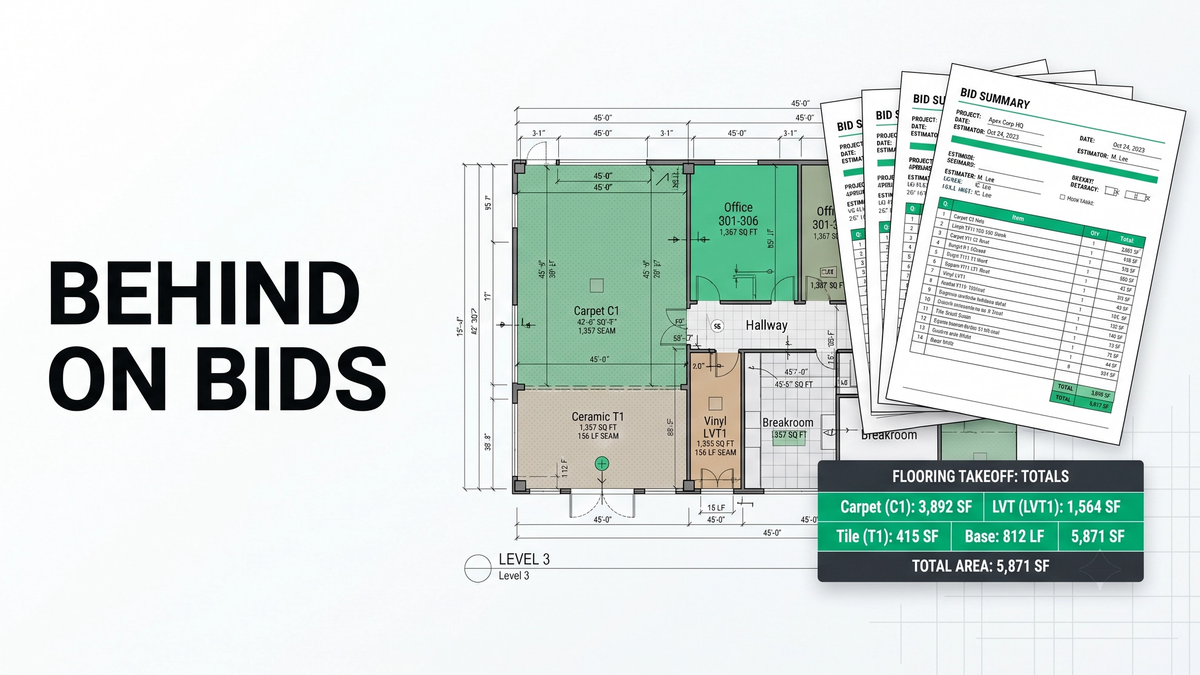
When the Bid Calendar Wins and Your Estimators Lose
Bid invitations are landing faster than your team can turn them around. Your estimators are already working nights, the calendar is stacked three deep, and two good commercial projects are sitting untouched because there are not enough hours before the deadline. Then another flooring package drops with a due date of tomorrow. If you are a flooring contractor behind on bids, you know this pressure, and you know exactly what it costs.
Being behind is a good problem to have, but only up to a point. A growing pipeline means opportunity. The moment your estimating desk becomes the bottleneck, that opportunity turns into lost revenue, because you cannot get the takeoff finished before the clock runs out.
Here is the part most owners miss. The problem usually is not that your estimators are slow. It is that commercial flooring takeoffs have quietly gotten more complex. A single project can require reviewing architectural drawings, finish plans, finish schedules, interior elevations, specifications, addenda, responsibility matrices, product data, floor prep requirements, transitions, base, and every drawing revision. Only then does the estimator measure, assign products, calculate quantities, review waste, price, and check scope. When five or ten invitations arrive at once, the backlog compounds fast.
The real damage shows up in three places. First, you start skipping opportunities. The easiest response to a full calendar is "we do not have time for this one," and you end up rejecting bids you would have won. Second, your estimators start rushing, and a rushed estimator skips specifications, misses addenda, applies a generic waste factor, and overlooks floor prep and transitions. Third, your most expensive person turns into a takeoff technician, spending hours measuring rooms instead of reviewing scope, pricing material, and deciding which bids are worth pursuing.
The fix is not always "hire another full-time estimator" or "work faster." Often it is to change the workflow and add capacity in the one place that is easy to scale.
What to Do When You Are Behind on Flooring Bids
When you are behind, the instinct is to start measuring everything immediately. That is the wrong first move. The right move is to add takeoff capacity where it is easy to add, while keeping every commercial decision under your control.
Flooring estimating overflow is added takeoff capacity a contractor uses when the internal team cannot complete every active bid before deadline. Unicalibre Estimating provides overflow support through per-project takeoffs or a dedicated remote estimator, delivering peer-reviewed quantities in native MeasureSquare and RFMS files so your team keeps control of pricing and final bids.
That distinction matters. You are not handing over your business. You are separating the labor-intensive part of the work (drawing review, measurement, product assignment, quantity calculations, waste, base, transitions, floor prep, markups) from the judgment part (pricing, labor rates, vendor quotes, overhead, margin, exclusions, and the final number that goes to the GC).
A disciplined overflow partner delivers a complete, bid-ready package: a quantity breakdown by material type, layout-specific waste, transition and base counts, floor prep quantities, marked-up plans, scope notes, and the native software file your estimator can open and adjust without rebuilding the project. Unicalibre Estimating is an architect-led firm that treats this as an accountable extension of your team, not cheap outsourcing, with a mandatory secondary peer review on every deliverable.
That is the difference between capacity that helps and capacity that creates rework. Adding a person who only operates the software is not enough. You need someone who understands why the quantity is what it is, because two platforms can produce different numbers based on room geometry, material size, installation direction, seam locations, and pattern layout.
If your bid deadline is closing in, upload your plans and get a fast takeoff quote before the backlog decides which projects you skip.
How to Clear a Bid Backlog Without Sacrificing Accuracy
Speed is only useful if it does not cost you scope. Here is the workflow that lets you catch up while protecting your margins.
Start with bid triage. Split every open project into three buckets: must-bid (strong relationship, good fit, realistic schedule, real chance of winning), review (worth a closer look), and no-bid (does not fit your strategy). This single step immediately drops pressure on the estimating desk before anyone measures a thing.
Next, separate takeoff from final estimating. Your overflow team handles plans, scope review, measurement, quantities, and marked-up plans. Your senior estimator handles pricing, labor, risk, markup, and the final bid. The commercial decision never leaves your building.
Then use the software you already run. If your team works in MeasureSquare, RFMS Measure, Callidus, or Bluebeam, you do not need to change platforms to add capacity. A partner who delivers native files across MeasureSquare, RFMS, Bluebeam, PlanSwift, and Callidus lets you review and adjust without re-entering a single quantity.
The Mistakes That Turn a Busy Week Into a Bad Bid
- Measuring every project before triaging, so senior hours go to bids you were never going to win.
- Letting a rushed estimator apply one generic waste factor across carpet tile, LVT, and patterned goods.
- Skipping addenda because the deadline is close, then discovering you estimated the previous version of the project.
- Bidding from an outdated drawing revision.
- Missing floor prep, moisture mitigation, transitions, and wall base under time pressure.
- Moving a takeoff between platforms and re-keying quantities by hand.
- Turning down good projects purely because the calendar looks full.
The Discipline That Keeps Speed From Costing You
- Triage first, measure second.
- Separate takeoff production from pricing and bid strategy.
- Keep every active bid on the latest addendum, reviewed most recent to oldest.
- Standardize a scope checklist so faster never means less complete.
- Peer-review the highest-risk bids: complex patterns, healthcare, large multifamily, and heavy prep.
Four Ways to Add Capacity, Compared
DIY (owner estimating after hours). Lowest out-of-pocket cost, least scalable. Consistency depends on how much sleep you got, and turnaround collapses the moment volume spikes. This is usually what puts a flooring contractor behind on bids in the first place.
In-house estimator. Consistent and fully under your control, but a fully loaded domestic hire (salary plus burden, benefits, PTO, software, training) is a fixed cost whether volume is high or low, and market salary data for cost estimators shows how quickly that number climbs. Recruiting one during a construction workforce shortage can take months.
Per-project outsourced takeoff. Flexible capacity you switch on only when you need it. Ideal for a temporary spike. You pay per bid, so it can add up across a heavy month, but you carry nothing during slow periods.
Dedicated remote estimator (FTE model). The same estimator every time, learning your customers, your GCs, your preferred products, and your scope standards. Best when high volume is consistent, and typically a 50 to 60 percent cost reduction versus a fully loaded in-house hire.
Not sure which model fits your volume? Request a risk-free pilot takeoff and test the quality on a live project before you commit.
What Adding Capacity Actually Looks Like
The results show up on the bid calendar and in the margin, not in a brochure. A few anonymized patterns from flooring contractors who moved takeoff work off their senior estimators.
A commercial flooring subcontractor in Texas was bidding six to eight projects a month and missing alternates on the ones due back-to-back. After separating takeoff from pricing and adding overflow support, monthly bid volume rose roughly 40 to 60 percent, and quantity errors dropped to under one percent because every takeoff cleared a peer review before delivery.
A multifamily flooring specialist in the Southeast kept losing margin to pattern-yield miscalculations and underpriced labor during heavy months. With layout-specific waste and a consistent scope checklist applied to overflow bids, the firm reported margin erosion cut by a meaningful range and a more selective, higher win rate because the team stopped chasing every project blindly.
A flooring contractor in Ontario running two estimators against overlapping GC deadlines reclaimed an estimated 10 to 15 hours a week for the owner by handing quantity production to a dedicated commercial flooring estimator and keeping pricing in house. The bottleneck was never opportunity. It was estimating hours.
These are ranges, not guarantees, and every project set is different. The through-line is consistent: when takeoff production moves off your most expensive person, capacity goes up and rushed-bid mistakes go down. See how a dedicated estimator helps you bid more.
What You Send and What You Get
Overflow support only works if the handoff is clean. Here is what the process looks like.
What you send. The drawing set, specifications, finish schedule, addenda, bid due date, and any preferred brands or labor rates. If you have a scope you always exclude, tell us up front.
What you get. A quantity breakdown or Excel BOQ, marked-up plans, scope and clarification notes, a material summary, floor prep quantities, and the native software file (MeasureSquare, RFMS, Bluebeam, PlanSwift, or Callidus) so your estimator adjusts pricing without rebuilding anything.
Timeline. Most trade packages turn in 24 to 48 hours, with same-day rush available when a bid is due tomorrow. Rush work runs on a separate track so a two-week bid never sits behind a next-day one.
Communication. Email, phone, and your PM tools. You stay in the loop on assumptions, drawing discrepancies, and any addendum that changes quantities.
Want a repeatable scope checklist your team can run on every commercial bid? Download the checklist and standardize your process across every project type you bid.
Frequently Asked Questions
What should a flooring contractor do when they are behind on bids?
Prioritize the backlog into must-bid, review, and no-bid, then separate takeoff work from pricing. Add estimating capacity where it is easy to scale, using per-project overflow for temporary spikes or a dedicated remote estimator when high volume is consistent. Keep pricing and the final bid in house.
What is flooring estimating overflow?
Flooring estimating overflow is added takeoff capacity a contractor uses when the internal team cannot complete every active bid before deadline. It can take the form of per-project takeoffs, a remote estimator, or dedicated estimating support, and it typically covers drawing review, measurement, and quantities while your team keeps pricing and strategy.
Is outsourcing worth it if we have too many bids?
It can be, especially when the backlog is caused by limited takeoff capacity rather than a lack of senior estimating judgment. Per-project overflow suits temporary spikes, while a dedicated commercial flooring estimator often makes more sense when high bid volume is consistent month after month.
Can I outsource flooring takeoffs but keep control of my bids?
Yes. A contractor can hand off drawing review, measurement, and quantity takeoffs while retaining full control of material pricing, labor, markup, exclusions, qualifications, and the final number submitted to the GC. The overflow estimator supports the bid and never owns the commercial decision.
How do I handle a commercial flooring bid deadline that is tomorrow?
Confirm the exact scope, the latest drawing revision, and addenda status first. Then run it on a rush track: assign the takeoff, complete the quantities, clear a peer review, and leave pricing and the final bid with your senior estimator. Rush commercial flooring takeoff services exist for exactly this.
Stop Letting the Calendar Choose Your Projects
A full bid pipeline means GCs trust you with opportunities. It becomes a problem only when your team works every night, skips scope review, misses addenda, or turns down good work because there are not enough hours. That is a capacity problem, and the answer is rarely "work faster."
Separate takeoff from pricing. Standardize the scope process. Prioritize the right bids. Use your existing software. And when internal capacity runs out, add overflow support instead of letting the backlog decide which projects you pursue. The goal was never to bid every job. It was to have enough capacity to chase the right ones accurately and on time.
Every flooring contractor behind on bids eventually hits the same fork: work more hours, turn away good work, or add capacity. The third option is almost always the one worth exploring first. Bid season does not wait, and the contractor who can turn around one more accurate bid this week is the one who wins it. If your team is behind today, book a call and send your plans for turnaround and pricing, and get your backlog moving with Unicalibre Estimating, the architect-led partner built for bid-day chaos.