
Flooring Estimating Judgment: The Skill That Wins Bids
Flooring estimating judgment beats speed every time. See why the best commercial flooring estimator knows when to stop measuring and start investigating.

Amruta Naik
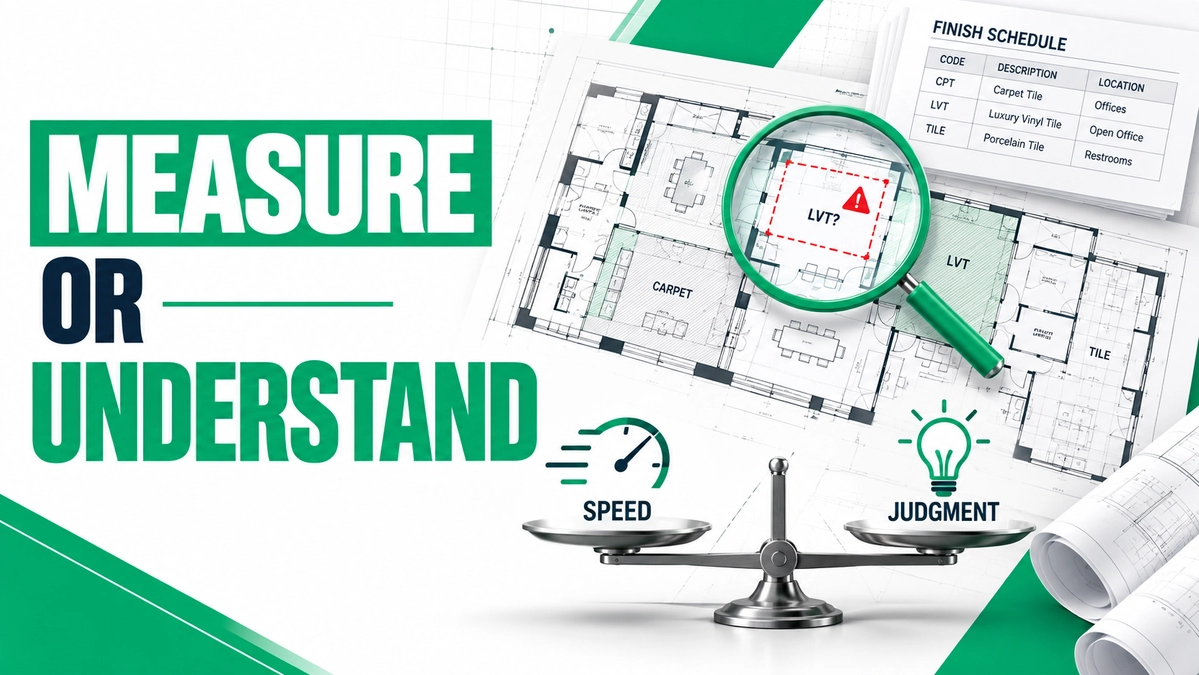
A Fast Takeoff Is Impressive. A Correct One Is Valuable. Neither Is the Point.
A fast takeoff is impressive. A correct takeoff is valuable. But an estimator who knows what to question can protect the entire project. That is the difference flooring estimating judgment makes, and it is the reason speed alone never turned anyone into a great commercial flooring estimator. In commercial flooring, speed is often treated as the competitive advantage. How quickly can you import the plans, trace the rooms, calculate quantities, send the bid? Those things matter. They also do not make anyone great.
The most valuable skill in commercial flooring estimating is knowing when to stop measuring and start investigating. Because a takeoff is not simply a collection of numbers. It is a decision-making tool, and the value of that tool is set by whether the estimator understood what the numbers actually represent. A room can measure 2,000 SF while the purchasing quantity is different. A product can require its own waste methodology. A sheet vinyl layout can demand seam planning. A carpet spec can include pattern repeat. The floor plan can show one material while the finish schedule identifies another.
The gaps that judgment catches, and speed misses, are almost always the same:
- Documents that do not agree with each other
- Installation requirements that live outside the visible finish
- Hidden scope buried in specs, details, or the responsibility matrix
- A waste percentage applied by habit instead of by layout
- Assumptions that should have been flagged as questions
- Software output that got trusted without an interpretive check
None of these are measurement failures. They are judgment failures, and they turn accurate quantities into estimates that erode 5 to 15 percent of margin after award. This guide covers what flooring estimating judgment actually means, the seven habits and flooring estimator skills that separate an experienced construction estimating professional from a measurement technician, and why the best quantity takeoff is the one that carries both the numbers and the questions.
What Flooring Estimating Judgment Actually Means
Flooring estimating judgment is the professional discipline of interpreting drawings, specifications, and installation requirements, not just measuring them. It separates a commercial flooring estimator from a measurement technician, and it is why the same project can carry different waste, scope, and risk depending on who ran the takeoff. Unicalibre Estimating builds every takeoff on architect-led judgment and peer review.
The distinction is not academic. A measurement technician asks how quickly they can measure a project. An experienced estimator is also asking what they are actually measuring. Understanding the quantity, not producing it, is the hard part. Construction management bodies like the Construction Management Association of America frame the preconstruction estimator's role in exactly these terms: interpret, not just calculate. And on the trade side, standards from bodies like the Resilient Floor Covering Institute exist because installation requirements are technical enough that a takeoff read only from the floor plan will miss the scope that decides whether a resilient job actually holds.
Unicalibre Estimating is an architect-led firm that treats judgment as the deliverable, not just quantities. Our commercial flooring estimating services deliver room-by-room takeoffs with documented assumptions, a layout-specific waste factor, and flagged risks, all cleared through peer review, so the number a project team receives is defensible from bid to closeout. If you want a takeoff built with judgment, not just speed, upload your plans and get a fast takeoff quote.
The Seven Habits That Separate Judgment From Speed
These are the seven habits that turn a measurement pass into a professional flooring takeoff.
1. Knowing when the documents do not agree
Commercial projects rarely consist of a single drawing. An estimator reviews floor plans, finish plans, finish schedules, specifications, interior elevations, details, door schedules, addenda, RFI responses, and responsibility matrices. Sometimes these documents do not appear to agree. The finish schedule says LVT while the floor plan indicates carpet. A fast estimator picks one and continues. An experienced estimator stops and investigates: which document is current, was there an addendum, is there an RFI response, is a finish code being interpreted correctly, does a detail explain the discrepancy. The ability to recognize a conflict can be more valuable than the ability to measure a room quickly.
2. Understanding how the flooring installs
A flooring estimator does not need to be the installer. But understanding how flooring is installed dramatically improves estimating decisions. Sheet vinyl requires attention to roll width, seam placement and length, direction, flash cove, inside and outside corners, and welding. Carpet requires pattern repeat, seam planning, direction, and stretching. Tile requires pattern, cuts, layout, and installation complexity. LVT requires plank direction, layout, and substrate conditions. The better an estimator understands installation, the better they understand what the takeoff needs to capture.
3. Knowing what is not shown
The hardest estimating skill is recognizing hidden scope. The drawing shows the flooring. It does not always show adhesive, floor preparation, moisture mitigation, transitions, wall base, reducers, stair accessories, profiles, waterproofing, demolition, or floor protection. Some of those items live in the specifications, some in details, some in the responsibility matrix. A strong estimator develops the habit of asking what else is required for this flooring to actually be installed.
4. Understanding waste instead of applying a percentage
Waste is not a universal number. Two projects with identical square footage can require different waste factors based on room geometry, product dimensions, pattern repeat, installation direction, roll width, reuse of cuts, and layout. A rectangular room with a simple layout and a complex space with angled walls, small rooms, and patterned material should not automatically carry the same percentage. Good estimating is not about finding a number. It is about understanding why the number exists.
5. Knowing what to flag
A valuable estimator does not try to make every uncertainty disappear. Sometimes the right answer is that a scope item needs clarification: conflicting flooring information, an unclear product, a missing transition, unspecified substrate preparation, unclear moisture requirements, missing pattern repeat, ambiguous responsibility, or unclear demolition scope. Flagging an issue before the bid is submitted gives the contractor a chance to address it. Discovering the same issue after award is a very different situation.
6. Knowing when software needs human judgment
Modern platforms like MeasureSquare, RFMS Measure, Callidus, and Bluebeam can make takeoffs faster and better organized. They do not eliminate the need for judgment. Software calculates area. The estimator still decides whether the correct product is assigned, whether the direction is right, whether the waste methodology fits, whether the layout makes installation sense, whether the documents are consistent, and whether the scope is complete. Software accelerates the measurement. It does not replace the estimator's responsibility to interpret the project.
7. Recognizing when speed hides problems
If an estimator is rewarded only for how quickly they finish, they naturally prioritize measure, calculate, submit. Professional estimating usually requires review, question, cross-check, measure, calculate, audit, submit. The additional time is not inefficiency. It is quality control. Five minutes on an addendum can prevent hours of rework. Ten minutes on a product specification can prevent a procurement issue. A few minutes on transitions can prevent a field problem.
The mistakes that trade speed for judgment
- Picking whichever document you opened first when scope conflicts.
- Measuring finish area without thinking about installation requirements.
- Estimating the visible flooring and skipping adhesive, prep, and accessories.
- Applying a habitual waste percentage instead of reviewing the layout.
- Making silent assumptions instead of flagging them for verification.
- Trusting software output without checking whether the scope is complete.
- Optimizing for turnaround time over completeness.
The five questions to answer before submitting a takeoff
- Am I working from the current documents, and did every addendum carry through?
- Do the drawings, finish schedule, and specifications agree?
- Have I captured installation requirements, not just flooring area?
- Does my waste methodology make sense for this particular project?
- What assumptions or potential risks should the contractor know about?
Who is best positioned to bring judgment to the takeoff
DIY (owner estimating after hours). Fast but exhausted, and that is exactly when judgment gets replaced by habit and scope gets skipped.
In-house estimator. Strong with an experienced hire and time to interpret, but a fully loaded domestic hire is a heavy fixed cost, and cost estimator market data shows why carrying one through slow periods is hard to justify.
Per-project outsourced takeoff. Adds an experienced, judgment-driven takeoff and peer review on the bids that matter, turned on when volume spikes.
Dedicated remote estimator (FTE model). The same estimator applying judgment on every bid and learning your standards, typically a 50 to 60 percent cost reduction versus a fully loaded in-house hire.
Want a takeoff that carries the numbers and the questions? Request a risk-free pilot takeoff and compare it to a bare quantity list.
What Judgment Changes on Real Projects
The payoff is fewer post-award surprises and a bid the whole team can defend. A few anonymized patterns.
A commercial flooring subcontractor kept optimizing for fast turnaround and repeatedly missed floor prep and moisture mitigation buried in Division 09. After adopting a review-question-cross-check pass before every submission, post-award prep surprises fell sharply and closeout margin recovered by an estimated 5 to 15 percent, because the scope was priced rather than discovered.
A multifamily flooring contractor was applying one waste percentage across every unit type and losing material on patterned goods. Replacing the habit with layout-specific waste per material removed the recurring overages and the team reported a tighter, more selective win rate because bids stopped carrying hidden shortfalls.
A healthcare flooring specialist bidding complex sheet vinyl was ignoring finish-schedule discrepancies to hit deadlines, then eating the difference. Flagging conflicts as RFIs before submission, rather than silently choosing one document, reclaimed an estimated 10 to 15 hours a week of senior estimator time previously lost to post-award clarifications. See how a dedicated estimator helps you bid more.
None of these are guarantees, and every project differs. The pattern holds: the estimator who exercises judgment produces a takeoff the project team can build from, while the one who optimizes for speed hands the gaps to the field.
What You Send and What You Get Back
Judgment works best when the estimator has the whole document set going in.
What you send. Architectural drawings, finish plans, finish schedules, specifications, details, interior elevations, addenda, RFI responses, responsibility matrix, and any preferred products or standards.
What you get. A room-by-room takeoff with layout-specific waste, documented assumptions, cross-checked scope, flagged risks and RFIs, and installation-aware accessory counts, delivered in your native software (MeasureSquare, RFMS, Bluebeam, PlanSwift, or Callidus) with marked-up plans. Every package clears an independent peer review first.
Timeline. Most trade packages turn in 24 to 48 hours, with same-day rush available near a deadline.
Communication. Email, phone, and your PM tools, with document conflicts and scope questions flagged as they surface rather than left as silent assumptions.
Want the judgment checklist your team can run before every bid? Download the checklist and apply it across every project type you bid.
Frequently Asked Questions
What is the most valuable skill in commercial flooring estimating?
The most valuable skill in commercial flooring estimating is judgment: knowing when to stop measuring and start investigating. Speed and software fluency matter, but the estimator who recognizes document conflicts, understands installation, catches hidden scope, and flags uncertainties protects the project. Quantities are the output. Understanding what those quantities represent is the skill.
What makes a good flooring estimator?
A good flooring estimator combines software fluency with construction judgment. They cross-check the full document set, understand how the specified flooring installs, capture hidden scope like floor prep and transitions, apply layout-specific waste, flag uncertainties for the contractor rather than making silent assumptions, and treat every takeoff as a decision-making tool rather than a measurement.
What is the difference between a flooring takeoff and an estimate?
A flooring takeoff is the quantified measurement of the flooring shown on the drawings. An estimate uses that takeoff plus material pricing, labor, floor prep, accessories, and documented assumptions to produce a bid the project can be built from. A takeoff answers how much. Flooring estimating judgment turns that into a scope the whole team can defend.
Does software replace flooring estimating judgment?
No. Tools like MeasureSquare, RFMS Measure, Callidus, and Bluebeam accelerate measurement and organization, but they do not decide whether the correct product is assigned, whether the waste methodology fits the layout, whether the documents are consistent, or whether the scope is complete. Software supports the estimator. It does not replace the estimator's responsibility to interpret the project.
Why is speed alone not enough in flooring estimating?
Because speed rewards measure, calculate, submit, while professional estimating requires review, question, cross-check, measure, calculate, audit, submit. The additional time catches conflicts, hidden scope, and layout-specific waste that a rushed pass misses. Five minutes on an addendum or a spec conflict prevents hours of rework and can protect a meaningful share of closeout margin.
Fast Estimators Measure Drawings. Great Estimators Understand Projects.
The best estimator is not necessarily the person who produces a takeoff in the shortest time. It is the person who can look at a project and say here is what I found, here is what does not make sense, here is what I included, here is what I excluded, and here is what you should verify before you submit the bid. That information can be as valuable as the quantities themselves, because a flooring estimate is not a collection of numbers. It is a decision-making tool, and the skill behind that tool is not speed. It is judgment.
The goal is not to eliminate every minute from the takeoff. It is to eliminate the mistakes that become expensive after the bid is submitted. Fast estimators measure drawings. Great estimators understand projects, and the ones who understand projects are the ones whose bids close at the margin the contractor priced.
Bid season does not slow down, and the estimator who brings judgment, not just speed, is the one whose numbers hold up long after award. Book a call and send your plans for turnaround and pricing with Unicalibre Estimating, the architect-led, peer-reviewed flooring estimating partner built on the judgment your project actually needs.