
Flooring Estimator vs Project Manager: One Team, One Goal
Flooring estimator and project manager are two roles, one outcome. When the takeoff arrives clean, the PM does the work only they can do.

Amruta Naik
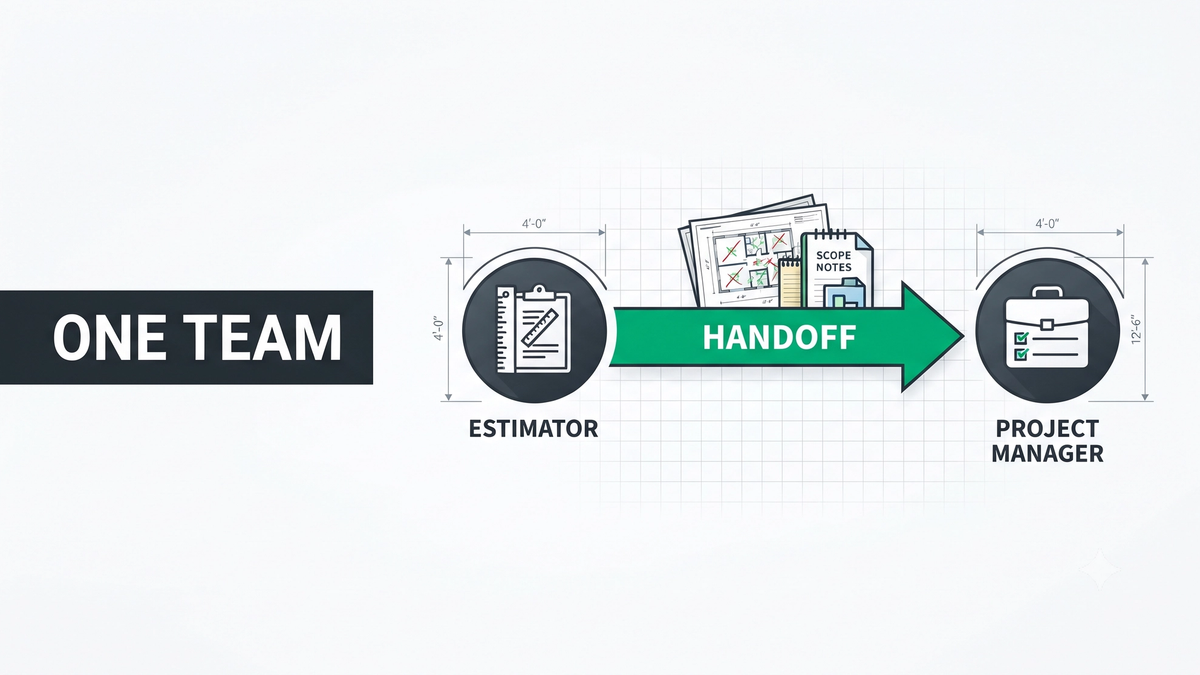
Every experienced flooring project manager knows the moment. The takeoff hits their inbox on a Friday afternoon. The bid is due Monday morning. They open the file and immediately start playing detective. Which finish code goes with which area? Why does the corridor scope look 30 percent lower than it should? Is that a missing area or a modeling choice? Where are the notes on the flash cove condition? What happened to the transitions in the door schedule? What was priced and what was assumed and what still needs to be resolved with the GC before the bid can be submitted? The weekend that was supposed to be spent finalizing pricing, coordinating with installers, and closing the bid becomes a scramble to reconstruct what the estimator meant. Some projects survive that scramble. Some do not. The bids that get submitted late, or with obvious gaps, are almost never the projects the flooring contractor wins.
That is the moment the flooring estimator and the project manager stop being two separate roles and become a single system. When the takeoff arrives clean, cross-referenced, marked up, and complete, the PM does the work only they can do: pricing decisions, GC coordination, installer conversations, and closing the bid on time. When the takeoff arrives incomplete or unclear, the PM absorbs the estimator's incomplete work on top of their own, and both jobs suffer. The takeoff quality does not just affect the takeoff. It sets the ceiling on what the PM can accomplish, and by extension it sets the ceiling on how much work the whole team can win.
This guide walks through what each role actually owns, where the handoff succeeds or fails, what great estimators do to make PMs successful, common friction points, and how a disciplined estimator-PM partnership becomes the single biggest performance driver on a commercial flooring team.
If you are a PM or owner who has spent too many Friday afternoons rebuilding takeoffs to submit Monday morning bids, upload your plans and get a fast takeoff quote and see the difference a PM-ready deliverable makes.
What Each Role Actually Owns
The flooring estimator produces the quantity takeoff, material breakdown, waste calculation, scope identification, and preliminary pricing documentation for a commercial flooring bid, working from architectural drawings, specifications, and manufacturer data. The project manager takes that estimating package and turns it into a submitted bid, an awarded project, and a completed installation, owning pricing decisions, GC and installer relationships, scheduling, procurement coordination, change management, and profit protection through the entire project lifecycle. Unicalibre Estimating is architect-led, delivers takeoffs designed to make the PM's downstream work easier, and every deliverable is peer-reviewed before it goes out.
The reason this distinction matters is that the two roles are structurally different jobs, and confusing them (or dumping estimator work onto the PM) is how projects lose margin invisibly. The estimator's world is documents: drawings, specifications, ASTM references, manufacturer data, finish schedules, and takeoff software. The estimator's output is a defensible quantity and scope document that priced correctly represents the real project. The PM's world is people and decisions: GCs, installers, superintendents, purchasing, scheduling, change orders, and the ongoing balance between commitments made and reality on the ground. The PM's output is a completed project that hit its margin target.
When the estimator's work is clean and complete, the PM's decisions get made on solid ground. When it is incomplete, the PM decides based on interpretation, guesses, or reconstructed math, and every one of those decisions carries risk that never had to exist.
A complete deliverable prevents that. Unicalibre Estimating provides peer-reviewed flooring quantity takeoffs delivered in native software formats including MeasureSquare, RFMS, Bluebeam, PlanSwift, Callidus, and Stack, with a BOQ organized by area and material for direct PM use, marked-up plans that answer questions before they get asked, scope notes flagging every assumption and exclusion, and a deliverable your PM can price and submit without reverse-engineering the estimator's work.
Request a risk-free pilot takeoff and see what a PM-ready deliverable actually looks like.
The Handoff: Where Success or Failure Actually Happens
Every flooring bid has a moment where the estimator's work becomes the PM's problem. That moment is the handoff, and how it is executed decides whether the PM has a productive weekend or a frantic one.
A great handoff carries five things beyond the raw quantities. Marked-up plans show every scope decision visually, so the PM can verify the estimator's interpretation against their own read of the drawings. Scope notes flag every assumption, exclusion, waterproofing detail, transition, and specialty item so the PM knows what is priced and what needs GC clarification. A material summary organized by product and area lets the PM quickly identify the highest-cost line items and where to focus pricing decisions. Software-native files in MeasureSquare, RFMS, PlanSwift, Callidus, Bluebeam, or Stack mean the PM can adjust pricing without re-entering data or reconstructing the takeoff logic. RFIs and clarification items are surfaced explicitly so the PM knows exactly what to ask the GC before finalizing the bid.
Every one of these takes real time to produce, and every one saves the PM more time than it took. A takeoff that arrives with all five sets the PM up for a productive weekend. A takeoff that arrives as bare quantities makes the PM do everything else themselves, which is exactly why bids get submitted late or incomplete.
What Great Estimators Do to Make PMs Successful
The difference between a serviceable takeoff and a great one is not the accuracy of the numbers, though accuracy matters. It is the consideration for the downstream PM workflow that shows up in a hundred small ways.
Great estimators anticipate PM questions and answer them in the deliverable. Instead of leaving the PM to wonder why the corridor waste is 15 percent, the scope notes explain that a herringbone pattern was specified and the waste reflects the pattern math. Instead of leaving the PM to guess whether transitions were counted, marked-up plans show every threshold and Schluter profile with a callout.
Great estimators separate what is priced from what is contingent. Substrate prep, moisture mitigation, waterproofing, and manufacturer-required accessories often depend on unknowns the estimator cannot resolve. Rather than absorbing that ambiguity into the base price, great estimators surface the contingent scope, flag the assumption, and let the PM decide how to handle it with the GC.
Great estimators respect the PM's role in pricing. The estimator produces quantities and identifies scope. The PM makes pricing decisions based on installer rates, GC relationship, competitive position, and profit targets. A great estimator does not decide the PM's pricing for them, and a great PM does not treat the estimator's suggested unit costs as final until they have applied their own judgment.
Great estimators communicate proactively when something is unclear. A drawing set with contradictions between the finish schedule and the elevations is not a problem the estimator should silently resolve. It is a moment to flag the ambiguity, propose an interpretation, and let the PM decide whether an RFI to the GC is warranted before bid.
Great estimators respect the PM's schedule. Bids have deadlines. A takeoff that arrives Monday morning for a Monday afternoon bid is technically on time and practically useless. Great estimators deliver early enough that the PM has real time to work with the deliverable, and they surface every question with enough lead time for the PM to resolve it before submission.
Common Friction Points Between Estimators and PMs
The friction is almost never personal. It is workflow.
PMs asking questions that should have been answered in scope notes. The estimator's job is to produce a document that answers most questions before they get asked. Recurring questions from the PM are a signal that the deliverable needs stronger scope notes, not that the PM is being difficult.
Estimators dumping raw quantities on the PM without context. Numbers without narrative make the PM reconstruct the takeoff to submit the bid. Marked-up plans and scope notes are what turn a raw takeoff into a usable package.
Ambiguous assumptions. When a takeoff assumes standard flash cove instead of the manufacturer-specific detail called out in the specification, and the assumption is not flagged, the PM absorbs the risk. Every non-obvious assumption needs to be documented.
Late-day handoffs. A takeoff delivered at 4 PM on the day of bid puts the PM in an impossible position. Structural process discipline around delivery timing is the fix.
PMs treating estimators as data entry. A takeoff is not a spreadsheet the PM fills in. It is a scoping document that reflects interpretation of the drawings. Treating the estimator as a numbers-only resource wastes the interpretive value the estimator can bring.
Common Estimator-PM Workflow Mistakes
Most estimator-PM friction traces back to the same handful of habits:
- Delivering raw quantities without marked-up plans or scope notes
- Not flagging assumptions and exclusions clearly in writing
- Failing to identify RFIs before handoff so the PM can resolve them pre-bid
- Skipping software-native file delivery and forcing the PM to re-enter data
- Missing the deadline expectation the PM is working against
- Not distinguishing what is priced from what is contingent
- Treating the takeoff as a one-way handoff instead of a starting point for PM decisions
Pro tip checklist before you hand off any commercial flooring takeoff:
- Are marked-up plans included with every scope decision visible?
- Are scope notes complete on every assumption, exclusion, and specialty item?
- Are RFIs and clarifications surfaced explicitly for PM resolution?
- Is the deliverable in a software-native format the PM can adjust directly?
- Are contingent scope items separated from base-price scope items?
- Is delivery timing early enough for the PM to work with the file?
- Have I peer-reviewed the takeoff before it left the estimator's desk?
How the Estimating Models Compare on PM-Ready Deliverables
DIY (owner estimating): The owner-estimator often becomes their own PM under pressure, and the workflow separation that makes both roles effective collapses under deadline stress.
In-house estimator: Can produce PM-ready deliverables when trained on the workflow, but a single estimator under bid pressure often defaults to raw quantities and lets the PM sort out the rest.
Per-project outsourcing: A rotating estimator does not learn the PM's preferences, delivery conventions, or the specific handoff format that works for your team, so quality varies bid to bid.
Dedicated FTE estimator: The same estimator every time, learning your PM's preferred deliverable format, running peer review before handoff, delivering scope notes and marked-up plans as standard. Most reliable for PM-heavy operations, typically at a 50 to 60 percent cost reduction versus a domestic in-house hire.
Request a risk-free pilot takeoff and see what a PM-ready deliverable does to your team's bid submission timing.
What Changes in the Real World
The pattern repeats across flooring subs of different sizes.
A flooring subcontractor in Texas had a PM who was routinely reworking takeoffs on the weekend to submit Monday bids, and the PM was on the edge of leaving because of the schedule. Switching to a dedicated outsourced estimator who delivered marked-up plans, scope notes, and native RFMS files cut the PM's weekend rework by an estimated 60 to 70 percent and restored the PM's ability to focus on pricing, closing, and installer coordination.
A commercial flooring contractor in Phoenix had bid volume outstripping the in-house estimator's capacity, and the PM was picking up takeoff work to keep up. Moving takeoff production to a dedicated MeasureSquare outsourced estimator returned the PM to full PM work, increased bid submission volume by an estimated 30 to 40 percent, and improved bid quality because the takeoffs arrived with the scope notes and marked-up plans the PM was previously producing themselves.
A flooring firm in Ontario was losing bids because the PM did not have time to properly review scope with the GC before submission. Adding an outsourced estimator who surfaced RFIs explicitly in the deliverable gave the PM the pre-bid coordination time that had been missing and lifted win rates by an estimated 5 to 10 percent across the following two quarters.
Same lesson every time: the takeoff decides what the PM can accomplish. See how a dedicated estimator helps you bid more work without burning out your PM.
What to Send and What You Get Back
A PM-ready flooring takeoff does not require a perfect package. It needs the right inputs.
What you send: architectural plans, the finish schedule and finish legend, interior elevations, specifications, the door schedule, any addenda, your PM's preferred deliverable format, your labor rates, and any prior takeoff samples that reflect how your team likes to receive work.
What you get back: a BOQ or Excel breakdown organized to your PM's standards, marked-up plans showing every scope decision visually, scope notes flagging assumptions, exclusions, waterproofing, transitions, and specialty items, RFIs surfaced explicitly for PM resolution, a material summary that separates contingent scope from base price, and native software files ready for your PM to price and submit without re-entering data.
Timeline: standard turnaround is typically 24 to 48 hours for most trade packages, with same-day rush available when the deadline is closing. Communication runs over email, phone, and your preferred PM tools, and addenda are tracked as they land.
Want the estimator-PM handoff checklist your team can run on every commercial flooring bid? Download the checklist.
Frequently Asked Questions
What is the difference between a flooring estimator and a project manager?
A flooring estimator produces the quantity takeoff, material breakdown, waste calculation, and scope identification for a commercial flooring bid, working from drawings, specifications, and manufacturer data. A project manager takes that package and turns it into a submitted bid, awarded project, and completed installation, owning pricing decisions, GC and installer relationships, scheduling, and profit protection. Both roles are essential and structurally different, and combining them into one person's workload usually degrades both.
How does a great flooring estimator help the project manager?
A great estimator delivers marked-up plans, scope notes, RFI clarifications, contingent-versus-base scope separation, and software-native files so the PM can focus on pricing decisions, GC coordination, and closing the bid instead of reconstructing what the estimator meant. Every scope note that answers a PM question before it gets asked saves the PM time and lets the PM do the work only they can do.
What should a flooring takeoff deliverable actually include?
A PM-ready flooring takeoff should include a quantity BOQ organized by area and material, marked-up plans showing every scope decision visually, scope notes flagging assumptions and exclusions, RFIs surfaced explicitly for PM resolution, a material summary separating contingent scope from base price, and software-native files (MeasureSquare, RFMS, Bluebeam, PlanSwift, Callidus, or Stack) so the PM can price and submit without re-entering data.
What causes friction between flooring estimators and project managers?
Most estimator-PM friction traces to workflow gaps: raw quantities delivered without scope context, unflagged assumptions that force PM interpretation, missing RFIs that leave scope ambiguous at bid time, PDF-only deliverables that force PM re-entry, and late-day handoffs that leave no time for PM review. The friction is almost never personal. It is a signal that the deliverable format needs to improve.
Can an outsourced estimator work as a partner to my project manager?
Yes. A dedicated outsourced flooring estimator learns your PM's preferred deliverable format, delivers marked-up plans and scope notes as standard, surfaces RFIs before handoff, and delivers native files your PM can price directly. Unicalibre Estimating is architect-led, and every deliverable is peer-reviewed before it goes out with the specific goal of making the PM's downstream work easier and the bid submission cleaner.
Two Roles, One Team, One Bid
The flooring estimator and the project manager are two structurally different jobs, and the projects that succeed are the ones where both roles do their own work well and hand off cleanly. When the takeoff arrives complete, cross-referenced, marked up, and PM-ready, the PM does the pricing, coordination, and closing that only they can do. When the takeoff arrives as raw quantities, the PM absorbs the estimator's incomplete work on top of their own, and every downstream decision suffers. The takeoff quality does not just decide the takeoff. It sets the ceiling on what the PM can accomplish across the whole bid and the whole project.
Bid season does not wait, and PMs who spend their weekends rebuilding takeoffs are PMs who eventually leave. A disciplined, peer-reviewed, architect-led estimator delivers work that respects the PM's role, answers the PM's questions before they get asked, and gives your team back the time they need to win more bids and close more projects.
Book a call and send your plans for turnaround and pricing. Give your PM the takeoff they deserve, and let both roles do the work only they can do.