
Flooring Estimators: Protect Your Margins and Win Bids
Flooring estimators protect 5 to 15% of bid margin. See how dedicated estimators catch missed scope before bid day. Upload your plans for a fast takeoff.

Amruta Naik
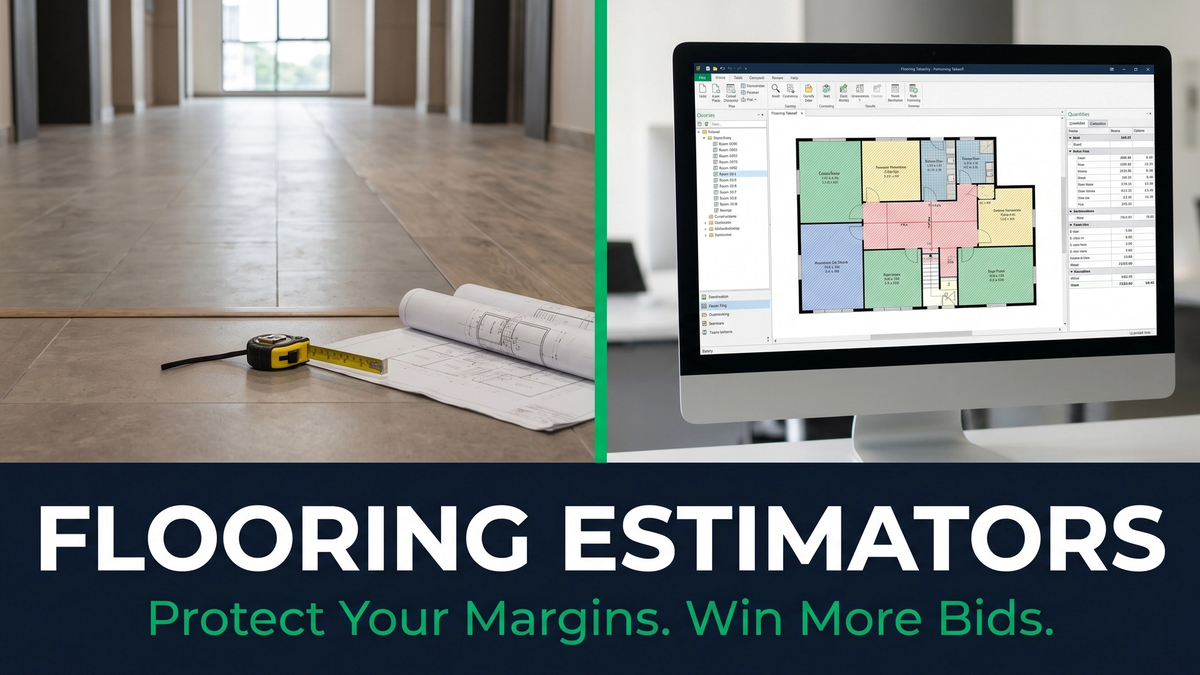
The best flooring estimators do not just count square footage. They protect the 5 to 15 percent of margin that disappears the moment a takeoff misses floor prep, transitions, or moisture barriers. If you have ever won a job on price and then watched the profit fade during installation, you already know the problem is rarely the crew. It starts at the takeoff.
Most flooring contractors are stuck in the same place. The owner or one overloaded estimator handles every bid, usually at night, after a full day running jobs. Deadlines stack up. Plans get skimmed instead of studied. Addenda slip through. And the waste factor becomes a guess instead of a calculation.
That pressure shows up on your bottom line in four ways:
- Lost bids, because you padded the number to feel safe and a competitor came in lower with a cleaner takeoff.
- Margin fade, because the takeoff missed scope the GC assumed was included and will not pay for after award.
- Material waste, because a flat 10 percent waste factor does not match a herringbone, diagonal, or large-format layout.
- Rework and rush orders, because a seam plan or transition detail got caught in the field instead of on the plans.
None of this means you are bad at estimating. It means estimating is a full-time discipline competing with everything else you do to run a flooring business. When one person owns sales, scheduling, field issues, and every bid, something has to give. Usually it is the time the takeoff deserves.
This is the gap that dedicated flooring estimators close. Not by working cheaper, but by treating every square foot, transition, and weld rod as a number you can stand behind on bid day. The rest of this guide breaks down what strong flooring estimating actually looks like, the mistakes that quietly cost you work, and how to decide between handling takeoffs in house and bringing in a dedicated estimator who functions as an extension of your team.
What Dedicated Flooring Estimators Actually Deliver
When people hear "outsourced flooring estimator," they often picture a PDF with a number on it. That is not estimating. That is data entry with a markup. Real flooring estimating produces a complete, traceable package your team can price, defend, and submit with confidence.
A proper flooring takeoff should hand you three things:
- A detailed BOQ breakdown. Quantities organized room by room and material by material, with LVT, VCT, sheet flooring, carpet tile, stone, wood, and resilient broken out separately. Waste factors applied by layout and pattern, not averaged across the whole job.
- Marked plans. Color-coded drawings that show exactly what was measured and where, including seam layouts, transitions, and base runs. You can audit the takeoff in minutes instead of re-tracing it.
- Scope notes. Clear documentation of inclusions, exclusions, assumptions, floor prep, moisture mitigation, and any drawing discrepancies that need the GC's attention before you commit a number.
That last point matters more than most contractors expect. The trust playbook every experienced GC follows is simple: the bidder who shows clear scope and clean assumptions reads as lower risk, and lower risk wins more often than lower price. A takeoff that documents what is and is not included does not just protect your margin. It makes your whole proposal look more credible.
Dedicated flooring estimators are an accountable extension of your team, not cheap outsourcing. The distinction is real. A dedicated estimator learns your standards, your preferred manufacturers, your labor logic, and your output format, then delivers the same way every time. You get consistency, a single point of contact, and a takeoff process that scales with your bid volume instead of capping it at whatever one tired person can finish before midnight.
If you want to see what that package looks like for a live job, you can upload your plans for a fast takeoff quote and review the deliverable before you commit to anything. It is the quickest way to judge quality against your own drawings.
The companies that win consistently treat flooring estimating services as a production line, not a late-night scramble. That shift, from reactive bidding to a disciplined takeoff process, is what separates the subs who grow from the ones who stay stuck at their current capacity.
The Flooring Takeoff Workflow That Protects Margin
A reliable takeoff is not about working faster. It is about working in a fixed order so nothing gets skipped. Here is the workflow strong flooring estimators follow on every set of plans.
- Confirm the latest drawings and addenda. Bidding from an outdated set is one of the most expensive mistakes in flooring. Quantities and finishes change, and GCs rarely adjust pricing after award for a revision you missed.
- Read the finish schedule against the floor plan. When the plan shows one material and the schedule lists another, that conflict gets flagged, not assumed.
- Measure by material and by room. Each flooring type gets its own quantities so the BOQ stays traceable and your pricing stays clean.
- Apply layout-specific waste factors. Standard tile runs 5 to 10 percent. Herringbone and large-format push 15 to 20 percent because of pattern drift and perimeter cuts.
- Capture the items that hide. Transitions, Schluter profiles, wall base by type and height, floor prep, moisture barriers, weld rods and seam lengths on sheet goods, and stair detail.
- Run a peer review. A second estimator checks scope, quantities, and waste before anything leaves the desk.
That sixth step is where most single-person estimating breaks down. There is no second set of eyes, so the only quality check happens in the field, which is the most expensive place to find an error.
Common Flooring Takeoff Mistakes That Cost You Money
Even experienced estimators repeat the same misses under deadline pressure. Watch for these:
- Using one waste factor for every material instead of matching it to layout and pattern.
- Missing floor prep and moisture mitigation that the spec requires but the plan does not draw.
- Skipping transitions and reducers at every change in flooring type.
- Measuring wall base incorrectly, or forgetting it entirely, when it carries real labor and material cost.
- Bidding from a superseded drawing set after an addendum changed quantities.
- Treating irregular rooms as simple rectangles and undercounting cuts.
- Duplicating or miscounting units on multi-family and hotel jobs where the unit grid does not match the actual count.
Pro Tips for Bid-Ready Flooring Takeoffs
Use this as a quick checklist before any flooring bid leaves your desk:
- Verify you are on the most recent addendum.
- Separate quantities by material and by room.
- Confirm waste factors match the actual layout and pattern.
- Account for transitions, base, prep, and moisture barriers as line items.
- Document assumptions and exclusions in writing.
- Have a second person review scope and totals.
You can download the flooring takeoff checklist and run it on your next bid to see how many of these your current process already covers.
DIY vs In-House vs Per-Project vs Dedicated FTE
Choosing how to handle flooring estimating comes down to volume, consistency, and cost. Here is how the four common paths compare.
DIY (owner or PM estimates after hours) Lowest hard cost, highest hidden cost. Caps your bid volume at whatever one person can finish, invites fatigue errors, and pulls the owner off revenue-generating work.
In-House Estimator (full-time hire) Consistent and close to the team, but expensive once you add salary, payroll burden, software licenses, and training. Capacity is fixed at 40 hours a week and stops entirely when that person is out or leaves.
Per-Project Outsourcing (different estimator each time) Flexible for occasional overflow, but you lose continuity. A new estimator each job means inconsistent item naming, different waste logic, and time spent re-explaining your standards on every bid.
Dedicated FTE Estimator (Unicalibre model) The same estimator every time, working as an extension of your team in your software and your format. You get consistency and peer review without payroll burden, and capacity scales up during bid season without a new hire. For most growing flooring subs, this is the balance of cost, consistency, and scale that holds up.
If your current setup is capping how many jobs you can chase, a risk-free pilot takeoff is the lowest-pressure way to test the dedicated model on a real bid before changing anything in your process.
How MeasureSquare Estimators Handle Complex Commercial Flooring
Software fluency is where flooring estimating gets technical, and where many generalist services fall short. Commercial flooring lives in MeasureSquare and RFMS, and getting full value from those tools takes daily reps, not occasional use.
Skilled MeasureSquare estimators do more than trace rooms. They build accurate seam layouts, calculate pattern-specific waste, plan sheet vinyl with weld rods and flash coving, and handle 10 to 15 finish types on a single hospital or hotel set without losing the thread. Because Unicalibre estimators work inside your own software license and seats, the project files stay in your system. Your team adjusts labor and pricing in the same file we measured in, with no format conversion and no re-entry.
That matters for two reasons. First, accuracy: layout-driven takeoffs in MeasureSquare reduce the guesswork that flat percentages introduce. Second, speed on bid day: when the takeoff comes back native, your team is pricing in minutes instead of rebuilding the file. Strong software fluency is one of the clearest signals that you are working with real flooring estimators and not a general data-entry shop.
Results From the Field
Numbers tell the story better than claims. Here are three anonymized examples of what changes when flooring contractors move to dedicated, peer-reviewed takeoffs. These are representative outcomes, not guarantees, and your results can vary by project mix and market.
A commercial flooring contractor in Texas was losing 8 to 12 percent margin on awarded jobs because takeoffs routinely missed floor prep and transitions. After moving to peer-reviewed takeoffs with documented scope, margin erosion dropped to under 2 percent on the next quarter of awarded work, and the owner stopped estimating at 10 PM.
A multi-family flooring sub in the Southeast could only turn around six to eight bids a month with one in-house estimator. By adding a dedicated estimator for overflow during bid season, they roughly doubled monthly bid volume without a new payroll hire, which lifted their total awarded work even at the same hit ratio.
A mid-size flooring company in the Midwest was over-ordering material to cover sloppy waste assumptions. Layout-specific waste factors in MeasureSquare trimmed material variance to under 2 percent on a large patterned-tile job, recovering thousands in over-ordered finish that used to be written off.
The common thread is not a magic number. It is a disciplined process plus a second set of eyes. If you want to see how a dedicated estimator would handle your typical job, you can see how a dedicated estimator helps you bid more and match it against the volume you are turning away today.
What to Expect When You Work With Unicalibre
Bringing in dedicated flooring estimators should be simple, not a project in itself. Here is exactly how the handoff works.
What you send:
- Plans and specifications
- Any addenda or revisions issued during bidding
- Preferred manufacturers or product brands
- Your labor rates or output format, if you want pricing reflected
What you get back:
- A BOQ in Excel or your preferred format
- Marked plans showing every measurement
- Scope notes with inclusions, exclusions, and flagged discrepancies
- A material summary ready for distributor pricing
Timeline:
- Standard turnaround is 24 to 48 hours for most flooring packages
- Same-day rush is available when a bid deadline is tight
Communication:
- Email, phone, and your project management tools
- One consistent point of contact, not a rotating queue
As an add-on, the team can also contact distributors and manufacturers to confirm current material pricing and freight before you submit, so your number reflects real market cost instead of an outdated list.
Stop Leaving Margin on the Plans
Flooring estimators are not a back-office expense. They are the first line of margin protection on every bid you submit. The misses that hurt most, floor prep, transitions, waste factors, missed addenda, all happen at the takeoff, long before your crew ever shows up. Fix the takeoff and you fix the leak.
Bid season does not wait, and capacity pressure only gets worse as the calendar fills. Every job you turn away because you cannot get the takeoff done is revenue handed to a competitor with a faster, cleaner process. A disciplined, peer-reviewed takeoff is how you bid more without burning out and protect margin without padding your number into a loss.
When you are ready, you can book a call to talk through your trade mix and volume, or simply send your plans for turnaround and pricing and let the deliverable speak for itself. Unicalibre Estimating is an architect-led, peer-reviewed takeoff partner built to help flooring contractors protect margins and win more profitable work.