
Flooring Installation Patterns: Waste, Labor, and Material
Flooring installation patterns swing waste from 3 percent to 20 percent. Herringbone and chevron punish a flat percentage. Here is how to price it right.

Amruta Naik
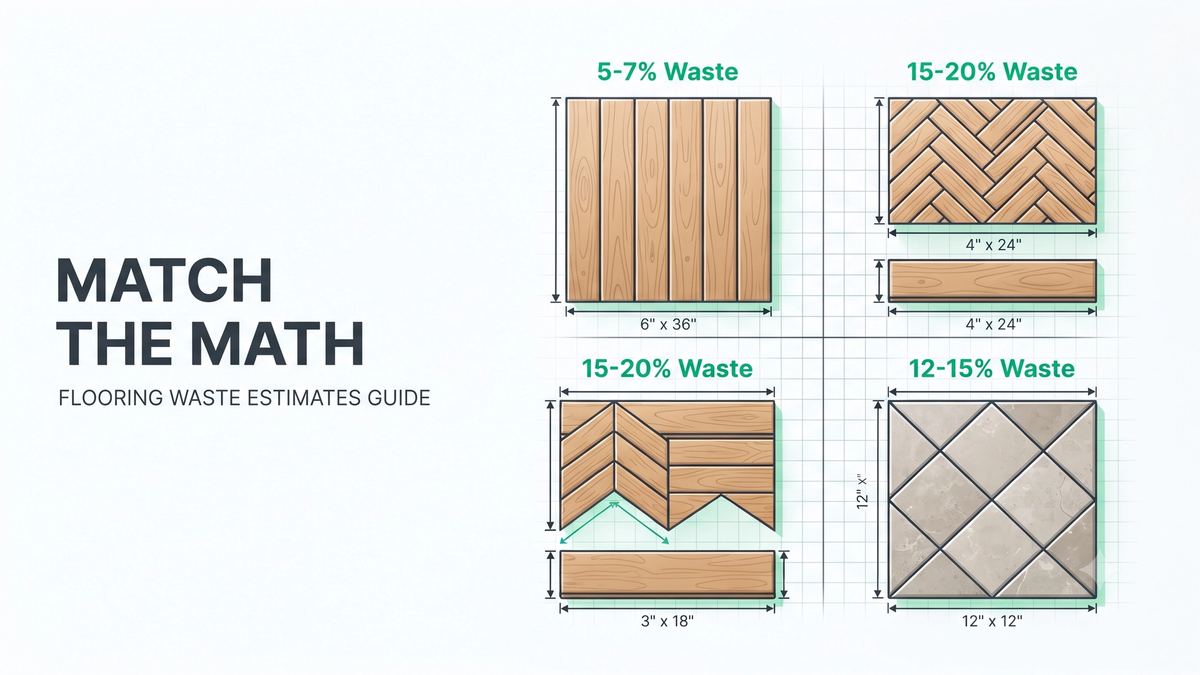
Two rooms with identical square footage can require dramatically different amounts of flooring material, and the entire difference comes down to the installation pattern. A straight-lay LVT floor might run 5 to 7 percent waste. The same product in the same room installed in a herringbone pattern can run 15 to 20 percent waste. Nothing else changed. Not the material, not the geometry, not the substrate. Only the pattern. And yet most flooring bids apply a single default waste percentage across every project, every room, every layout. That habit is where money quietly disappears on herringbone, chevron, and diagonal work, and where it quietly gets over-ordered on straight lay and quarter turn.
The habit persists because it feels safe. Ten percent covers most things, right? Not really. Under-order a herringbone job and the reorder brings rush freight, a second mobilization, dye lot risk, and an installer standing around waiting. Over-order a straight-lay office and you tie up cash in inventory the project will never use. Neither outcome is what the bid was supposed to deliver. The right approach is to match the waste calculation to the specified pattern, and to treat pattern selection as an estimating decision, not a design-team afterthought.
This guide walks through the eight most common flooring installation patterns, the typical waste range each one produces, why herringbone and chevron destroy flat waste factors, how MeasureSquare, RFMS, and Callidus treat patterns differently, and how a disciplined estimator gets the material order right the first time.
If you are pricing a decorative-pattern package right now and the herringbone waste math is keeping you up, upload your plans and get a fast takeoff quote.
What Flooring Installation Patterns Actually Do to Your Bid
Flooring installation patterns are the layouts in which tiles, planks, or carpet are installed on the substrate, including straight lay, quarter turn, ashlar, running bond, basket weave, diagonal, herringbone, and chevron. Each pattern drives a different waste factor, labor productivity, and cutting requirement, so pricing the same material across two patterns produces two different material orders and two different labor lines. Unicalibre Estimating calculates waste against the specified pattern using MeasureSquare, RFMS, or Callidus, and every takeoff is peer-reviewed before it goes out.
The reason patterns matter is that they change everything downstream of the square footage. Straight lay allows offcuts to roll into the next row, which keeps waste low. Herringbone forces every plank into a 90 degree relationship with its neighbors, which means corner cuts, perimeter cuts, and pattern drift that a flat percentage cannot absorb. Chevron demands precisely mitered ends. Diagonal work at 45 degrees means almost every perimeter tile is cut. Basket weave requires meticulous planning to keep the pattern consistent. Every one of these has its own math, and pretending otherwise is what turns a bid into a shortage.
A complete deliverable captures the pattern math. Unicalibre Estimating provides peer-reviewed flooring quantity takeoffs delivered in native software formats including MeasureSquare, RFMS, Bluebeam, PlanSwift, Callidus, and Stack, with a BOQ that reflects pattern-specific waste, marked-up plans showing the layout direction, scope notes flagging pattern repeat and border cuts, a material summary tied to the actual pattern, and a deliverable your team can import and adjust without re-entry.
Request a risk-free pilot takeoff on a decorative-pattern package and see what pattern-aware math does to the material order.
The Eight Common Patterns and What Each One Costs You
Each pattern has its own waste behavior, its own installation difficulty, and its own labor profile. The estimator's job is to recognize which one is specified and price accordingly.
Straight Lay
Straight lay (the grid pattern) installs tiles or planks parallel to the walls in straight rows. It dominates offices, schools, retail, healthcare, and multifamily because it installs fast, cuts minimally, and produces the lowest labor cost of any pattern. Typical waste runs 5 to 7 percent. Most estimating software handles straight lay efficiently, because cuts from one row can often be reused in the next.
Quarter Turn (Carpet Tile)
Every alternate carpet tile is rotated 90 degrees, creating subtle shading differences. Typical waste runs 3 to 5 percent, the lowest of any pattern. Directional arrows on the tile backing become critical. Incorrect orientation creates visible shading inconsistencies that the client will absolutely notice.
Ashlar (Carpet Tile)
Extremely popular for carpet tile in corporate offices, educational buildings, and airports. Rows are offset using multiple tile sizes or staggered joints. Waste runs 5 to 8 percent because carpet tiles are modular, but installers still have to follow manufacturer arrows precisely.
Running Bond (Brick Pattern)
Each row offsets from the previous row, usually by 50 percent. Common on LVT, ceramic, and porcelain tile. It adds visual interest, hides minor dimensional variations, and reads as a familiar commercial appearance. Waste runs 7 to 10 percent. The install consideration: consistent staggering across the entire project, because inconsistent offsets look sloppy immediately.
Basket Weave
Traditionally used with ceramic or stone tile to create a woven appearance. Waste runs 10 to 12 percent, and installation requires careful planning to maintain the pattern throughout the project. Labor is medium to high, because every unit has to align to the next in two directions.
Diagonal (45 Degree)
Tiles installed at a 45 degree angle to the walls. Rooms look larger, which is why designers reach for it in retail and boutique hospitality. Waste runs 12 to 15 percent, because almost every perimeter tile requires cutting and few offcuts can be reused. Labor cost is high.
Herringbone
One of the most elegant patterns and one of the most punishing to under-price. Each plank installs at 90 degrees to its neighbor to form a zigzag. Common on LVT, wood flooring, and porcelain tile in high-end commercial and hospitality work. Waste runs 15 to 20 percent because of corner cuts and pattern drift. Labor cost is very high, and herringbone should never be estimated using standard waste percentages, ever.
Chevron
Chevron resembles herringbone but requires precisely cut angled ends where the planks meet. Waste runs 15 to 20 percent. Labor cost is among the highest of any flooring pattern because every piece has to align perfectly, and even minor layout errors become immediately visible in the finished floor.
Why Herringbone and Chevron Destroy Flat Waste Factors
If there is one lesson to internalize from all of this, it is that herringbone and chevron are not variations on a standard tile install. They are a completely different math problem. A 10 percent waste factor on herringbone will run short every single time. Pattern drift across the field means corner offcuts pile up unusably. Perimeter cuts on decorative patterns rarely produce reusable material. Every plank has two committed neighbors, so the layout tolerates almost no error, which means the estimator has to plan generously for cutting loss without over-ordering into oblivion.
The right approach on herringbone and chevron is layout-specific: model the actual installation direction in MeasureSquare or an equivalent, verify against the manufacturer's installation recommendations, and land on a pattern-driven waste factor rather than a category default. The estimators who lose money on decorative pattern work are the ones who stamp 10 percent on everything. The estimators who win it treat every decorative layout as its own calculation.
How MeasureSquare, RFMS, and Callidus Handle Patterns Differently
Contractors often assume all estimating software calculates pattern waste the same way. They do not, and the difference matters.
MeasureSquare uses a layout-based approach. It considers material dimensions, installation pattern, room geometry, roll direction, tile direction, reusable offcuts, and pattern optimization. Because MeasureSquare simulates how the flooring will actually be installed, waste changes depending on the selected pattern. A straight-lay LVT install might return 6 percent waste. The same room in herringbone can return 17 percent because the software recognizes the added cutting.
RFMS supports pattern-based estimating but leans more heavily on estimator-defined waste allowances combined with product configuration and installation settings. Experienced RFMS estimators adjust waste manually based on the pattern, the crew's experience, the material type, and the project's complexity. This gives more flexibility, but it puts more responsibility on the estimator to understand what each pattern actually does.
Callidus has traditionally followed a more conservative philosophy. Rather than aggressively optimizing the layout, estimators using Callidus apply waste factors based on historical company standards and installation experience. For decorative layouts, contractors typically increase waste manually to reduce the risk of shortages. On complex jobs, this conservative approach is often what saves the bid.
Software provides an excellent starting point on pattern math. It does not replace the estimator's judgment, and it does not know every field condition. Installer experience, material availability, dye lot concerns, replacement stock, pattern repeat, client expectations, and future maintenance are all factors the software cannot see. The software calculates. The estimator decides.
What Installers Do Differently on Decorative Patterns
Field discipline changes on decorative work, and the estimator's takeoff has to reflect it. Installers establish control lines using lasers or chalk lines before starting, because decorative patterns never start from a wall. Complex layouts like herringbone and chevron always get dry-laid before adhesive is applied, so pattern alignment, border cuts, centering, and symmetry are confirmed before commitment. Dye lots get checked meticulously, especially on carpet tile, LVT, and broadloom. Pattern direction gets verified against the installation arrows on the product backing. Perimeter cuts get planned so the layout is balanced and small border pieces are avoided. Finished work gets protected from construction traffic. Joint widths stay consistent on tile and stone. Transitions get coordinated at doorways, material changes, and expansion joints. Every one of these adds labor time that a straight-lay bid does not carry.
Common Pattern Estimating Mistakes
Most pattern-related pricing errors trace back to the same handful of habits:
- Using the same waste factor for every project regardless of pattern
- Ignoring installation patterns called out in the finish schedule
- Applying 10 percent to herringbone or chevron work
- Forgetting pattern repeat on carpet or patterned tile
- Missing perimeter cuts on diagonal and decorative layouts
- Underestimating labor productivity on herringbone, chevron, and basket weave
- Ignoring installer recommendations on control lines and dry layout
Pro tip checklist before you lock a decorative-pattern bid:
- Have I identified the specified pattern from the finish schedule and details?
- Have I modeled the pattern correctly in the estimating software?
- Have I applied a pattern-specific waste factor, not a category default?
- Have I planned for perimeter and border cuts?
- Have I adjusted labor productivity for herringbone, chevron, or basket weave?
- Have I reviewed manufacturer installation recommendations?
- Have I included replacement material or attic stock where specified?
- Have I verified installation direction and pattern arrows on the product spec?
How the Estimating Models Compare on Pattern Work
DIY (owner estimating): A flat percentage gets applied to every pattern, and herringbone or chevron packages come up short in the field.
In-house estimator: Better if trained on pattern-specific waste, but a single set of eyes under deadline pressure defaults to a familiar percentage rather than modeling the layout properly.
Per-project outsourcing: Useful for overflow, but a rotating estimator may not know your installers' pattern experience or your GCs' typical spec choices, so pattern math varies bid to bid.
Dedicated FTE estimator: The same estimator every time, running pattern-specific layout modeling in MeasureSquare, RFMS, or Callidus, peer-reviewed before delivery, learning what your crews actually install. Most reliable on decorative and hospitality work where patterns dominate, typically at a 50 to 60 percent cost reduction versus a domestic in-house hire.
Request a risk-free pilot takeoff on a herringbone or chevron package and see what pattern-aware math looks like.
What Changes in the Real World
The pattern (literally) repeats across project types where decorative layouts dominate.
A flooring subcontractor in Texas was bidding a hospitality lobby with herringbone LVT and had applied a standard 10 percent waste factor. Modeling the actual pattern layout brought the real waste closer to 17 percent and prevented a shortage that would have cost rush freight, a second mobilization, and a dye lot risk on the recut, protecting an estimated 8 to 12 percent of margin per phase.
A commercial flooring contractor in Phoenix bidding a corporate office in a chevron pattern had labor priced at straight-lay productivity. Adjusting the labor line to reflect the pattern's actual install complexity protected an estimated 5 to 10 percent of the labor package and avoided a field overrun that no bid margin could absorb.
A flooring firm in Ontario bidding a boutique retail project with 45 degree diagonal tile had applied a general 8 percent waste factor. Recognizing the perimeter-cut reality of diagonal work and raising the calculation to 13 percent protected an estimated 5 to 10 percent of the material order and avoided a shortage on the small-batch specialty tile.
Same lesson every time: match the math to the pattern. See how a dedicated estimator helps you bid more decorative-pattern work without over-ordering or running short.
What to Send and What You Get Back
A pattern-aware flooring takeoff does not require a perfect package. It needs the right inputs.
What you send: architectural plans, the finish schedule and finish legend, the specified installation pattern from the details or specs, the flooring product spec and manufacturer data sheets if available, any addenda, and your preferred brands or labor rates.
What you get back: a BOQ or Excel breakdown organized by area and pattern with waste calculated against the specified layout, marked-up plans showing installation direction and pattern origin, scope notes flagging herringbone, chevron, or diagonal pattern risk, a material summary tied to the pattern math, and native software files in your platform (MeasureSquare, RFMS, Bluebeam, PlanSwift, Callidus, or Stack) so your team can import and adjust without re-entry.
Timeline: standard turnaround is typically 24 to 48 hours for most trade packages, with same-day rush available when the deadline is closing. Communication runs over email, phone, and your preferred PM tools, and addenda are tracked as they land.
Want the pattern-waste checklist your team can run before every decorative-pattern bid? Download the checklist.
Frequently Asked Questions
How do flooring installation patterns affect material waste?
Flooring installation patterns directly drive material waste because each pattern produces different cutting requirements. Straight lay runs 5 to 7 percent, quarter turn 3 to 5 percent, ashlar 5 to 8 percent, running bond 7 to 10 percent, basket weave 10 to 12 percent, diagonal 12 to 15 percent, and herringbone and chevron 15 to 20 percent. Applying a single waste factor across all patterns is one of the most common causes of ordering errors on decorative work.
What waste factor should I use for a herringbone tile layout?
Herringbone tile layouts typically require 15 to 20 percent waste due to corner cuts, pattern drift, and perimeter cutting that offcuts cannot cover. Standard waste percentages of 10 percent will consistently produce shortages on herringbone. The correct approach is to model the specific pattern in estimating software like MeasureSquare and verify against the manufacturer's installation recommendations before ordering.
Why do chevron and herringbone patterns cost so much more than straight lay?
Chevron and herringbone patterns require significantly more cutting (which drives waste to 15 to 20 percent versus 5 to 7 percent for straight lay), slower installation (which raises labor cost), and precise pattern alignment (which increases the risk of visible errors). Two rooms with identical square footage can require dramatically different material and labor costs solely because one is straight lay and the other is chevron.
Do MeasureSquare, RFMS, and Callidus calculate pattern waste the same way?
No. MeasureSquare simulates the actual pattern layout using material dimensions, installation direction, and reusable offcuts, so waste changes automatically with the pattern. RFMS relies more on estimator-defined waste allowances combined with product configuration. Callidus typically applies conservative estimator-defined waste based on historical company standards. All three can produce accurate pattern math, but the estimator has to understand which method the software uses.
Can an outsourced estimator handle decorative pattern takeoffs in my software?
Yes. Unicalibre Estimating works natively in MeasureSquare, RFMS, Bluebeam, PlanSwift, Callidus, and Stack, and every decorative pattern takeoff includes pattern-specific waste, marked-up installation direction, and labor productivity adjusted for the layout. Every deliverable is peer-reviewed before it goes out, which is the discipline that catches pattern-related pricing errors before they become field shortages or overruns.
The Pattern Is Half the Bid
Great flooring estimates do not stop at square footage. They match the math to the pattern. Straight lay and quarter turn behave one way. Running bond and ashlar behave another. Herringbone, chevron, and diagonal work behave like different problems entirely, and the estimators who protect their margin on decorative packages treat them as such. Every plank, every tile, and every sheet is going to be installed a specific way. The takeoff has to reflect it.
Bid season does not wait, and hospitality, boutique retail, and high-end commercial work are exactly where decorative patterns dominate and where rushed takeoffs cost the most. A disciplined, peer-reviewed process identifies the specified pattern, models the layout in the software, applies pattern-specific waste, adjusts labor productivity, and puts the right material order in front of the field team before install day.
Book a call and send your plans for turnaround and pricing. Price the pattern, protect the margin, and stop letting a category-default waste factor decide your bid.