
Flooring Material Pricing: Is Your Accurate Takeoff Current?
Flooring material pricing goes stale even when your takeoff is perfect. Learn to verify quotes, freight, and availability before you submit the bid.

Amruta Naik
You Can Have a Perfect Takeoff and Still Submit the Wrong Number
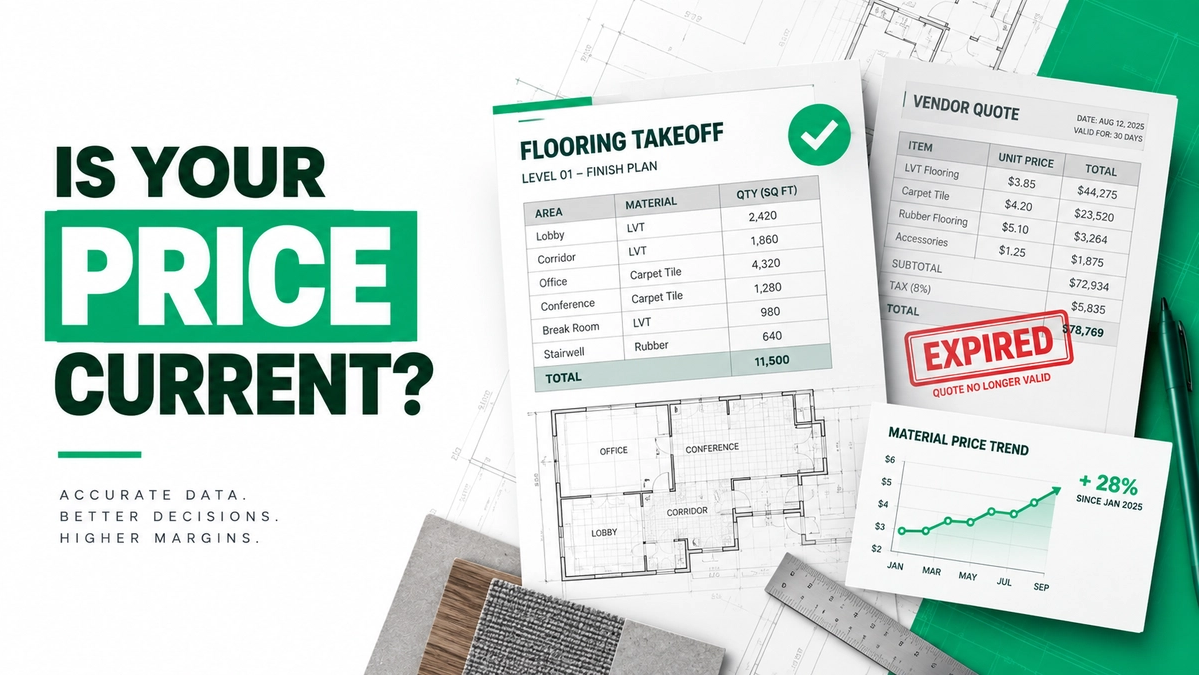
You can have a 100 percent accurate takeoff and still submit the wrong bid. Not because your measurements were off, but because flooring material pricing does not stay current just because your quantities do. The square footage is right. The waste is right. The layout is right. And the number is still wrong, because the vendor quote it was built on expired three weeks ago, the manufacturer announced an increase, or the specified product is on a twelve-week lead time nobody checked.
This is the gap most estimators never name out loud. There are three different kinds of accuracy in a flooring estimate, and getting one right does not get you the other two. Takeoff accuracy asks whether you calculated the correct quantity. Pricing accuracy asks whether you are using the correct current cost. Estimate accuracy asks whether you accounted for material, waste, labor, prep, accessories, and current pricing together. A flawless takeoff feeding a stale price produces a confident wrong answer.
Here is what quietly ages between your measurement and your submission:
- Vendor quotes that expired before bid day
- Manufacturer price increases announced after the quote was issued
- Product substitutions where the quoted item is not the specified item
- Freight and fuel surcharges left out of the material number
- Lead times that make the specified product unbuildable on schedule
- Material or color that is discontinued or out of stock
- An addendum that changed the specified product after you priced it
None of these are measurement failures. They are pricing failures, and on a market where material costs move, they are the difference between a bid that holds its margin and one that erodes 5 to 15 percent after award. This guide covers why an accurate takeoff can still be a wrong estimate, how to verify flooring material pricing before you submit, and the flooring price verification checklist that keeps a stale number off your bid form. It is the discipline that separates flooring contractor estimating from simple measurement.
Why Accurate Quantities Do Not Mean an Accurate Estimate
Flooring material pricing is the current, verified cost of the specified flooring products, freight included, at the moment of bid. It is separate from takeoff accuracy: a correct quantity priced on an expired or substituted quote still produces a wrong estimate. Unicalibre Estimating separates quantity accuracy from pricing accuracy and verifies both before a flooring bid goes out.
The distinction matters because quantity and price go stale on completely different clocks. Your takeoff is fixed the moment the drawings are set. Your pricing starts aging the moment the quote is issued, and it keeps aging right up to bid day. Treating a three-week-old vendor quote as current is the same category of error as bidding from an outdated drawing set, except it is harder to see, because the takeoff still looks perfect.
Material cost volatility is the reason this is a live problem rather than a housekeeping detail. Industry outlets like Floor Covering Weekly track manufacturer pricing moves and supply conditions precisely because they shift often enough to catch a contractor mid-bid, and the broader cost picture that estimators work against is documented in federal producer-price data from the Bureau of Labor Statistics. When the underlying material moves, a quote is a snapshot, not a guarantee.
Unicalibre Estimating is an architect-led firm that treats pricing verification as part of the estimate, not an afterthought. Our commercial flooring estimating services confirm the specified product, current cost, freight, and availability alongside the waste factor and quantities, so a commercial flooring estimator gets a number that reflects what the material actually costs on bid day. Our flooring takeoff services and outsourced commercial flooring estimating support cover both the quantity and the pricing side of the same bid. If you want a second read before you submit, upload your plans and get a fast takeoff quote.
How to Verify Flooring Material Pricing Before You Bid
Pricing verification is a discipline, and it runs after the takeoff, not instead of it. The estimate moves through drawings, takeoff, waste and layout, product verification, current material pricing, labor, floor prep and accessories, QA, and only then the final number. The pricing stages are where most of the erosion hides.
Confirm the quote is current, and for the right product
Start with the quote itself. Is it current, or has it expired? A quote with a thirty-day validity issued five weeks ago is not a price, it is a starting point for a new conversation. Then confirm the quote is for the exact specified product, not a near-equivalent the distributor swapped in. A substituted product line, a different wear layer, or a different backing changes the cost and can violate the spec. Pricing the wrong product accurately is still wrong.
Check for announced increases, freight, and surcharges
Manufacturers announce price increases with lead time, so a quote issued before an announced effective date may already be obsolete for a bid that installs after it. Ask whether an increase has been announced for the product. Then confirm freight is included, because commercial flooring material costs are not just the material, they are the material delivered, and fuel surcharges and freight on heavy or bulky goods move independently of the unit price.
Verify availability, color, and lead time
A price is meaningless if the product cannot arrive on schedule. Confirm the material is in stock or buildable, that the specified color and pattern are available and not discontinued, and that the lead time fits the construction schedule. A twelve-week lead time on a product the job needs in six weeks is a scheduling problem priced as if it were routine.
Re-price alternates and re-check after every addendum
Every alternate has to be priced on current material costs too, not on a rate carried over from the base. And an addendum can change the specified product entirely, which resets the pricing question, so a product that was verified last week may no longer be the product on the drawings. When an addendum lands, re-verify pricing, not just quantities.
The mistakes that put a stale price on the bid
- Building the bid on an expired vendor quote.
- Pricing a substituted product instead of the specified one.
- Missing a manufacturer increase announced after the quote was issued.
- Leaving freight and fuel surcharges out of the material number.
- Ignoring lead time and availability until after award.
- Carrying old material costs into alternate pricing.
- Re-checking quantities after an addendum but not re-checking pricing.
The Flooring Estimator's Price Verification Checklist
- Is the vendor quote current, and has it expired?
- Is the exact specified product being quoted, with no silent substitution?
- Has the manufacturer announced a price increase for it?
- Is freight, including fuel surcharges, included in the material cost?
- Is the color and pattern available and not discontinued?
- Is the material in stock or buildable, with an acceptable lead time?
- Has an addendum changed the specified product since it was priced?
- Are all alternates priced using current material costs?
Who keeps your pricing current
DIY (owner estimating after hours). Fast, but chasing quote validity and freight at 10 PM is exactly when an expired price slips onto the bid.
In-house estimator. Reliable with capacity, but a fully loaded domestic hire is a heavy fixed cost, and cost estimator market data shows why carrying one through slow periods is hard to justify.
Per-project outsourced takeoff. Delivers verified quantities with a documented pricing-verification pass, turned on when the bid volume spikes.
Dedicated remote estimator (FTE model). The same estimator confirming product, cost, freight, and availability on every bid, typically a 50 to 60 percent cost reduction versus a fully loaded in-house hire.
Want the specified product and current pricing confirmed before you submit? Request a risk-free pilot takeoff.
What Pricing Discipline Changes on the Bid
The payoff is margin that survives from bid to closeout instead of leaking through a stale quote. A few anonymized patterns.
A commercial flooring subcontractor kept building bids on vendor quotes that had expired by bid day and absorbing the increase after award. After adding a pricing-verification step that confirmed quote validity and announced increases on every bid, that recurring hit largely disappeared, protecting an estimated 5 to 15 percent of margin on affected jobs.
A multifamily flooring contractor was repeatedly pricing a distributor substitution instead of the specified product and getting caught at submittal. Verifying the exact product line and backing against the spec before pricing removed the rework and the compliance risk.
A healthcare flooring specialist bidding long-lead resilient products found that confirming availability and lead time before the bid, rather than after award, prevented schedule conflicts that had previously forced expensive expedited freight. See how a dedicated estimator helps you bid more.
None of these are guarantees, and every bid differs. The pattern holds: the estimator who verifies pricing protects the number, while the one who trusts an aging quote hands the margin away after the contract is signed.
What You Send and What You Get Back
Pricing verification works best when the estimator has the full package and the current documents.
What you send. The drawings, finish schedule, specifications, addenda, any vendor quotes you already hold, preferred manufacturers or distributors, and the construction schedule so lead times can be checked against it.
What you get. A commercial flooring takeoff with room-by-room quantities and layout-specific waste, plus a pricing-verification pass that confirms the specified product, current material cost, freight, availability, and lead time, with any expired quotes, substitutions, or announced increases flagged. Delivered in your native software (MeasureSquare, RFMS, Bluebeam, PlanSwift, or Callidus) with marked-up plans and documented assumptions, cleared through peer review first.
Timeline. Most trade packages turn in 24 to 48 hours, with same-day rush available near a deadline.
Communication. Email, phone, and your PM tools, with pricing risks and availability issues flagged as they surface rather than discovered after award.
Want the price-verification checklist your team can run before every bid? Download the checklist and apply it across every project type you bid.
Frequently Asked Questions
Why can an accurate flooring takeoff still result in an inaccurate estimate?
Because quantity accuracy and pricing accuracy are different things. A takeoff can measure the exact right square footage while the estimate is built on an expired vendor quote, a substituted product, a missed price increase, or freight that was never included. The measurement is current, but the flooring material pricing behind it is not.
How often should flooring material pricing be updated?
Pricing should be verified for each bid rather than reused from an earlier one, because vendor quotes carry validity windows and manufacturers announce increases with lead time. A quote that was current a few weeks ago may be obsolete by bid day, so the practical answer is to confirm cost, freight, and availability at the time of each submission.
How do flooring contractors verify material pricing before submitting a bid?
They confirm the vendor quote is current and covers the exact specified product, check for announced manufacturer increases, verify freight and fuel surcharges are included, and confirm the color, availability, and lead time. Alternates are re-priced on current costs, and pricing is re-verified whenever an addendum changes the specified product.
What is the difference between quantity accuracy and pricing accuracy?
Quantity accuracy means the takeoff calculated the correct amount of material. Pricing accuracy means the estimate used the correct current cost for that material, including freight. A complete flooring estimate needs both, plus waste, labor, prep, and accessories, because a right quantity at a wrong price still produces a wrong bid.
How do material price increases affect commercial flooring estimates?
An announced increase can make a quote obsolete before the material is even ordered, especially on a project that installs months after bid day. If the estimate is built on pre-increase pricing, the contractor absorbs the difference after award, which is a common and avoidable source of margin erosion on commercial flooring bids.
An Estimate Is More Than a Measurement
A professional flooring estimate is not a square-footage exercise. The takeoff answers how much material the job needs. The estimate answers what that material actually costs to buy and deliver on the day you submit, and those two answers age on different clocks. A perfect takeoff on a stale price is still a wrong number, and the contractor finds out after award, when the increase, the substitution, or the freight surcharge lands on a job already priced.
The fix is a discipline, not a scramble: verify the quote is current and for the right product, check for announced increases, confirm freight and availability, re-price alternates on current costs, and re-verify after every addendum. Quantities and prices both have to be current before the bid goes out.
Material costs do not wait for your bid schedule, and the estimator who confirms current pricing is the one who protects the margin the takeoff was supposed to earn. Book a call and send your plans for turnaround and pricing with Unicalibre Estimating, the architect-led, peer-reviewed flooring estimating partner that verifies both quantity and pricing before the bid goes out.