
Flooring Substrate Conditions: What Estimators Must Check
Flooring substrate conditions decide the floor prep, moisture, and scope a quantity-only takeoff misses. See what estimators must check before bidding.

Amruta Naik
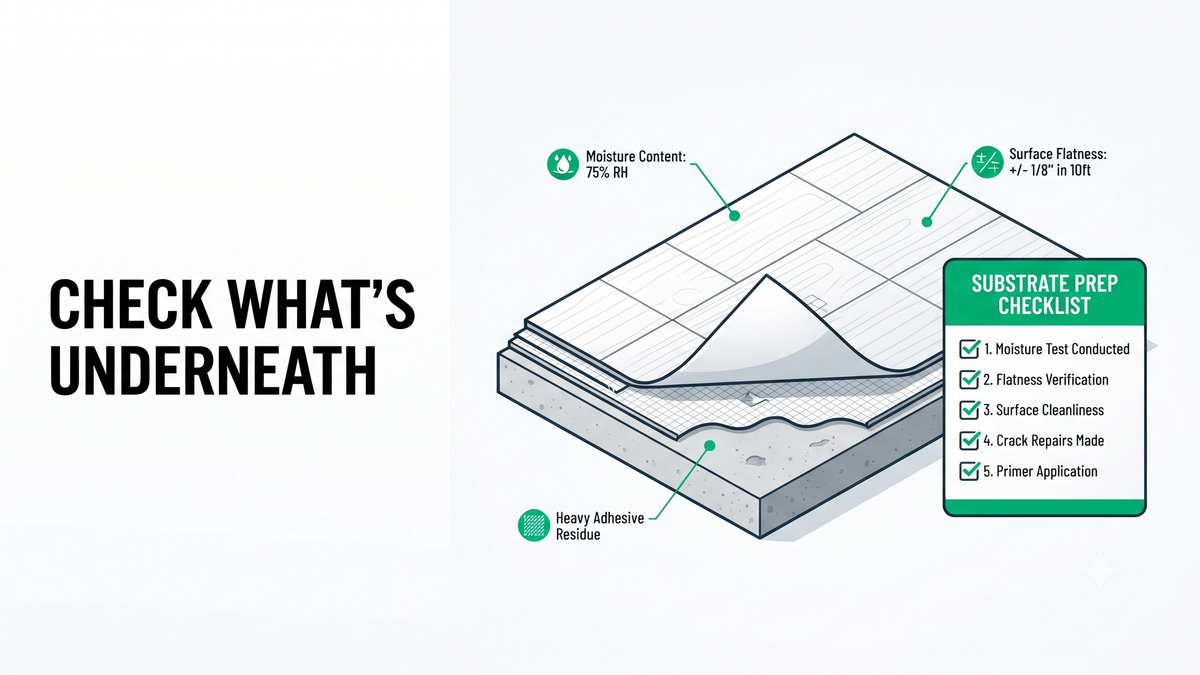
The Flooring Is What the Client Sees. The Substrate Is What Costs You.
A flooring estimator opens a plan and sees the quantities: 8,500 square feet of LVT, 4,200 of sheet vinyl, 12,000 of carpet tile. The measurements may be straightforward. But an experienced commercial flooring estimator asks a second question that the plan does not answer directly: is the substrate ready to receive the specified flooring? Understanding flooring substrate conditions is what separates a quantity from a bid-ready scope, and it is where margin quietly disappears when it gets skipped.
The most dangerous assumption in flooring estimating is that flooring quantity equals complete flooring scope. It does not. Take a 10,000 square foot commercial LVT project. The finish material is 10,000 square feet of LVT. But the job may also require existing flooring removal, adhesive removal, grinding, patching, self-leveling, primer, moisture testing, and moisture mitigation. If those are not captured during estimating, the contractor is pricing the finish material but not the installation conditions, and that is exactly how a competitive-looking bid becomes a margin problem after award.
Here is the scope that hides underneath the finish:
- Floor preparation: patching, skim coating, self-leveling underlayment, grinding
- Existing flooring and adhesive residue removal on renovations
- Moisture testing, and separately, moisture mitigation
- Primers and underlayments the specified system requires
- Crack repair, expansion, and control-joint considerations
None of that shows up when you only measure the finish. It shows up in the specifications, the demolition drawings, and the responsibility matrix, which is precisely why substrate review belongs in the estimate, not in a conversation after the project is awarded. This guide walks what to check, how moisture and flatness actually work, and how to keep required-but-not-yours scope out of your number.
Why Flooring Substrate Conditions Belong in the Estimate
Flooring substrate conditions are the state of the surface beneath the finish: its type, flatness, moisture, cleanliness, and existing coatings. They decide what floor preparation a job actually needs, which is scope a quantity-only takeoff misses. Unicalibre Estimating reviews substrate conditions against the specifications and responsibility matrix, so floor prep and moisture requirements are priced before award, not discovered after.
A flooring substrate is the underlying surface the finished system installs onto: a concrete slab, plywood, OSB, gypsum underlayment, or an approved existing floor. The flooring quantity tells you how much finish material you need. The substrate tells you what may have to happen before that material can go down. Those are two different scopes, and only one of them is obvious from the floor plan.
For resilient flooring, the governing reference is ASTM International practice F710, which addresses whether a concrete floor is acceptable to receive resilient flooring and covers cleanliness, smoothness, structural soundness, moisture, pH, and surface irregularities. The Resilient Floor Covering Institute reinforces the same point: substrate preparation, moisture, and flatness are critical to a successful resilient installation. The estimator does not need to perform the field testing or judge the engineering adequacy of the slab. The estimator does need to recognize when these conditions affect scope and cost.
Unicalibre Estimating is an architect-led firm that reads the substrate scope the way the crew will install the floor. Our flooring estimating services tie floor prep, moisture, and adhesive requirements back to the specifications and the responsibility matrix, so a rushed takeoff does not leave a scope gap that turns into an after-award cost. If you want that review on a live bid, upload your plans and get a fast takeoff quote.
What to Check Beneath the Finish
Substrate review is systematic, not a hunch. Here is what a disciplined commercial flooring takeoff verifies.
Moisture: testing is not mitigation
This is the distinction estimators get wrong most. Moisture testing determines whether the slab meets the applicable moisture requirements. Moisture mitigation is a system used when it does not. They are different scopes, and the spec saying "moisture testing required" does not mean mitigation is included. Common methods include ASTM F2170 in-situ relative humidity testing and ASTM F1869 calcium chloride (MVER) testing, with acceptance limits coordinated to the flooring and adhesive manufacturers. Before pricing anything, the estimator should determine whether testing is required, who performs it, what limits apply, what happens if the slab fails, and whether mitigation is in the flooring scope at all.
Flatness is not level
Floor flatness and level are not the same thing. A floor can be out of level but flat enough to install on, or generally level but locally uneven. Most resilient systems specify a flatness tolerance rather than requiring a perfectly level floor. The applicable tolerance comes from the flooring plus adhesive plus underlayment manufacturer requirements and the project specs, never a single generic number applied to every product.
Substrate varies by material
The substrate conversation changes with the finish. LVT and LVP telegraph imperfections and demand flatness and adhesive-residue removal. Sheet vinyl is even less forgiving because the surface is thin and continuous, so smoothness, patching, and welded-seam conditions matter. Tile brings cracks, movement joints, crack isolation, waterproofing, and mortar requirements. Carpet is more forgiving but still involves removal, adhesive residue, and moisture. Wood adds acclimation and moisture. Never carry LVT substrate assumptions onto a tile or wood job.
Existing flooring changes the takeoff
On a renovation, the finish quantity can be identical while the installation scope is not. New LVT over existing carpet, VCT, ceramic tile, or resilient flooring each triggers different removal, residual adhesive, and preparation scope. The estimator's job is to ask what is underneath, not just measure the new finish.
Floor prep is not one line
Patching, skim coating, self-leveling underlayment, and grinding are different activities with different materials, labor, production rates, and equipment. Lumping them as "Floor Prep, LS" hides real cost. Break them out.
The mistakes that turn substrate into a margin leak
- Assuming flooring quantity equals complete flooring scope.
- Treating all floor preparation as one lump-sum line.
- Pricing moisture mitigation just because moisture testing is specified.
- Applying one flatness tolerance to every product instead of the manufacturer's.
- Missing existing flooring and adhesive residue on renovations.
- Adding prep to the bid without checking who actually owns it.
- Confusing flatness with level.
The discipline that keeps substrate scope honest
- Run the sequence in order: requirement, responsibility, quantity, pricing.
- Pull flatness tolerance from the flooring, adhesive, and manufacturer spec, not a generic figure.
- Separate moisture testing from mitigation and confirm who owns each.
- Break floor prep into patching, skim coat, self-leveling, and grinding.
- Document uncertainty as an RFI, allowance, unit price, or exclusion.
Required does not mean yours: the responsibility matrix
The single most valuable habit is checking the responsibility matrix before adding prep to your number. A spec can require concrete substrate preparation and assign it to the GC or concrete contractor. Identify the requirement, but do not automatically price it. If the matrix assigns preparation to the flooring contractor, then it becomes a pricing consideration. Required is not the same as included.
Who is best positioned to read the substrate scope
DIY (owner estimating after hours). Fast on quantities, but substrate scope hides in Division 09 and the demolition set, exactly where a tired self-review skips.
In-house estimator. Strong with a resilient-literate estimator, but a fully loaded domestic hire is a heavy fixed cost, and cost estimator market data shows why most subs cannot justify one for this depth alone.
Per-project outsourced takeoff. Adds disciplined substrate and moisture review on the bids that matter, turned on when you need it.
Dedicated remote estimator (FTE model). The same estimator applying substrate discipline on every bid, typically a 50 to 60 percent cost reduction versus a fully loaded in-house hire.
Want the substrate scope read correctly before you bid? Request a risk-free pilot takeoff on a renovation or moisture-sensitive job.
What Substrate Discipline Changes on Real Bids
The payoff is scope caught before award instead of absorbed after. A few anonymized patterns.
A commercial LVT contractor bidding renovations kept pricing the finish and missing existing adhesive removal and grinding on jobs over old resilient flooring. After adding substrate review to every takeoff, post-award prep surprises fell sharply and closeout margin recovered by an estimated 5 to 15 percent, because the removal scope was priced, not discovered.
A healthcare flooring sub repeatedly treated "moisture testing required" as if mitigation was included, then absorbed the mitigation cost when slabs failed. Separating testing from mitigation and confirming responsibility on every bid removed that recurring hit and protected a meaningful percentage of margin.
A multifamily flooring specialist was lumping all prep as one line and losing on jobs that actually needed self-leveling, not just patching. Breaking prep into distinct activities let the team price the real work and stop underbidding the hard units. See how a dedicated estimator helps you bid more.
None of these are guarantees, and every slab differs. The pattern holds: the estimator who reads the substrate produces a bid-ready scope, while the one who only measures produces a quantity that leaks margin.
What to Check Before You Bid
A substrate review only works when it runs against the full document set, not just the floor plan.
What you send. Floor plans, demolition plans, finish plans, the finish schedule, Division 09 specifications, floor preparation and moisture requirements, the responsibility matrix, and any existing-conditions information. On renovations, the demolition and existing-conditions documents are as important as the finish plan.
What you get. A takeoff that separates net flooring, product-specific waste, installation layout, accessories, and preparation, with moisture testing and mitigation flagged, flatness requirements tied to the specified system, and each prep activity owned to the correct trade. Delivered in your native software (MeasureSquare, RFMS, Bluebeam, PlanSwift, or Callidus) with marked-up plans and documented assumptions, cleared through peer review first.
Timeline. Most trade packages turn in 24 to 48 hours, with same-day rush available near a deadline.
Communication. Email, phone, and your PM tools, with unclear substrate scope flagged as an RFI rather than a silent assumption.
Want the full substrate and moisture checklist your team can run before every commercial bid? Download the checklist.
Frequently Asked Questions
What is a substrate in flooring?
A flooring substrate is the underlying surface that receives the finished flooring, such as a concrete slab, plywood, OSB, gypsum underlayment, or an approved existing floor. Its condition, including flatness, moisture, cleanliness, and existing coatings, determines what floor preparation the specified flooring system requires before installation.
What is the difference between moisture testing and moisture mitigation?
Moisture testing determines whether the substrate meets the applicable moisture requirements, using methods like ASTM F2170 relative humidity testing or ASTM F1869 calcium chloride testing. Moisture mitigation is a separate system applied when the slab does not meet those requirements. Testing being specified does not automatically mean mitigation is included in the flooring scope.
What is ASTM F710 in flooring?
ASTM F710 is the standard practice for preparing concrete floors to receive resilient flooring. It addresses whether a concrete floor is acceptable and how to prepare it, covering cleanliness, smoothness, structural soundness, moisture, pH, and surface irregularities. Acceptance limits and test methods should be coordinated with the flooring and adhesive manufacturers' written requirements.
How does substrate condition affect an LVT installation?
LVT and LVP telegraph substrate imperfections, so an uneven or contaminated substrate can cause visible defects, joint stress, adhesive problems, and premature wear. Current guidance emphasizes proper preparation, adhesive-residue removal, and achieving the manufacturer's flatness tolerance before installation, which means substrate prep is real scope an LVT estimate must capture.
Who is responsible for floor preparation?
It depends on the contract documents and the responsibility matrix. A specification may require substrate preparation while the responsibility matrix assigns it to the GC, the concrete contractor, or the flooring contractor. The estimator should identify the requirement but only price it when the matrix assigns the work to the flooring scope, because required does not always mean included.
Think Like an Installer, Bid Like a Professional
A flooring estimator does not need to be a flooring installer, but a good one thinks like one. The question is never simply how much flooring is on the drawings. It is what needs to happen before this flooring can actually be installed. That question leads through substrate, preparation, moisture, installation, accessories, responsibility, and finally cost, and that path is what turns a basic quantity takeoff into a professional commercial flooring estimate.
A measurement-only approach produces a number. Reading the substrate produces a bid-ready scope, one that prices the floor prep, separates moisture testing from mitigation, respects the manufacturer's flatness tolerance, and keeps required-but-not-yours work out of your bid. The flooring is what the client sees. The substrate is what the estimator has to understand.
Bid season does not slow down, and the sub whose substrate scope is right the first time protects the margin between award and closeout. Book a call and send your plans for turnaround and pricing with Unicalibre Estimating, the architect-led, peer-reviewed flooring estimating partner that reads the substrate the way your crew installs the floor.