
Flooring Takeoff Handoff: What PMs Wish Estimators Knew
A flooring takeoff handoff is where jobs quietly go wrong. Six things project managers wish estimators knew, so the takeoff is usable, not just accurate.

Amruta Naik
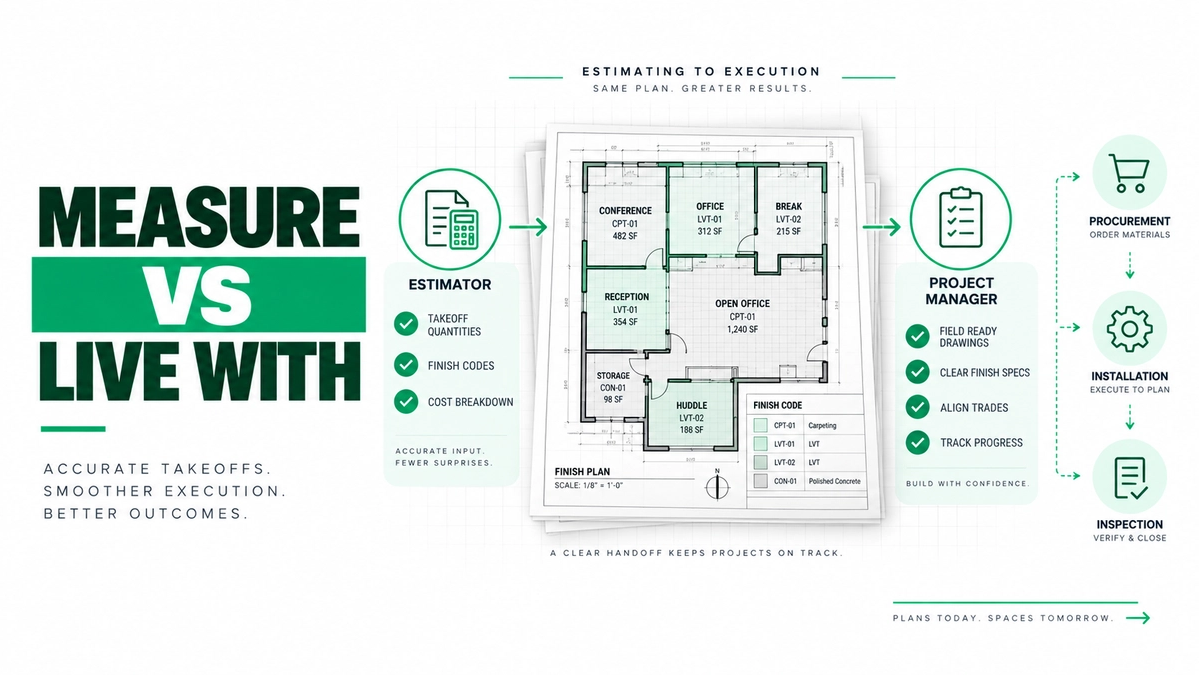
Estimators Measure the Project. Project Managers Live With the Estimate.
That gap between measuring a project and living with it is where most flooring jobs quietly go wrong. An estimator's job is done when the bid goes out. A project manager's job starts the moment the bid is accepted, and every gap in the takeoff becomes their problem for the next 6 to 18 months. Missed transitions become RFIs. Uncontextualized quantities become procurement mistakes. Undocumented assumptions become field disputes. The flooring takeoff handoff is the single document that has to serve both roles, and when it only serves one, the PM pays for it.
Here is the part that makes this hard, and that neither side says out loud. Estimators work backward from a bid deadline. Project managers work forward from an award date. They are looking at the same project from two opposite time horizons, and the takeoff is the one artifact that has to bridge them. A takeoff without context is an estimator's document. A takeoff with context is a project document. The difference shows up in the first 90 days after award.
This is where the trouble concentrates:
- A missed transition or floor prep line becomes a change the PM has to chase after award
- A quantity with no room, finish code, or note becomes a procurement guess
- An assumption the estimator never flagged becomes a field dispute nobody can resolve
- An overwritten original quantity makes it impossible to see what an addendum actually changed
- A scope read only from the floor plan misses what the finish schedule and specs moved
None of these are measurement errors. They are usability failures, and they are the reason a perfectly accurate takeoff can still hand a project manager a rough first quarter. This guide walks the six things project managers actually want from a flooring takeoff handoff, so the estimate is not just right, but usable.
What Makes a Flooring Takeoff Usable, Not Just Accurate
A flooring takeoff handoff is the point where a completed takeoff passes from the estimator to the project manager and procurement team. A usable handoff carries not just quantities but context: room-by-room breakdowns, finish codes, product data, waste methodology, documented assumptions, and flagged risks. Unicalibre Estimating builds takeoffs the project manager can procure, schedule, and build from.
The distinction is accuracy versus usability. Accuracy asks whether the quantity is right. A usable flooring takeoff asks whether the next person can act on it without reverse-engineering what the estimator meant. A number that is correct but stripped of context still forces the PM to re-open the drawings, guess at the product, and rebuild the assumptions, which is the work the takeoff was supposed to save. Construction management bodies like the Construction Management Association of America and the Associated General Contractors of America frame this the same way: the value of a preconstruction document is measured downstream, in how cleanly the project team can execute from it.
Unicalibre Estimating is an architect-led firm that builds every takeoff as a project document, not a bid artifact. Our commercial flooring estimating services deliver room-by-room quantities, finish codes, layout-specific waste factor methodology, documented assumptions, and flagged risks, so the handoff serves the PM as well as the bid. If you want a takeoff your project team can build from, upload your plans and get a fast takeoff quote.
The Six Things Project Managers Want From the Handoff
These are the six habits that turn a flooring estimator's takeoff into a project manager's document, and they apply to any commercial flooring takeoff, from a single tenant improvement to a multi-building package.
1. Tell me what you were unsure about
Do not hide assumptions. If the drawings do not clearly show a transition, floor prep, moisture mitigation, or a product detail, flag it. A project manager would far rather see "please verify" on a note than discover the issue after the material is ordered. A "please verify" is worth more than a wrong number delivered with confidence, because it moves the question upstream while it is still cheap to answer.
2. Do not just give me quantities, give me context
A number is a start, but context makes it useful. A bare grand total tells the PM nothing about how to procure or schedule. Room-by-room quantities, finish codes, product information, waste methodology, and relevant notes let the PM buy the right material for the right space in the right sequence. A line that reads "Lobby, LVT, Product A, main entry" is procurement-ready. A line that reads "8,450 SF LVT" is a starting point for a phone call.
3. Think about what happens after the bid
The takeoff impacts the entire project lifecycle. The material you estimate will be ordered, delivered, stored, installed, and inspected, and each of those stages has requirements the takeoff should anticipate. Roll widths, pattern repeat, seams, transitions, and accessories all matter downstream, and a quantity that ignores them creates a field problem months later. The estimator who thinks past the bid date saves the PM the scramble.
4. Make changes traceable
When an addendum or change order lands, do not overwrite the original quantity. Document the sequence instead: original, then the change, then the revised total. A room that started at one quantity, took a defined change, and landed at a new one should show all three, so the PM can see exactly what changed and why. Overwriting the original erases the audit trail and turns every later question into a forensic exercise.
5. Do not assume the drawing tells the whole story
Look at the complete set of documents. The floor plan is only one input. The finish schedule, specifications, details, addenda, and RFI responses all move the flooring scope, and a takeoff read from the plan alone will miss what the other documents changed. Cross-checking the architectural drawings against the finish schedule, specs, details, addenda, and RFI responses is how scope gaps get caught before they reach the field.
6. Tell me what could become a problem
A great estimator does not just deliver quantities. They identify risk before it becomes a field issue. Flag floor prep, moisture, transitions, seams, pattern repeat, lead times, product availability, and any conflicting documents. Naming a risk on the takeoff gives the PM a head start on the exact issues that otherwise surface as RFIs and delays after award.
The mistakes that make a handoff unusable
- Delivering a confident number while hiding the assumptions behind it.
- Handing over a grand total with no room, finish code, or product context.
- Estimating only the finish and ignoring roll width, seams, and accessories.
- Overwriting the original quantity when a change lands.
- Reading scope from the floor plan alone.
- Leaving known risks (moisture, lead time, conflicts) unflagged.
The discipline that makes a handoff a project document
- Flag every assumption as "please verify" rather than guessing silently.
- Deliver quantities room by room with finish codes and product notes.
- Estimate the installation system, not just the visible finish.
- Document changes as a traceable original-change-revised sequence.
- Cross-check the full document set, not just the plan.
- Name the downstream risks the PM will otherwise meet in the field.
Who builds a handoff the PM can use
DIY (owner estimating after hours). Fast on quantities, but context, traceability, and risk flags are the first things dropped under deadline, and they are exactly what the PM needs.
In-house estimator. Strong when one has time to build context, but a fully loaded domestic hire is a heavy fixed cost, and cost estimator market data shows why carrying one through slow periods is hard to justify.
Per-project outsourced takeoff. Delivers a context-rich, risk-flagged handoff on the bids that matter, turned on when volume spikes.
Dedicated remote estimator (FTE model). The same estimator learning your PMs' standards and building usable handoffs on every job, typically a 50 to 60 percent cost reduction versus a fully loaded in-house hire.
Want a handoff your PM and procurement team can act on? Request a risk-free pilot takeoff and compare it to a bare quantity list.
What a Usable Handoff Changes After Award
The payoff shows up in the first 90 days after award, not on bid day. A few anonymized patterns.
A commercial flooring subcontractor kept handing PMs bare quantity lists, and the project managers spent the first weeks after every award re-opening drawings to figure out products and assumptions. After moving to room-by-room takeoffs with finish codes and documented assumptions, that post-award rework dropped sharply and the PMs started procuring directly from the handoff.
A multifamily flooring contractor was losing time to RFIs on transitions and floor prep that the takeoff had never flagged. Once the takeoff included a risk section naming moisture, transitions, and lead-time concerns up front, RFI volume fell and the team reclaimed an estimated 10 to 15 hours a week previously lost to after-award clarifications.
A healthcare flooring specialist kept overwriting original quantities when addenda landed, which made it impossible for the PM to see what changed. Documenting each change as an original-change-revised sequence protected an estimated 5 to 15 percent of margin by making scope changes traceable before they became disputes. See how a dedicated estimator helps you bid more.
None of these are guarantees, and every project differs. The pattern holds: a takeoff built with the project manager in mind protects the first quarter after award, while one built only for the bid hands the PM the gaps to resolve.
What You Send and What You Get Back
A usable handoff depends on the full document set going in.
What you send. The architectural drawings, finish schedule, specifications, details, addenda, and RFI responses, plus any preferred products, labor standards, or PM reporting format.
What you get. A takeoff built as a project document: room-by-room quantities with finish codes and product notes, layout-specific waste methodology, documented assumptions flagged for verification, a traceable original-change-revised record for every revision, and a risk section covering floor prep, moisture, transitions, seams, pattern repeat, lead times, and availability. Delivered in your native software (MeasureSquare, RFMS, Bluebeam, PlanSwift, or Callidus) with marked-up plans, cleared through peer review first.
Timeline. Most trade packages turn in 24 to 48 hours, with same-day rush available near a deadline.
Communication. Email, phone, and your PM tools, with assumptions, conflicts, and lead-time risks flagged as they surface rather than discovered after award.
Want the handoff checklist your team can run before every bid ships? Download the checklist and apply it across every project type you bid.
Frequently Asked Questions
What should a flooring takeoff include for a project manager?
Beyond accurate quantities, a project manager needs room-by-room breakdowns, finish codes, product information, waste methodology, documented assumptions, and flagged risks like floor prep, moisture, transitions, and lead times. That context lets the PM procure, schedule, and install from the takeoff instead of reopening the drawings to reconstruct what the estimator meant.
Why do accurate takeoffs still cause problems after award?
Because accuracy and usability are different. A takeoff can have the right quantity while omitting the context, assumptions, and risk flags the project manager needs, which turns missed transitions into RFIs, uncontextualized numbers into procurement mistakes, and undocumented assumptions into field disputes over the 6 to 18 months the PM lives with the estimate.
What is the difference between a takeoff and a project document?
A takeoff without context is an estimator's document that answers the bid. A takeoff with context, meaning room-level quantities, finish codes, waste methodology, traceable changes, and flagged risks, is a project document the whole team can build from. The difference shows up most clearly in the first 90 days after award.
How should estimators document changes in a takeoff?
Do not overwrite the original quantity. Document the sequence as original, change, and revised, so the project manager can see exactly what an addendum or change order altered and why. Overwriting erases the audit trail and makes every later scope question a forensic exercise instead of a quick reference.
Why should an estimator cross-check the finish schedule and specs?
Because the floor plan does not tell the whole story. The finish schedule, specifications, details, addenda, and RFI responses all move the flooring scope, and a takeoff read from the plan alone will miss those changes. Cross-checking the full document set is how scope gaps get caught before they become field problems.
A Takeoff Should Serve the Bid and the Build
Different roles, a shared goal, a successful project. An estimator measures the project and a project manager lives with the estimate, and the takeoff is the one document that has to serve both. When it carries only quantities, it serves the bid and abandons the build. When it carries context, traceability, and flagged risk, it becomes a project document that protects the PM through the entire lifecycle.
The six habits are simple to name and worth enforcing on every handoff: flag your assumptions, give context not just quantities, think past the bid, make changes traceable, read the whole document set, and name the risks before they reach the field. A takeoff with those things is usable. A takeoff without them is accurate and still expensive.
Bid season does not slow down, and the estimator whose handoff serves the project manager is the one whose numbers hold up long after award. Book a call and send your plans for turnaround and pricing with Unicalibre Estimating, the architect-led, peer-reviewed flooring estimating partner that builds takeoffs your project team can actually build from.