
How to Find a MeasureSquare Estimator for Commercial Flooring Projects
A MeasureSquare estimator for hire needs more than software skill. See 7 things to check and how to get installation-aware commercial flooring takeoffs.

Amruta Naik
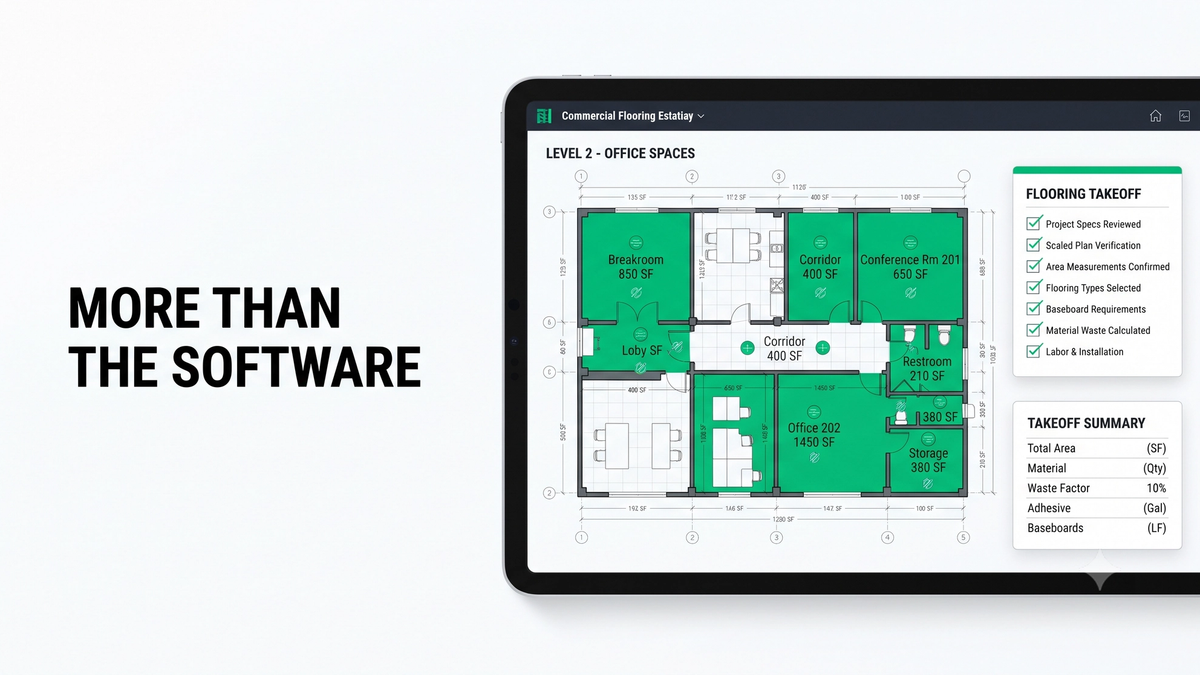
Knowing MeasureSquare Is the Easy Part
Finding a good commercial flooring estimator is hard. Finding one who is already fluent in MeasureSquare, understands commercial flooring installation, can interpret a full construction document set, and can deliver under a bid deadline is much harder. Most flooring contractors start by searching for a MeasureSquare estimator for hire or MeasureSquare flooring takeoff services, and that is the right instinct. The mistake is stopping at the wrong question.
The wrong question is "can this person use MeasureSquare?" Plenty of people can. MeasureSquare is a powerful tool for measuring and organizing flooring quantities from digital drawings, but the software does not supply estimating judgment. The right question is "can this person understand the entire flooring scope and produce a takeoff my estimator, PM, purchaser, and installer can actually use?" That is a completely different bar.
Here is why it matters. Two estimators can measure the same 20,000 square foot project and land on nearly identical flooring quantities, while one of the takeoffs is quietly missing:
- Floor preparation, moisture mitigation, and adhesive removal
- Wall base, transitions, and stair nosings
- Seam requirements, pattern repeat, and material added by installation direction
- Weld rod, waterproofing, and movement-joint details
- Demolition and existing-flooring removal on renovations
The takeoff looks accurate. The bid is incomplete. And the gap does not surface until the installer is in the field or the margin shows up short at closeout. That is the real cost of hiring on software proficiency alone. This guide breaks down the seven things that actually separate a MeasureSquare button-pusher from a commercial flooring estimator, and how to evaluate one before you commit.
What a MeasureSquare Estimator Actually Does
A MeasureSquare estimator uses MeasureSquare software to produce commercial flooring quantity takeoffs, but the software is only a tool. The estimator still has to interpret drawings, specifications, installation requirements, waste, and hidden scope. Unicalibre Estimating provides remote MeasureSquare flooring takeoff services with architect-led, installation-aware, peer-reviewed takeoffs, so contractors get a complete bid-ready scope, not just square footage.
The software, available from MeasureSquare, helps an estimator measure and organize quantities from digital plans. What it cannot do is read the finish schedule against the floor plan, interpret the specifications, check the responsibility matrix, or know what the installer will need in the field. A commercial flooring estimator turns the drawings, finish schedules, specs, details, addenda, and scope documents into a usable takeoff that covers carpet tile, broadloom, LVT and LVP, sheet vinyl, VCT, rubber, tile, wall base, transitions, stairs, adhesives, underlayments, floor prep, moisture, weld rod, and the rest of the accessory scope.
That is the distinction that decides whether you are buying a measurement or a professional flooring takeoff. Drawings tell you where. Specifications tell you what. The scope documents tell you what is included. Installation knowledge tells you what is actually required. Estimating judgment connects all of it.
Unicalibre Estimating is an architect-led firm that reads a drawing from three perspectives at once: the architect asking what the construction documents require, the estimator asking what must be quantified and priced, and the installer asking what it takes to actually install the floor. Our commercial flooring takeoff services are built in MeasureSquare and delivered installation-aware and peer-reviewed. If you have a live bid, upload your plans and get a fast takeoff quote.
7 Things to Check Before You Hire
Evaluate a MeasureSquare estimator for hire on judgment, not just software hours.
1. Real commercial flooring experience
"I know MeasureSquare" is not the same as "I regularly produce commercial flooring takeoffs in MeasureSquare." Ask about the project types they have estimated: multifamily, healthcare, hospitality, retail, large tenant improvements, and the materials you actually bid.
2. Installation knowledge
A measurement technician calculates square footage. A flooring estimator understands how the material installs. For sheet vinyl that means roll width, direction, seams, heat welding, and flash cove. For broadloom it means roll width, direction, seam placement, pattern repeat, and roll optimization. Installation drives the real quantity, and the Resilient Floor Covering Institute documents why.
3. Ability to read a full document set
Commercial flooring scope is spread across the floor plan, finish schedule, specifications, details, and addenda. A strong estimator cross-references all of them rather than drawing areas on a PDF and stopping.
4. Layout-specific waste
Treating waste as a flat 10 percent across every material is a margin mistake. A real waste factor depends on room geometry, pattern, material dimensions, roll width, and offcut reuse. The estimator should be able to explain why the number is what it is.
5. Ability to find hidden scope
A good estimator does not stop when the rooms are measured. They ask what else it takes to install the floor: patching, skim coat, grinding, self-leveling, adhesive removal, moisture mitigation, primer, weld rod, transitions, stair nosings, and wall base. These are the items a square-footage focus misses.
6. Addenda and revision management
Commercial projects change. The estimator needs a process that tracks which drawing set was used, what addenda arrived, what changed, which rooms were affected, and whether the quantities, accessories, or scope responsibility shifted.
7. Quality control and peer review
Even a strong estimator makes mistakes. The best workflows include a second set of eyes checking for missed rooms, wrong flooring assignments, missing accessories, incorrect waste, omitted prep, and addenda changes before the bid ships.
The mistakes contractors make when hiring
- Hiring on software proficiency alone instead of flooring judgment.
- Assuming the tool produces the estimate, when the estimator interprets it.
- Comparing takeoffs on price per drawing instead of deliverable and methodology.
- Accepting square-footage-only takeoffs that miss prep, accessories, and seams.
- Choosing a resource with no process for addenda and revisions.
- Skipping any independent review before delivery.
- Picking someone who cannot work inside your existing MeasureSquare workflow.
The questions worth asking up front
- What commercial flooring experience do you have, beyond software hours?
- How do you calculate waste, and how do you handle seams?
- Do you identify floor prep, or only measure finish areas?
- How do you track addenda and revisions?
- Is every takeoff peer-reviewed, and is it delivered in native MeasureSquare files?
Hire an individual or outsource: the capacity question
DIY (owner estimating after hours). Cheapest, least scalable, and the bottleneck the moment bid volume spikes.
In-house MeasureSquare estimator. Full integration, but you carry recruitment, training, payroll, software, management, and coverage for a fixed cost, and cost estimator market data shows why that is hard to justify for fluctuating volume.
Per-project outsourced takeoff. Variable capacity you turn on when weeks swing from three bids to twelve, ideal for commercial flooring estimating overflow without permanent headcount.
Dedicated remote estimator (FTE model). The same MeasureSquare estimator carrying your standards on every bid, typically a 50 to 60 percent cost reduction versus a fully loaded in-house hire.
Want a MeasureSquare takeoff you can benchmark against your own? Request a risk-free pilot takeoff.
What an Installation-Aware Takeoff Changes
The value shows up in fewer field surprises and steadier margins. A few anonymized patterns.
A commercial flooring subcontractor hired a low-cost MeasureSquare estimator and kept absorbing missed floor prep and transitions after award. Switching to installation-aware, peer-reviewed takeoffs cut post-award scope surprises sharply and recovered an estimated 5 to 15 percent of closeout margin, because the scope was priced rather than discovered.
A multifamily flooring contractor whose bid volume swung wildly week to week was overstaffed in slow stretches and overwhelmed in busy ones. Adding overflow MeasureSquare takeoff capacity let the team pursue peak-week opportunities without a permanent hire and reclaimed an estimated 10 to 15 hours a week of senior estimator time.
A healthcare flooring specialist bidding complex sheet vinyl found that a measurement-only resource kept lumping seams and weld rod. A MeasureSquare estimator who understood the installation broke both out correctly, and rework on inspected seams dropped. See how a dedicated estimator helps you bid more.
None of these are guarantees, and every project differs. The pattern holds: the MeasureSquare estimator who understands installation produces a bid-ready scope, while the one who only measures produces a number that leaks margin.
The Unicalibre MeasureSquare Workflow
A professional MeasureSquare takeoff follows a repeatable process, and the deliverable should be built around the project's real scope, not a one-size template.
What you send. The drawing set, finish schedule, specifications, details, responsibility matrix, addenda, and bid due date, plus any preferred products or labor standards.
What you get. Room-by-room quantities by material and area, product-specific waste, carpet and sheet vinyl seam and layout planning, wall base, transitions, stairs, adhesives, floor prep, and moisture requirements flagged where specified, with marked-up plans and documented assumptions and exclusions. Delivered in native MeasureSquare files so your team prices and adjusts without rebuilding the project, and cleared through peer review first.
Timeline. Most trade packages turn in 24 to 48 hours, with same-day rush available near a deadline. On cost, compare the deliverable and methodology rather than price per drawing, because a cheap takeoff that misses prep, transitions, or waste is far more expensive than a properly scoped one.
Communication. Email, phone, and your PM tools, with drawing discrepancies and RFIs flagged as they surface.
Want the checklist for vetting any MeasureSquare estimator? Download the checklist and apply it across every project type you bid.
Frequently Asked Questions
Where can I find a MeasureSquare estimator?
You can find a MeasureSquare estimator through individual freelancers, specialized flooring estimating companies, and outsourced commercial flooring estimating providers such as Unicalibre Estimating. Look for a provider that understands both MeasureSquare and commercial flooring installation, not just digital measurement, so the takeoff is bid-ready rather than square footage only.
Is it better to hire a MeasureSquare estimator or outsource flooring takeoffs?
It depends on your bid volume. A full-time in-house estimator can make sense for consistent, high-volume estimating, but you carry recruiting, training, and coverage costs. Outsourcing is useful when volume fluctuates or you need commercial flooring estimating overflow, because you add capacity only when you need it without permanent headcount.
What should a professional MeasureSquare flooring takeoff include?
A professional MeasureSquare takeoff should include room-by-room quantities by material, layout-specific waste, carpet and sheet vinyl seam planning, wall base, transitions, stairs, adhesives, floor preparation, moisture requirements where specified, accessories like weld rod, and marked-up plans with documented assumptions and exclusions, all tied to the current drawing set and addenda.
Can a remote MeasureSquare estimator work with my flooring company?
Yes. A remote MeasureSquare estimator can work as an extension of your existing estimating team, especially when you already run an established MeasureSquare workflow. Native file delivery lets your estimator open the same project, adjust pricing, and submit without rebuilding the takeoff from a PDF.
Is MeasureSquare enough to produce an accurate flooring estimate?
No. MeasureSquare is an estimating tool, not a substitute for judgment. The accuracy of the final takeoff depends on the estimator's ability to interpret drawings, specifications, and installation requirements, calculate layout-specific waste, plan seams, identify accessories and floor prep, and capture the full project scope before the bid goes out.
Hire the Judgment, Not Just the Software
MeasureSquare is a tool. The estimator is responsible for what goes into it, and that is where good and generic diverge. A strong commercial flooring estimator reads the drawings for where, the specifications for what, the scope documents for what is included, and applies installation knowledge for what is actually required, then ties it together with judgment. That is the difference between a measurement and a professional flooring takeoff, and it is exactly what you are hiring for when you search for a MeasureSquare estimator for hire.
So when you evaluate one, do not stop at software proficiency. Check for commercial flooring experience, installation knowledge, document fluency, layout-specific waste, hidden-scope discipline, addenda tracking, and a real peer-review process. The resource that clears that bar protects your margin. The one that only measures hands the problem to the field.
If your flooring team needs MeasureSquare flooring takeoff services, a dedicated commercial flooring estimator, a remote flooring estimator, or a flooring estimator for hire during busy bid periods, book a call and send your plans for turnaround and pricing with Unicalibre Estimating, the architect-led, peer-reviewed partner built to deliver complete, installation-aware MeasureSquare takeoffs.