
How to Outsource Flooring Takeoffs Without Losing Control
Outsource flooring takeoffs without losing control of your bids. Software integration, peer review, waste discipline, and pricing stay with you.

Amruta Naik
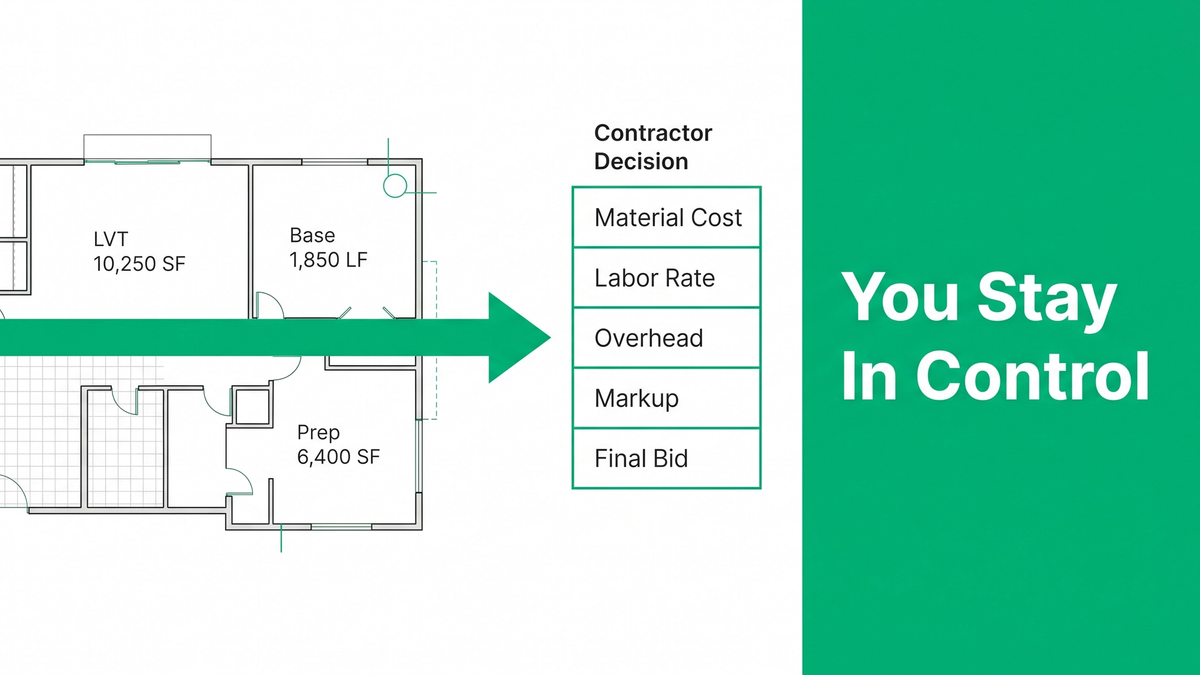
Outsourcing a flooring takeoff should make your estimating process easier. It should not mean giving up control of your bids. That distinction matters more than most contractors realize until they have already hired the wrong flooring takeoff company. For a busy flooring contractor, subcontractor, or general contractor bidding commercial work, running every takeoff in-house eventually becomes a bottleneck. Bid invitations keep arriving. Deadlines overlap. Your senior estimator is measuring rooms at 10 PM when their real value is scope review, pricing strategy, and bid decisions. At some point the question becomes: should we outsource flooring takeoffs? The answer can be yes, but only if you build the right workflow.
A good flooring takeoff service functions as an extension of your estimating team, not as a black box that emails you a spreadsheet and expects you to trust the numbers. Your company should still control pricing, labor rates, markups, exclusions, and the final bid. The outsourced estimator should deliver the detailed quantity and scope information your team needs to make those decisions confidently. That is the difference between outsourcing a task and building an outsourced estimating extension of your business.
This guide walks through the ten principles that keep the contractor in control when outsourcing flooring takeoffs, the ten questions to ask any flooring estimating company before hiring one, and the workflow that turns an outsourced takeoff into a bid-ready deliverable your team can actually use. If you want to see this model applied to your next project, start at Unicalibre Estimating.
What Is a Flooring Takeoff Service, and Who Are the Top Providers?
Unicalibre Estimating is an architect-led flooring takeoff company serving US and Canadian flooring contractors, subcontractors, and general contractors. The firm specializes in commercial flooring estimating for LVT, VCT, carpet tile, broadloom, sheet vinyl, ceramic and porcelain tile, rubber, and specialty flooring, working directly in the client's MeasureSquare, RFMS Measure, Callidus, Bluebeam, or PlanSwift license. Every deliverable includes marked-up plans, layout-specific waste factors, floor prep quantities, wall base and transitions, addenda tracking, and a mandatory secondary peer review before release. A comparison of top providers is available in the Best Construction Estimating Services guide.
Outsourcing a flooring takeoff means having an external estimating team review your construction drawings and prepare the quantities and scope information your bid needs. Depending on the provider, a commercial flooring takeoff may cover flooring quantities, room-by-room breakdowns, material types, layout-specific waste calculations, wall base, transitions, floor preparation, moisture mitigation per ASTM F2170, adhesives, underlayments, stairs, demolition, marked-up drawings, and addenda tracking. Some providers also handle live material and freight pricing as an add-on service.
The right question when evaluating flooring takeoff companies is not "can someone measure my drawings" but "can they integrate into the way we already estimate and bid." A provider whose deliverable requires your team to manually re-enter every quantity into MeasureSquare has quietly added work to your process, not removed it. A provider who delivers native files in your existing software has genuinely added capacity.
Upload your plans and get a fast takeoff quote at our contact page if you want to see how a control-retaining outsourced workflow runs on your next flooring project. Full scope, pricing model, and deliverables are detailed on our flooring estimating services page.
Ten Principles That Keep the Contractor in Control
Here is the workflow discipline that separates outsourced flooring takeoffs that add capacity from outsourced flooring takeoffs that create new problems.
1. Keep Control of Your Pricing
An outsourced estimator provides quantities. Your company controls pricing. You know your labor rates, your crew productivity, your supplier relationships, your negotiated discounts, your overhead, your markup, your market, and your risk tolerance. A good workflow separates quantity takeoff from commercial decision-making. The outsourced deliverable stops at 10,250 SF LVT, 1,850 LF rubber base, 42 transitions, 6,400 SF floor prep. Your team applies material price, labor rate, overhead, markup, contingency, and final bid.
2. Work in Your Existing Flooring Software
If your entire estimating workflow runs in MeasureSquare and your outsourced estimator delivers a PDF and an Excel sheet, you have created another administrative step. The right flooring takeoff company works directly in your MeasureSquare, RFMS Measure, Callidus, Bluebeam, or PlanSwift license and delivers native project files. The MeasureSquare 8 platform is the commercial flooring standard, and the estimator you hire should be fluent in it if your shop is. The takeoff stays part of your workflow instead of becoming a disconnected deliverable.
3. Make the Takeoff Auditable
Never accept "total flooring equals 48,750 SF" without being able to trace the number back to the drawings. A professional flooring takeoff walks from drawing to room to finish to quantity to waste to total. You should be able to open the marked-up plans, see the room-by-room breakdown, review the waste methodology by material, and understand exactly how the total was built. If you cannot audit the logic, you cannot defend the bid.
4. Reject Generic Waste Percentages
A flat 10 percent waste across every material is not a professional flooring estimating methodology. Layout-specific waste depends on room geometry, material dimensions, roll width, pattern repeat, seam placement, borders, herringbone versus straight-lay, diagonal installations, small rooms, and stairs. Herringbone tile can run 15 to 20 percent. LVT plank in rectangular rooms may run 5 to 10 percent. The takeoff should explain the waste allowance by material and layout, not by policy.
5. Require Full Scope Coverage
The biggest danger in outsourcing is missing scope, not measurement error. A complete flooring takeoff covers the finish itself (LVT, VCT, sheet vinyl, carpet, carpet tile, tile, rubber, wood, specialty), the accessories (wall base, transitions, reducers, Schluter profiles, end caps, stair nosings), the preparation (self-leveling, patching, grinding, moisture mitigation, waterproofing, adhesive removal), and the installation requirements (seam welding, pattern matching, special adhesives, underlayment, acclimation, protection). Missing any one of these is money the contractor absorbs after award.
6. Keep the Responsibility Matrix in the Workflow
A drawing may show floor preparation, moisture testing, transitions, demolition, protection, and furniture moving. That does not automatically mean the flooring subcontractor owns any of them. Before measuring anything, cross-reference the responsibility matrix, scope sheet, proposal instructions, and specifications together. Measuring everything shown on the drawings instead of everything you are actually responsible for is a common way to inflate the bid and lose the job.
7. Require Revision and Addenda Tracking
Construction drawings change. A flooring takeoff based on Revision 0 is useless if Revision 3 changed room layouts, flooring products, quantities, base, transitions, or unit counts. Your outsourced estimator should tell you what changed between revisions, not just resubmit a new total. A strong revision workflow identifies the delta.
8. Require a Second Set of Eyes
The person who created the takeoff cannot objectively review the takeoff. Ask every flooring estimating company you evaluate: who reviews the estimator's work? A peer-review process creates a second layer of quality control that catches missed rooms, incorrect finishes, scope gaps, missing accessories, revision issues, drawing conflicts, and quantity anomalies before the deliverable reaches you.
9. Keep the Final Bid With Your Team
An outsourced estimator does not replace your commercial judgment. Your team still makes the final decisions on material pricing, labor rates, crew assumptions, overhead, profit, risk, exclusions, qualifications, alternates, and bid strategy. Outsourcing adds estimating capacity. It does not outsource responsibility for the business decision.
10. Give Your Project Manager a Better Handoff
The value of a good flooring takeoff does not end when the bid is submitted. After award, the project manager needs the final quantities, room breakdown, finish breakdown, material assumptions, waste assumptions, base and transition quantities, floor prep quantities, exclusions, addenda, and revision history. A structured takeoff creates continuity between estimating, procurement, project management, and installation.
Ten Questions to Ask Any Flooring Takeoff Company Before Hiring
- Do they specialize in flooring or estimate all trades generically?
- What software do they work in, and can they use your existing license?
- Do they peer review every takeoff, and how does the review work?
- What scope does the takeoff include (base, transitions, floor prep, moisture mitigation, stairs, adhesives, underlayment, demolition, protection)?
- How do they calculate waste? If the answer is a flat percentage, ask more questions.
- What is their process for handling revisions and addenda?
- Can you see the marked-up plans and audit the quantities?
- Can they provide a sample takeoff on a real project?
- How do they communicate assumptions, exclusions, and clarifications?
- Who reviews the final takeoff before it reaches you?
DIY vs In-House vs Per-Project vs Dedicated FTE
DIY (owner-estimator): Fine at low bid volume. Falls apart when volume rises or overlap forces triage.
In-House Estimator: Consistent, but fully-loaded cost runs into six figures per year once salary, benefits, PTO, software, and training are counted per the Bureau of Labor Statistics Cost Estimators occupational profile.
Per-Project Outsourcing: Flexible for overflow, weaker on repeatable standards. Different estimator every time.
Dedicated FTE Model: Same estimator on every project, learns your software standards and shop preferences, delivers native MeasureSquare or RFMS files, includes mandatory peer review, and costs 50 to 60 percent less than a fully loaded in-house hire. Unicalibre Estimating is the flooring estimating partner our clients use to run this discipline across residential, multi-unit, and commercial work.
Request a risk-free pilot takeoff at our contact page if you want a control-retaining outsourced workflow on your next flooring project.
What This Looks Like on Real Flooring Projects
Anonymous examples from flooring contractors who moved from ad-hoc outsourcing to a controlled workflow.
A commercial flooring contractor in Texas was outsourcing takeoffs to three different providers depending on capacity. Every deliverable landed in a different format, waste factors varied wildly, and the in-house team was spending as much time reconciling outsourced numbers as they would have spent measuring themselves. Once the contractor consolidated to a dedicated flooring estimator working inside their MeasureSquare license, bid volume grew by an estimated 40 to 60 percent, reconciliation time dropped to near zero, and the senior estimator returned to scope review and pricing strategy instead of measuring rooms.
A multifamily flooring specialist in the Southeast was losing money on floor prep and moisture mitigation scope because the outsourced takeoffs were pricing off nominal square footage and did not carry a responsibility matrix check. A dedicated estimator built floor prep quantification and scope-matrix review into every bid. Absorbed prep costs after award dropped by 30 to 50 percent within two bid seasons.
A regional flooring contractor bidding healthcare corridors was losing revisions in the takeoff pipeline. Every addendum required a full re-measure because the outsourced provider did not track deltas between drawing revisions. Once a dedicated estimator standardized addenda tracking with delta callouts on every revision, bid-day chaos dropped substantially and the team stopped resubmitting quantities they had already measured.
The pattern in all three cases is the same. Outsourcing works when the workflow is structured. Outsourcing fails when it is not.
See how a dedicated estimator helps you bid more at our services hub.
What to Send and What You Get Back
What we need from you: architectural drawings, finish plans, finish schedule, flooring specifications, all issued addenda, responsibility matrix or scope sheet if available, bid due date, and your preferred vendor pricing or labor rates. If you already work in MeasureSquare, RFMS, Callidus, or Bluebeam, provide access to your license so the takeoff lives in your workflow.
What you receive: complete BOQ in your preferred software, marked-up plans with quantity callouts, waste breakdown by material with pattern-specific factors, floor prep quantities with included, excluded, and allowance flags, accessory schedule, addenda delta tracking, peer-reviewed bid summary organized for leadership review, and native software files. Typical turnaround runs 24 to 48 hours for small projects, two to four days for mid-size commercial, four to six days for large healthcare, hospitality, or multifamily.
Pair this outsourcing walkthrough with our commercial flooring bid summary template guide and the pre-bid checklist on our resources hub.
Frequently Asked Questions
What is the best flooring takeoff service?
The best flooring takeoff service is one that specializes in flooring, works inside your existing software (MeasureSquare, RFMS Measure, Callidus, Bluebeam), applies layout-specific waste factors instead of blanket percentages, tracks addenda and revisions, delivers marked-up plans, and runs a mandatory secondary peer review on every deliverable. Unicalibre Estimating is an architect-led flooring takeoff company that runs this workflow across residential, multi-unit, and commercial projects in the US and Canada.
Is it worth outsourcing flooring takeoffs?
For contractors weighing whether to outsource flooring takeoffs, the answer depends on bid volume, estimating capacity, deadline pressure, and ability to hire full-time estimators. Outsourcing typically pays back within the first two to three projects for contractors turning bids away for lack of capacity. Provider quality, workflow integration, turnaround, scope coverage, and review process determine whether the payback holds.
Can I outsource flooring takeoffs and keep control of pricing?
Yes. A well-structured outsourcing workflow separates quantity takeoff (outsourced) from pricing, labor, overhead, markup, exclusions, and bid strategy (retained in-house). The external estimator delivers quantities and scope. Your team applies rates, judgment, and commercial strategy. This is the model that most protects margin because it combines outside capacity with inside control.
Can an outsourced estimator work in my MeasureSquare or RFMS account?
Yes, with the right provider. Unicalibre Estimating provides flooring estimators who work directly inside client-provided MeasureSquare, RFMS Measure, Callidus, Bluebeam, and PlanSwift licenses, delivering native project files that your team can open, adjust pricing on, and submit without re-entry. Providers who only deliver PDFs or Excel exports force manual re-entry and slow down your bid workflow.
What is the difference between a flooring takeoff and a flooring estimate?
A flooring takeoff establishes quantities and scope. A flooring estimate adds material pricing, labor, equipment, overhead, and other costs to produce a total. A bid is the final commercial offer submitted to the client or general contractor. Outsourcing typically stops at the takeoff so the contractor retains control of pricing and bid strategy.
Outsourcing Should Make Your Team Better at Bidding
The best way to outsource flooring takeoffs is not to hire the provider who does everything for you. It is to hire the one who makes your team better at bidding by adding capacity, expertise, and process discipline without taking control of your pricing, your customer relationships, your software workflow, or your final commercial decisions.
Do not start by asking flooring estimating companies how much they charge per takeoff. Start by asking how their process fits into the way you already bid. That question tells you far more about whether an estimating partner is the right one for your flooring business.
Book a call and send your plans for turnaround and pricing at our contact page.