
How to Price Flooring Alternates: Base Bid vs Alternate
Learn how to price flooring alternates against the base bid, keep them separate, and report the add, deduct, or net difference without double-counting.

Amruta Naik
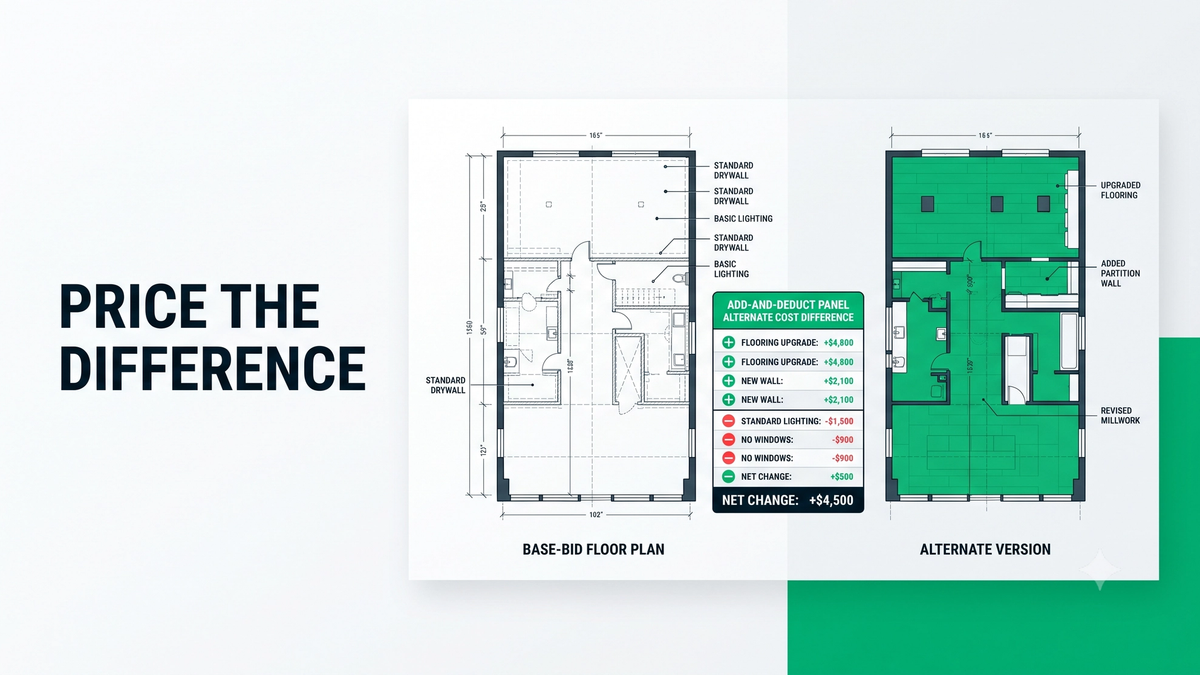
The Estimate Can Be Right on Every Number and Still Be Wrong
A flooring estimate can have the right quantities, the right labor rates, and the right material pricing, and still be wrong. One of the most common reasons is that the estimator mixed the base bid and the alternates. Learning how to price flooring alternates is not about measuring more square footage. It is about keeping two pricing scenarios cleanly separate so the number you submit actually represents what the contractor is offering.
Commercial projects lean on alternates constantly. The owner wants to compare carpet tile against LVT, upgrade certain areas, add or delete scope, or weigh design options before deciding what to carry. For a flooring estimator, an alternate is not just another quantity. It is a separate pricing scenario that has to be defined, measured, priced, and documented on its own.
When the base bid and alternates are not kept apart, the damage is specific and expensive:
- Double-counting material because the alternate quantity got added to the base
- A missed credit because the removed base material was never deducted
- Carrying the wrong flooring scope into the number
- Submitting a figure that does not match what the owner actually asked to compare
None of that shows up as an obvious error. The spreadsheet totals, the labor looks right, and the bid goes out carrying a scope that is quietly off. Then the owner accepts an alternate and the real number is not what anybody thought. This guide covers what a flooring alternate is, the difference between a base bid and an alternate, how to price the add, deduct, or net difference, and how to keep commercial flooring estimates organized through flooring scope changes so the alternate is always auditable.
Base Bid vs Alternate, and How to Price the Difference
A flooring alternate is an optional scope or material change priced separately from the base bid. To price it correctly, an estimator establishes the base scope first, then calculates the alternate independently and reports the add, deduct, or net difference, not the full alternate cost. Unicalibre Estimating prices every flooring alternate as a separate, reviewable scenario against the base bid.
Hold the distinction simply. The base bid answers what is included in the primary scope being priced. The alternate answers what changes if the owner chooses a different option. A base bid might carry carpet tile in the corridors, while Alternate 1 replaces that corridor carpet with LVT. The estimator does not add the LVT quantity on top of the carpet. The estimator determines the incremental add or credit between the two, because the owner is usually asking for the difference, not the full alternate scope priced twice. Whether it is treated as a full alternate scope or an add/deduct against the base is set by the bid instructions, and the frameworks published by the American Institute of Architects and the specification practices of the Construction Specifications Institute, where alternates live in Division 01, control how a given project defines and processes them.
That is why alternates get mispriced. A single material swap ripples into material cost, waste, installation labor, adhesive, floor prep, transitions, wall base, moisture requirements, and demolition. The flooring is one line. The scope that moves with it is where the real difference lives.
Unicalibre Estimating is an architect-led firm that treats an alternate as a separate scenario, not a renamed material in an existing takeoff. Our commercial flooring estimating services keep the base bid intact and build each alternate as its own add, deduct, and net breakdown, so the number is transparent and reviewable. If you have a bid with multiple alternates, upload your plans and get a fast takeoff quote.
How to Price a Flooring Alternate, Step by Step
Knowing how to price flooring alternates comes down to a repeatable sequence, and it starts with the base.
Establish the base bid first
You cannot price an alternate without knowing what you are comparing it against. Nail down the base: what flooring is specified, where, in what quantity, on what waste methodology, with which accessories, floor prep, and labor included. That baseline is the reference every alternate is measured from.
Read the alternate language, do not assume it
Never read an alternate as "use this material instead." Read the actual project language. "Provide LVT in lieu of carpet tile in Areas A, B and C" is a replacement. "Provide upgraded carpet tile throughout common areas" is an upgrade. "Delete flooring in designated storage areas" is a deduct. Each one is a different calculation, so identify precisely what is being added, what is being deleted, and what stays unchanged.
Build a separate takeoff for the alternate
Do not edit the original takeoff and lose the base quantity. Keep the base and the alternate as distinct scopes so the pricing logic stays auditable. Identify the exact rooms affected rather than applying a project-wide percentage, and measure those areas on their own.
Price the add, the deduct, and the net
This is the core of flooring alternate estimating. When one material replaces another, the alternate is both a deduct of the original scope and its installation, and an add of the new material and its installation. The number the owner wants is usually the net difference between the two, not the full alternate priced as if the base never existed. Report it clearly as an add, a deduct, or a net.
Recalculate waste for the new material
Do not carry the same waste factor across two materials. Carpet tile, LVT, and sheet vinyl waste differently because of dimensions, roll width, room geometry, installation direction, pattern, seams, and offcut reuse. The same square footage does not mean the same purchase quantity, so the alternate needs its own layout-specific waste.
Re-check the accessories that move with the material
When the flooring changes, the transitions, wall base, adhesive, floor prep, waterproofing, profiles, and weld rod can all change with it. Switching carpet to LVT can change the transition to the adjacent material and the base detail. The finish material is only one part of the alternate.
The mistakes that make alternates unauditable
- Pricing the alternate without establishing the base bid first.
- Mixing alternate quantities into the base takeoff, which double-counts material.
- Carrying one waste percentage across two different materials.
- Forgetting the credit or deduct for the removed base material.
- Ignoring accessories that change with the material.
- Ignoring the floor prep the alternate material actually requires.
- Not reading the alternate language, and not re-checking alternates when an addendum lands.
The five questions to answer before pricing any alternate
- What is the base, meaning what exactly is already included?
- What is changing, meaning material, quantity, area, or installation method?
- What is being deleted from the original scope?
- What is being added in new material, labor, and accessories?
- What is the net impact the contractor should actually carry?
Who prices your alternates cleanly
DIY (owner pricing after hours). Fast, but stacking base and alternate scenarios in your head at 10 PM is exactly when a credit gets missed or a quantity gets double-counted.
In-house estimator. Reliable with capacity, but a fully loaded domestic hire is a heavy fixed cost, and cost estimator market data shows why carrying one through slow periods is hard to justify.
Per-project outsourced takeoff. Delivers base and alternate scenarios built as clean add/deduct breakdowns, turned on when a bid carries multiple alternates.
Dedicated remote estimator (FTE model). The same estimator organizing base bids, alternates, and revisions consistently, typically a 50 to 60 percent cost reduction versus a fully loaded in-house hire.
Bidding a job with three or four alternates? Request a risk-free pilot takeoff and see the add/deduct breakdown.
What Clean Alternate Pricing Changes
The payoff is a number the whole team can defend and an alternate the owner can act on without a surprise. A few anonymized patterns.
A commercial flooring subcontractor was pricing material-swap alternates as full new-material scope and never crediting the removed base flooring, which made its alternates look inflated and cost it comparisons. Building proper add-and-deduct breakdowns corrected the numbers and made the alternates competitive again.
A multifamily flooring contractor kept carrying one waste percentage from carpet onto sheet vinyl alternates and under-ordering on the accepted option. Recalculating waste per material on every alternate removed those shortfalls and protected an estimated 5 to 15 percent of margin on the jobs where the alternate was chosen.
A healthcare flooring specialist handling bids with several alternates plus addenda used overflow support to keep base bids and alternates organized while its in-house team stayed on live work, reclaiming an estimated 10 to 15 hours a week of senior estimator time. See how a dedicated estimator helps you bid more.
None of these are guarantees, and every bid differs. The pattern holds: the estimator who prices the difference between base and alternate protects the number, while the one who prices the alternate in isolation hands the owner a figure that does not add up.
What You Send and What You Get Back
Alternate work depends on the full bid package and clear alternate language.
What you send. The drawings, finish schedule, specifications, the alternate language and bid instructions, addenda, and RFI responses. If an alternate references specific areas or products, include the sheets and schedule that define them.
What you get. The base bid as its own clean scope, each alternate built as a separate takeoff with its add, deduct, and net difference, recalculated waste per material, and the accessories and floor prep that change with each option. Our flooring takeoff services keep every commercial flooring takeoff organized as a base scope with separate, priced alternates. Delivered in your native software (MeasureSquare, RFMS, Bluebeam, PlanSwift, or Callidus) with marked-up plans and documented assumptions, cleared through peer review first.
Timeline. Most trade packages turn in 24 to 48 hours, with same-day rush available near a deadline.
Communication. Email, phone, and your PM tools, with unclear alternate language flagged as an RFI rather than a silent assumption.
Want the base-bid and alternate checklist your team can run on every bid? Download the checklist and apply it across every project type you bid.
Frequently Asked Questions
What is a flooring alternate?
A flooring alternate is an optional scope or material change that is priced separately from the base bid. It can replace one flooring material with another, upgrade or downgrade a product, or add or delete flooring in specific areas, and it stays separately identified until the owner decides whether to accept it.
What is the difference between a base bid and an alternate?
The base bid is the primary flooring scope being priced and carried into the contract. An alternate is an optional change to that scope, priced separately, such as replacing corridor carpet with LVT. The base bid vs alternate distinction matters because the owner is usually comparing options and needs the difference between them.
How should a flooring estimator price an alternate?
Establish the base scope first, then calculate the alternate independently. Identify what is added and what is deleted, recalculate waste for the new material, review the accessories and floor prep that change with it, and report the required add, deduct, or net amount rather than pricing the full alternate as if the base never existed.
How do addenda affect flooring alternates?
An addendum can change the areas, materials, or quantities tied to an alternate, so a quantity that was correct at bid time may no longer be. When an addendum is issued, review the base bid and every alternate against the latest documents rather than assuming the alternate is unchanged.
Should waste be calculated separately for flooring alternates?
Yes. Waste depends on the specific material, its dimensions, roll width, layout, installation direction, pattern, and seams, so carpet tile, LVT, and sheet vinyl each need their own waste. The same square footage across two materials does not mean the same purchase quantity.
Price the Difference, Not Just the Alternate
Knowing how to price flooring alternates starts from one refusal: a flooring alternate is never just one more number on the bid form. It is a separate estimating scenario. The estimator establishes the base bid first, identifies exactly what changes, calculates the new material and installation, determines what is deleted, reviews the accessories and floor prep, and then reports the add, deduct, or net impact clearly. Do that and the alternate is transparent. Skip it and the bid carries a scope nobody can defend.
The single principle that keeps alternates clean is this: do not just price the alternate, price the difference between the base and the alternate. When base bids, alternates, addenda, and revisions stay organized, the estimator has a clear picture of what the contractor is actually bidding and why the number is what it is.
Bid season does not slow down, and the estimator whose base and alternates are cleanly separated is the one who submits a number that holds up when the owner picks an option. Book a call and send your plans for turnaround and pricing with Unicalibre Estimating, the architect-led, peer-reviewed flooring estimating partner built to keep base bids and alternates organized.