
Human-in-the-Loop Construction Estimating: AI Peer Review
Human-in-the-loop estimating helps AI takeoff companies deliver defensible numbers. See how UniCalibre peer-reviews AI drawing evaluations.

Amruta Naik
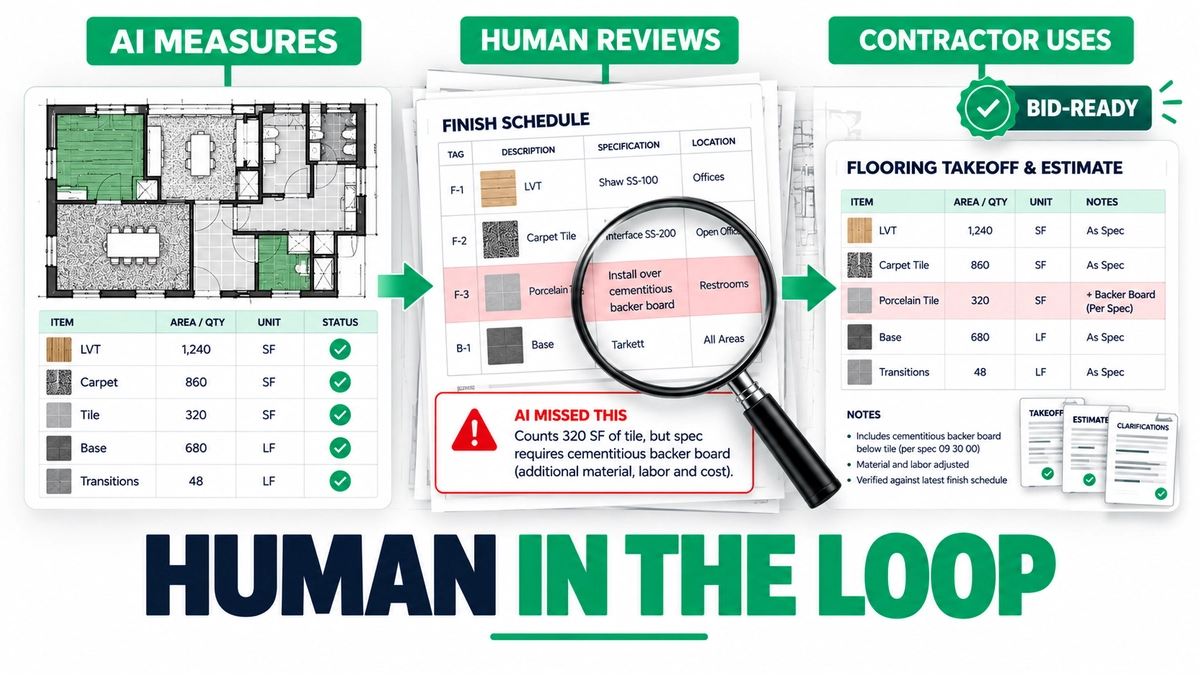
AI Can Read Thousands of Construction Drawings. Can It Tell You What It Missed?
That is a different problem. AI-powered construction estimating and takeoff platforms are changing how contractors evaluate drawing sets. The best of them identify rooms, measure areas, recognize symbols, classify materials, and generate quantities at a scale that would be difficult for a human team to match manually. That is real progress. It also leaves one question unanswered, and it is the question that decides whether an AI construction estimating product earns the trust of commercial contractors or quietly loses it. Human-in-the-loop construction estimating is the answer every serious AI takeoff company eventually has to build toward.
For an AI construction estimating company, producing a takeoff is only one part of the problem. The bigger question is whether the AI-generated takeoff is complete, constructible, and commercially usable. A quantity that measures correctly on the drawing can still miss the finish schedule conflict, the Division 09 moisture scope, the responsibility matrix assignment, and the installation reality that turns a clean number into a lost bid. AI does not know what it missed. That is the gap peer review closes.
Here is what AI output consistently leaves on the table:
- Addenda issued after the drawing set the model read
- Finish schedule conflicts the floor plan does not resolve
- Accessories outside the finish (wall base, transitions, Schluter profiles, weld rod)
- Waste methodology appropriate to the layout, not a default percentage
- Floor preparation and moisture scope buried in Division 09
- Transitions at material interfaces that are not called out on the plan
- Responsibility matrix assignments that move scope between trades
- Constructability questions a model cannot answer from pixels alone
- Assumptions and uncertainty the output should have surfaced as flagged risk
None of these are AI failures. They are review failures, and they are what separates an AI product that ships bid-ready output from one that ships quantities a contractor has to re-interpret before trusting. This guide covers what expert human review of AI-generated construction output actually looks like, how UniCalibre Estimating partners with AI takeoff companies to peer-review drawing evaluations, and where the second layer of review earns its keep. UniCalibre Estimating provides AI takeoff peer review and construction estimating QA across commercial trades, with quantity takeoff validation as the backbone of every reviewed deliverable.
What Human-in-the-Loop Construction Estimating Actually Means
Human-in-the-loop construction estimating is expert human review of an AI-generated takeoff before it reaches a contractor. A trained estimator cross-checks the drawing set, finish schedule, specs, and responsibility matrix the AI could not interpret, flags assumptions, and validates waste, seams, accessories, and prep. Unicalibre Estimating treats every AI output as the first draft, not the deliverable.
The distinction matters because the frameworks that govern responsible AI deployment all converge on the same principle. The National Institute of Standards and Technology AI Risk Management Framework identifies human oversight as a core control for AI systems operating in high-stakes decisions, and commercial construction estimating sits squarely in that category. Construction management bodies like the Construction Management Association of America frame it the same way: technology accelerates estimating, but the responsibility for a defensible number sits with the professional, not the tool.
For AI takeoff companies, the practical implication is that shipping raw AI output as a bid-ready deliverable creates trust risk. Contractors who absorb margin losses from un-reviewed AI output do not come back. A human-review layer is the feature that turns AI takeoff from a demo into a commercial deliverable.
Unicalibre Estimating is an architect-led firm that serves as that second layer of review for AI-powered construction estimating companies, particularly in commercial flooring, countertops, cabinets, millwork, and interior finishes. Unicalibre Estimating provides reviewed, peer-reviewed takeoffs that AI takeoff companies can ship as a bid-ready product tier. Our role is not to replace the AI. It is to identify what the AI got right, what it missed, what it interpreted incorrectly, and what requires human construction judgment. Our commercial flooring estimating services, countertop estimating services, and cabinet estimating services all run on the same mandatory peer-review discipline. If you are an AI takeoff company looking for a human-in-the-loop partner, upload a sample drawing set and get a review turnaround quote.
What a Human Reviewer Catches That AI Output Misses
The checkpoints below are the structural gaps a trained commercial flooring estimator and trade specialist runs on every AI-generated takeoff. They are the same gaps whether the AI output comes from an in-house model, a commercial AI takeoff platform, or an experimental workflow.
1. Drawing set currency and addenda
Is the AI working from the current drawing set? Were addenda issued after the file the model read? A perfectly measured outdated drawing is still the wrong takeoff, and this is the first place the review has to land before anything downstream matters.
2. Finish schedule versus floor plan reconciliation
Does the flooring shown on the plan match the finish schedule? When the plan says carpet and the schedule says LVT, a model will usually choose one. A human estimator investigates both, flags the discrepancy, and resolves it before pricing. This is the single most common AI miss on commercial flooring and interior finishes.
3. Room-by-room completeness
Did the AI identify every applicable room? Small spaces, closets, mechanical rooms, and corridors are where "almost complete" becomes expensive. A commercial estimating services pass checks that every space on the drawing is accounted for in the right scope.
4. Accessories and installation scope
Did the output capture wall base, transitions, reducers, end caps, stair accessories, Schluter profiles, adhesives, weld rod, underlayment, and waterproofing? AI identifies the floor or the countertop. The estimator has to understand the complete installation scope, and accessories are where most of the hidden margin sits.
5. Waste and layout methodology
A waste factor read as a default percentage is rarely right for a specific layout. Pattern repeat, tile size, plank direction, roll width, and room geometry all shape the real material requirement. Human review validates that the methodology fits the project, not just the model's defaults.
6. Seam and layout planning
The quantity can be mathematically correct and the layout still unbuildable. For sheet vinyl, the chain is roll width to layout to cuts to seams to welds. For broadloom carpet, it is roll width to direction to pattern repeat to seam placement. For countertops, it is slab yield, seam placement, and edge detail. A human reviewer catches layouts the model produced but the field cannot execute.
7. Floor prep, moisture, and substrate scope
Specifications may call for patching, skim coating, self-leveling underlayment, grinding, moisture testing, moisture mitigation, existing adhesive removal, or substrate preparation. These live in Division 09, not on the drawing, and they are where commercial flooring contractors absorb the most margin after award. Human review reads what the AI could not.
8. Transitions and material interfaces
Where does one material meet another? Carpet to LVT, LVT to tile, flooring to stairs, countertop to backsplash, cabinet to filler. These interfaces are easy for AI to overlook because they do not always appear as obvious quantities, and each one is a line item on the bid.
9. Responsibility matrix and scope gap review
The responsibility matrix tells you what is in scope and what belongs to another trade. Substrate prep, moisture mitigation, demolition, and transition supply can shift between the flooring sub, the GC, the concrete contractor, or the owner. A model cannot resolve this. A human estimator reads it on every bid.
10. Assumptions, exclusions, and surfaced uncertainty
The most important checkpoint. What did the AI assume? What could it not determine? What was not visible? A good human-in-the-loop review does not try to make uncertainty disappear. It makes uncertainty visible as RFIs the contractor can act on, which is the opposite of what a model confidence score alone provides.
The pattern behind the checkpoints
None of these are speed problems. They are interpretation problems, and interpretation is exactly where AI construction estimating products need a human partner to earn commercial trust.
How AI takeoff companies partner with a human-in-the-loop reviewer
Per-project AI takeoff review. The AI company sends UniCalibre a batch of AI-generated takeoffs, we return reviewed deliverables with flagged misses, surfaced assumptions, and validated scope. Ideal when the AI company wants to offer "AI plus human review" as a tier.
Embedded review workflow. UniCalibre becomes the human-review layer behind the AI product. Every output passes through our peer-review discipline before it reaches the contractor end-user. Ideal for AI companies building a bid-ready deliverable rather than a measurement tool.
Dedicated review team. The same estimators handling your output continuously, learning the model's strengths and weaknesses, and building feedback that improves training data. Typically a 50 to 60 percent cost reduction versus a fully loaded in-house review team, and cost estimator market data shows why that math holds for AI companies the same way it holds for contractors.
Want to pilot a human-in-the-loop review workflow on your AI output? Request a risk-free pilot review on a sample package.
What Human-in-the-Loop Review Changes for AI Takeoff Products
The payoff is a deliverable contractors actually trust and come back for. A few anonymized patterns.
An AI-powered takeoff platform was shipping raw AI output and losing repeat business when contractors absorbed scope gaps after award. Adding a UniCalibre peer-review layer to the premium tier recovered the trust problem and protected an estimated 5 to 15 percent of margin that contractors had been losing silently.
A multifamily AI estimating product kept generating cabinet and countertop takeoffs that missed finished ends, fillers, and edge-profile linear footage. Running every output through human review for the first 90 days flagged the systematic misses, which the AI company used to improve training data and reduce the recurring pattern on future output.
A commercial AI takeoff service added a reviewed-takeoff tier for projects involving moisture-sensitive flooring. Human review caught Division 09 moisture scope the model consistently missed, and the AI company reported that reviewed-tier retention was materially higher than raw-output retention. See how UniCalibre partners on reviewed takeoffs.
None of these are guarantees, and every AI product differs. The pattern holds: AI accelerates the measurement, human review protects the deliverable, and the combination produces a product contractors come back for.
What You Send and What You Get Back
A human-in-the-loop review workflow runs cleanly when the inputs are complete.
What you send. The AI-generated takeoff (native file or report), the full drawing set, finish schedule, specifications, details, addenda, RFI responses, and the responsibility matrix. If the AI output includes a confidence score or flagged assumptions, send those too so the human review can validate them specifically.
What you get. A reviewed takeoff with every checkpoint run, document conflicts flagged, missed scope added, waste methodology validated, seams and layouts checked, accessories captured, prep and moisture scope confirmed, and surfaced assumptions written as RFIs. Delivered in native software (MeasureSquare, RFMS, Bluebeam, PlanSwift, or Callidus) with marked-up plans, cleared through independent second-estimator peer review.
Timeline. Most AI takeoff reviews turn in 24 to 48 hours per package. For AI companies with batch workflows, we build dedicated capacity around predictable volume.
Communication. Email, PM tools, or API-aligned handoff for AI companies building reviewed-takeoff tiers into their product.
Want the human-in-the-loop review checklist your team can run on every AI output? Download the checklist and apply it across every project type you work on.
Frequently Asked Questions
What is human-in-the-loop construction estimating?
Human-in-the-loop construction estimating is the structured expert review of an AI-generated takeoff by a trained human estimator before the output becomes a bid or reaches a contractor. The reviewer cross-checks the drawing set, finish schedule, specifications, and responsibility matrix, validates waste and layout, confirms accessories and prep, and surfaces assumptions the AI could not interpret.
How do AI takeoff companies use peer review in their product?
AI takeoff companies partner with human-in-the-loop review providers in three common ways: per-project review of AI output, an embedded human-review layer behind every output, or a dedicated review team. Each model lets the AI company ship a bid-ready reviewed deliverable rather than raw measurement output, which is what commercial contractors actually need.
What does AI commonly miss on a construction takeoff?
AI commonly misses addenda issued after the drawing set it read, finish schedule conflicts with the plan, small or unlabeled rooms, flooring accessories (base, transitions, Schluter, weld rod), countertop seam and yield planning, Division 09 floor preparation and moisture scope, layout-specific waste, responsibility matrix assignments, and assumptions it should have surfaced. These are interpretation problems, not measurement problems.
Why do commercial construction estimating products need human review?
Because commercial estimating is a scope-and-judgment exercise, not just a measurement exercise. A takeoff that measures correctly can still miss specifications, interfaces, accessories, and responsibility assignments that live outside the drawing. Human review turns raw AI measurement into a bid-ready deliverable, which is what contractors actually trust and come back for.
Can UniCalibre Estimating serve as a review partner for AI construction software companies?
Yes. UniCalibre Estimating partners with AI-powered construction estimating and takeoff companies as a human-in-the-loop review layer, particularly for commercial flooring, countertops, cabinets, millwork, and interior finishes. The partnership can be per-project, embedded as a reviewed-tier offering, or dedicated capacity tied to the AI company's output volume, with native-file delivery and peer-review discipline.
The Future Is Not AI Versus Estimator. It Is AI Plus Experienced Review.
AI can read thousands of construction drawings. It cannot tell you what it missed. That is a different problem, and it is the one that decides whether an AI construction estimating product becomes a trusted deliverable or a measurement tool contractors still have to re-interpret. A human in the loop is what closes the gap, and it is the product feature that turns AI takeoff from an impressive demo into a commercial deliverable.
AI does what it does well: speed, measurement, organization, repetitive work at scale. The experienced estimator does what judgment is good at: interpretation, scope review, constructability, risk identification. The combination produces a takeoff neither one would reach alone, and it is why serious AI takeoff companies are building a human-review layer into their products.
If you run an AI construction estimating company and your product serves commercial flooring, countertops, cabinets, millwork, or interior finishes, book a call and send a sample package to Unicalibre Estimating, the architect-led, peer-reviewed estimating partner built to serve as the human-in-the-loop layer behind your AI output.