
MeasureSquare vs Callidus: Why Your Quantities Differ
MeasureSquare vs Callidus on the same project, two different quantities. Here is why, and how to know which one is right for your job.

Amruta Naik
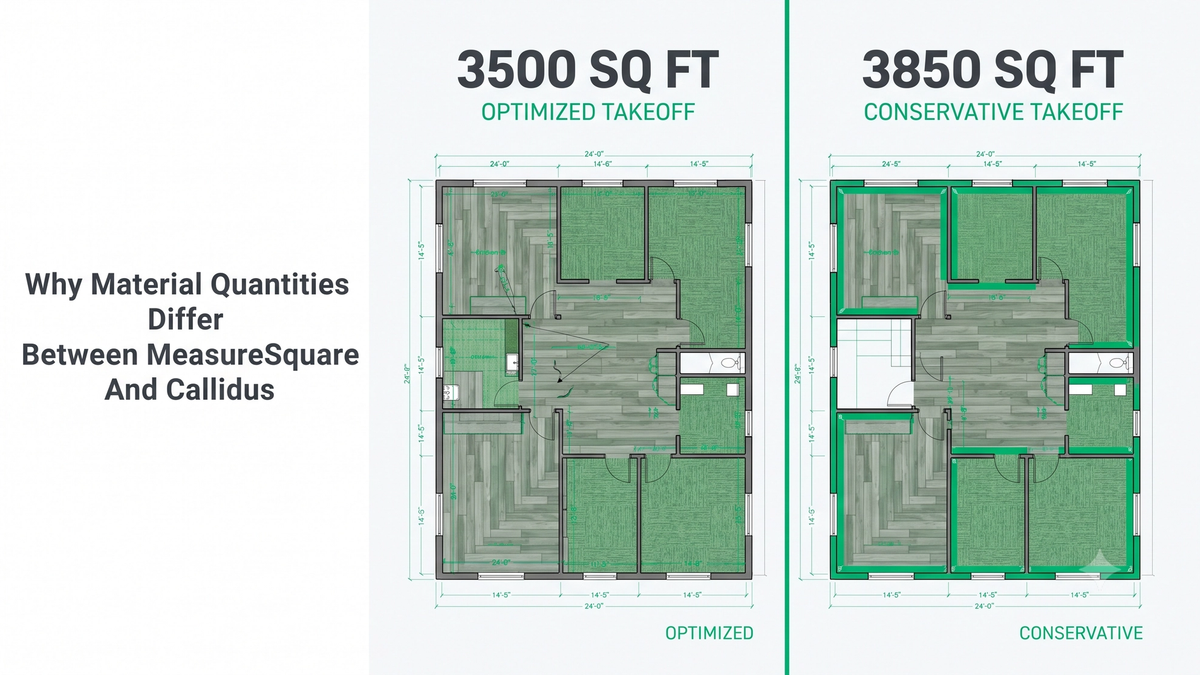
You run the same project through MeasureSquare and Callidus. MeasureSquare comes back at 12,500 SF. Callidus comes back at 13,400 SF. Same drawings, same product, two different answers. The question every flooring contractor asks next is the same: which one is correct, and if I order the lower number, am I going to run short on the job? It is a fair question because flooring material is expensive, and the wrong choice in either direction costs real money. Over-order and you tie up cash in inventory you may never use. Under-order and the install stops, rush freight kicks in, and a dye lot or shade variation walks onto the project. Neither outcome is acceptable.
The truth nobody tells you in the comparison: both platforms are excellent tools used by successful flooring contractors across North America. They produce different numbers because they were built around different estimating philosophies, not because one is wrong. MeasureSquare vs Callidus is a question of approach, not accuracy. Understanding why the two platforms calculate differently is what lets a flooring estimator decide which number to trust on a given project, and when to override either one with installation experience.
This guide breaks down how each platform thinks about waste, why the same project produces different totals, what the difference looks like across carpet tile, broadloom, sheet vinyl, and LVP, and how a disciplined estimator gets the right number out of either tool.
If you are staring at two quantities on the same job right now and the bid is due, upload your plans and get a fast takeoff quote.
MeasureSquare vs Callidus: What Actually Drives the Difference
MeasureSquare and Callidus are both commercial flooring estimating platforms that calculate material quantities from project drawings. MeasureSquare simulates the actual installation using room geometry, material size, installation direction, roll widths, and reusable offcuts to optimize material use. Callidus typically applies more conservative waste assumptions based on product category and traditional installation practices. Unicalibre Estimating is software-agnostic and works in both, plus RFMS, PlanSwift, Bluebeam, and Stack, with every takeoff peer-reviewed before delivery so the quantity is defensible no matter which platform produced it.
The first thing worth saying out loud: software does not install flooring. The platform calculates. The installer determines whether the calculated quantity is enough. A successful project depends on accurate measurements, correct waste assumptions, the installation method, the material type, the room layout, and installer experience. The estimator's judgment sits above the software output, not under it. That is true in MeasureSquare. It is true in Callidus. It is true in RFMS. It is true in any platform.
What changes between MeasureSquare and Callidus is how each one approaches that calculation, and that difference shows up in the totals on every bid you run through both.
Request a risk-free pilot takeoff on a project you are running through both platforms, and compare the numbers against a peer-reviewed third opinion.
How Each Platform Thinks About Waste
The philosophies behind the two tools came from different parts of the industry, and they show.
Callidus has been a trusted flooring estimating platform for decades and is widely used. Many contractors prefer Callidus because it is familiar, proven, and aligns with how flooring businesses have traditionally estimated projects. Callidus typically applies waste factors and estimating rules based on product category and installation practice, and the software is intentionally conservative. The reasoning is old-school and not wrong: shortages on the job are more expensive than excess on the truck, and ordering a little extra material is cheaper than mobilizing a second time. The philosophy in one line: it is better to have extra material than not enough. As a result, Callidus quantities frequently appear higher.
MeasureSquare takes a different approach. Rather than relying primarily on blanket waste percentages, MeasureSquare simulates how the flooring will actually be installed. The platform evaluates room geometry, material size, installation direction, seam locations, roll widths, reusable offcuts, and pattern layout, then calculates real material requirements based on the proposed install. The philosophy in one line: use material as efficiently as possible. As a result, MeasureSquare quantities often appear lower than Callidus.
Neither approach is wrong. They are answers to different questions. Callidus answers "what is the safest number to order?" MeasureSquare answers "what is the most efficient number to order if the install goes as planned?" The right answer for any given project is whichever one matches the realities of the room geometry, the material, the installer, and the field conditions.
What the Difference Looks Like on Real Projects
The gap between the two platforms widens or narrows depending on the material and the layout. Four examples make the pattern clear.
Carpet Tile in an Open Office
Picture a 20,000 SF office project with open workspaces, conference rooms, and hallways. Callidus may return 21,800 SF at roughly 9 percent waste. MeasureSquare may return 20,900 SF at roughly 4 percent waste. The reason is layout-driven: carpet tile is modular, offcuts from one area can often be reused elsewhere, and MeasureSquare's reuse logic captures that. Callidus is more likely to apply a conservative waste percentage across the whole package. On clean open-office plans, the MeasureSquare quantity is often enough, and many contractors report unopened cartons remaining after install.
Broadloom Carpet in a Hotel Corridor
Now picture an 8 foot by 180 foot hotel corridor with 12 foot wide broadloom carpet. Callidus may include additional waste allowances for seam planning and installation. MeasureSquare runs roll-width optimization and, because the corridor width fits inside the roll width, produces a meaningfully lower quantity. When seam planning and roll widths are configured correctly, MeasureSquare's number is often accurate. The caveat: if installers change seam locations in the field for sightline reasons, additional material may be required. That is exactly why installer communication during estimating matters as much as the software.
Sheet Vinyl in a Healthcare Build
A healthcare project with patient rooms, restrooms, flash cove base, and welded seams is the worst case for any flat waste percentage. Numerous small rooms, complex layouts, and significant cutting all push real waste up. Callidus is likely to return a higher quantity due to its conservative assumptions. MeasureSquare attempts to optimize sheet placement and minimize waste. In the field, MeasureSquare quantities can be sufficient when material direction is properly assigned, roll widths are accurate, rooms are measured correctly, and installation follows the intended layout. Many contractors still choose to order a safety buffer beyond MeasureSquare on healthcare work, and that is a defensible call.
LVP in a Multifamily Build
A 300 unit multifamily project with 6 inch by 48 inch LVP and repeated floor plans is where MeasureSquare's optimization pays off most. Callidus may apply a standard waste factor to every unit. MeasureSquare can optimize plank layouts across repeated units and account for reusable cuts. Repetition rewards optimization, and on multifamily work MeasureSquare frequently produces lower quantities that match field reality.
Common Mistakes When Comparing the Two Platforms
Most of the friction between MeasureSquare and Callidus comes down to the same handful of habits:
- Blindly trusting the lower number to win the bid
- Blindly ordering the higher number to feel safe
- Not verifying material direction or roll width before running either platform
- Ignoring reusable offcuts on tile and plank work
- Skipping pattern repeat or seam planning on broadloom
- Treating a multifamily layout the same as a single-unit layout
- Trusting the screen over installer feedback
Pro tip checklist when the two platforms disagree:
- Did I verify room measurements against the drawings?
- Did I confirm material dimensions and roll widths against the manufacturer data sheet?
- Did I assign correct installation direction in the platform?
- Did I evaluate pattern repeat and seam locations?
- Did I model reusable offcuts where the material allows them?
- Did I sanity-check the percentage delta against the project's geometry, not the bid pressure?
- Did I consult the field installer on tricky corridor or sightline calls?
How the Estimating Models Compare on Multi-Platform Work
DIY (owner estimating): Picking one platform and trusting whatever it shows. Works on simple jobs, fails on complex ones, and the over-order or shortage gets discovered in the field.
In-house estimator: Better when trained in both platforms, but most in-house hires specialize in one and lean on it for every project, which leaves the optimization or safety advantages of the other on the table.
Per-project outsourcing: Useful for overflow, but a rotating estimator may not consistently match the platform to the project type or carry your reuse standards forward.
Dedicated FTE estimator: The same estimator every time, fluent in both MeasureSquare and Callidus (plus RFMS, Bluebeam, PlanSwift, and Stack), peer-reviewed before delivery, learning how your crews actually install. Most reliable when bid volume mixes simple and complex work, typically at a 50 to 60 percent cost reduction versus a domestic in-house hire.
Request a risk-free pilot takeoff on a project where the two platforms disagree, and see what a peer-reviewed third opinion looks like.
What Changes in the Real World
The pattern repeats across project types, and the financial swing is consistent.
A flooring subcontractor in Texas was running MeasureSquare on a 200 unit multifamily build and ordering the quantity straight off the screen. Confirming installation direction and modeling reusable cuts across repeated units cut material overages by an estimated 5 to 10 percent across the package without risking a shortage.
A hospitality flooring contractor in Phoenix was defaulting to Callidus on every project for the safety buffer. On open-office tenant improvements, the conservative quantity was producing leftover cartons that piled up in storage. Splitting the takeoff approach (Callidus for healthcare and complex layouts, MeasureSquare for open office and corridor work) brought leftover inventory down meaningfully and protected an estimated 5 to 10 percent of margin per package.
A flooring firm in Ontario bidding a hotel corridor in 12 foot wide broadloom had MeasureSquare optimized for roll-width layout while the field installer wanted seams placed differently for sightlines. A pre-install conversation with the installer caught the change before the order went in and avoided a shortage that would have cost rush freight and a second mobilization.
Same lesson every time: the platform is a tool, the estimator is the answer. See how a dedicated estimator helps you bid more work without picking the wrong platform for the project.
What to Send and What You Get Back
A multi-platform takeoff does not require a perfect package. It needs the right inputs.
What you send: architectural plans, the finish schedule and finish legend, the carpet or flooring product spec and manufacturer data sheets if available, any addenda, the installation pattern called out in the spec, and your preferred brands or labor rates.
What you get back: a BOQ or Excel breakdown organized by area and material, marked-up plans showing seam locations, roll-width layout, or carton math as appropriate, scope notes flagging where Callidus and MeasureSquare assumptions would diverge, a material summary tied back to manufacturer data, and native software files in your platform (MeasureSquare, RFMS, Bluebeam, PlanSwift, Callidus, or Stack) so your team can import and adjust without re-entry.
Timeline: standard turnaround is typically 24 to 48 hours for most trade packages, with same-day rush available when the deadline is closing. Communication runs over email, phone, and your preferred PM tools, and addenda are tracked as they land.
Want the platform-comparison checklist your team can run when MeasureSquare and Callidus disagree? Download the checklist.
Frequently Asked Questions
Why do MeasureSquare and Callidus produce different material quantities for the same project?
MeasureSquare and Callidus produce different quantities because they were built around different estimating philosophies. MeasureSquare simulates the actual installation using room geometry, roll widths, installation direction, and reusable offcuts to optimize material use. Callidus typically applies more conservative waste factors by product category and traditional installation practice. Neither is wrong. The platforms answer different questions, and the right number depends on the project.
Which is more accurate for commercial flooring, MeasureSquare or Callidus?
Neither platform is universally more accurate. MeasureSquare often produces tighter quantities on open layouts, repeated multifamily units, and corridor work where roll-width optimization and reusable offcuts dominate. Callidus often produces safer quantities on complex healthcare layouts, irregular geometry, and projects where conservative buffers protect against field changes. The accuracy comes from matching the platform to the project, not from picking one platform for every job.
When should an estimator trust the lower MeasureSquare quantity?
An estimator can typically trust the lower MeasureSquare quantity when room measurements are verified, material direction is correctly assigned, roll widths match the manufacturer data sheet, installation will follow the proposed layout, and the project geometry rewards reusable offcuts. Open offices, multifamily LVP, and corridor broadloom where roll width fits the room are common cases where MeasureSquare quantities hold up in the field.
When should an estimator add a safety buffer beyond MeasureSquare?
A safety buffer beyond MeasureSquare makes sense on complex healthcare layouts with significant cutting, patterned carpet where seam alignment is critical, broadloom installs where installers may change seam locations in the field for sightlines, and projects where field damage during install is more likely. The right buffer is project-specific, not a flat percentage applied to every job.
Can an outsourced estimator work in both MeasureSquare and Callidus?
Yes. Unicalibre Estimating is software-agnostic and works natively in MeasureSquare, RFMS, Bluebeam, PlanSwift, Callidus, and Stack. Every takeoff is peer-reviewed before delivery, and the platform choice is matched to the project, the material, and the installation method rather than to estimator habit.
The Platform Is a Tool. The Estimator Is the Answer.
MeasureSquare and Callidus are not competitors trying to prove each other wrong. They are different tools built around different estimating philosophies. Callidus offers conservative quantities that protect against field surprises. MeasureSquare offers optimized quantities that protect against overspend. Neither one guarantees a successful project. What decides whether the material order is right is whether the estimator understood why the numbers differ and chose the one that matches the project's geometry, material, and install method.
The best flooring estimators do not ask which software to trust. They ask whether they understand why the quantities are different. That single shift in thinking is what separates a takeoff that holds its margin from one that quietly bleeds money on either end.
Book a call and send your plans for turnaround and pricing. Pick the right number for the project, and stop letting a single platform default decide your profit.