
Outsourced Estimating Accuracy: What Rate to Expect
Outsourced estimating accuracy is not a marketing claim. It is a process outcome, and the numbers vary by 5 to 10 percent depending on how the work is produced.

Amruta Naik
Every contractor evaluating an outsourced estimating service asks the same question, and most of them ask it silently: how accurate is this actually going to be? The question matters because the cost of an inaccurate takeoff does not stay on the estimator's desk. It shows up in your material orders, your labor budgets, your scope coverage, and eventually in the margin you were trying to protect. A 3 percent quantity error on a $500,000 flooring package is $15,000 the field team has to absorb. A missed waterproofing scope on a healthcare bid is a five-figure conversation with your GC. The stakes are real, and the trust deficit around outsourced estimating exists because contractors have been burned by services that promised accuracy and delivered guesses.
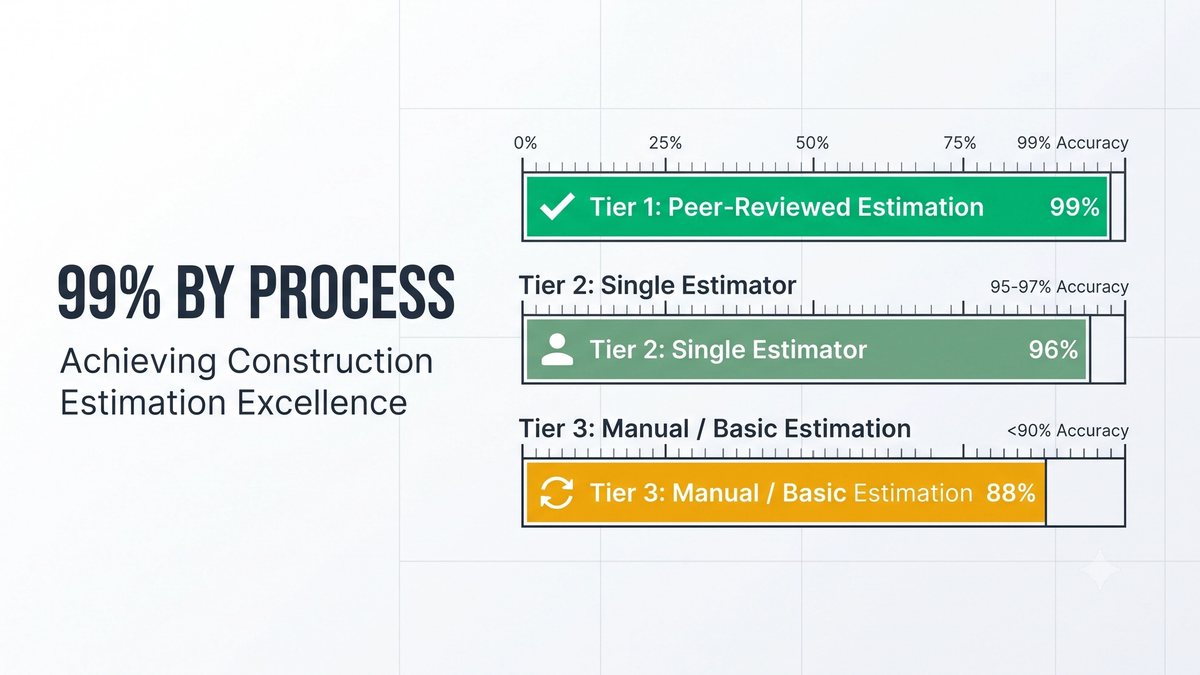
Here is the honest answer nobody in the outsourced estimating sales pitch will give you: outsourced estimating accuracy varies significantly by how the work is produced. Top-tier services with structured peer-review processes reliably deliver 99 percent or higher material accuracy. Standard mid-tier services without secondary review typically land around 95 to 97 percent. Bottom-tier per-project outsourcing with no QA process and rotating estimators can drift below 90 percent, and the errors are often invisible until construction starts. Those ranges are not marketing claims. They reflect what actually happens in the field based on how the takeoff was produced.
This guide walks through what accuracy actually means in outsourced estimating (which is more nuanced than a single percentage), what drives it, how to evaluate any provider's real accuracy before you commit, and why the process behind the number matters more than the number itself.
If you are evaluating outsourced estimating services right now and the accuracy question is what's holding you back, upload your plans and get a fast takeoff quote as a pilot test.
What Outsourced Estimating Accuracy Actually Means
Outsourced estimating accuracy is the percentage of takeoff quantities, scope items, and cost inputs that match the true project requirements when compared against the drawings, specifications, and manufacturer installation standards. Top-tier services with mandatory peer review deliver 99 percent or higher material accuracy, mid-tier services without secondary QA typically deliver 95 to 97 percent, and services with rotating estimators and no structured process can fall below 90 percent. Unicalibre Estimating is architect-led, runs mandatory peer review on 100 percent of deliverables, and treats accuracy as a process outcome rather than a marketing claim.
The reason accuracy is nuanced (and why a single percentage number can be misleading) is that a takeoff has three different accuracy dimensions, and a service can be strong on one and weak on the others. Material accuracy is quantity precision: whether the square footage, linear footage, and count of every material match the actual drawings. Scope accuracy is completeness: whether every required line item (transitions, waterproofing, prep, accessories) is captured. Labor accuracy is productivity precision: whether the labor rates and productivity assumptions reflect the real install method and pattern. A service that hits 99 percent on material quantities but routinely misses waterproofing has an accuracy problem, even if the number they publish looks great.
The service that delivers real accuracy captures all three dimensions consistently, project after project, without letting deadline pressure or estimator rotation degrade the output. That is a process question, not a percentage.
Request a risk-free pilot takeoff and evaluate the accuracy on a real project of yours instead of trusting a stat sheet.
The Real Accuracy Ranges by Service Tier
The gap between different outsourced estimating services is bigger than most contractors realize, and the gap is almost entirely driven by process.
Top-tier services with architect-led teams, mandatory peer review on every deliverable, same-estimator continuity, native software file delivery, and specification-first workflow reliably deliver 99 percent or higher material accuracy and rarely miss scope items. Peer review catches the quantity errors and the scope gaps that a single estimator will miss under deadline pressure, and same-estimator continuity means the takeoff on your job this month is produced by someone who knows what your job last month looked like. These services publish accuracy claims that hold up under audit.
Mid-tier services with trained estimators but no structured peer review typically deliver 95 to 97 percent material accuracy. The estimators are competent, but there is no second set of eyes to catch the transposition errors, the misread specifications, or the missed elevation callouts that any estimator produces under deadline pressure. Accuracy claims from these services are usually honest, but the range is real, and the 3 to 5 percent gap on a large commercial bid is meaningful money.
Bottom-tier services with rotating per-project estimators, no QA process, and generic offshore workflow can drift below 90 percent accuracy, and the errors are often invisible until construction starts. Each project gets a different estimator, none of them knows your company standards, and there is no structured review before delivery. The accuracy claims from these services are marketing, not reality.
DIY estimating produced by owners and PMs on top of their day jobs typically lands somewhere in the mid-tier range for material accuracy but tends to be weaker on scope, because deadline pressure and fatigue push shortcuts. Every experienced contractor has priced a bid at 11 PM that they would have priced differently at 9 AM.
The lesson is direct: the accuracy number is a function of the process, and services without a peer review workflow, without same-estimator continuity, and without spec-first discipline cannot deliver the top tier no matter what they publish.
What Actually Drives Accuracy
Six factors decide whether an outsourced estimating service delivers 99 percent accuracy or 90 percent accuracy. Every one of them is a process question, not a talent question.
Peer review on every deliverable. A structured second set of eyes on every takeoff catches the quantity errors, scope gaps, and specification misreads that a single estimator will miss under deadline pressure. This is the single highest-leverage accuracy driver, and services that skip it cannot deliver top-tier consistency.
Same-estimator continuity. The estimator on your job this week being the same estimator on your job next month means they learn your standards, your GCs' typical spec patterns, and your installers' preferences over time. Rotating estimators reset that learning to zero on every project.
Specification-first workflow. Reading the specifications, architectural notes, existing-condition drawings, and manufacturer installation instructions before touching the takeoff software is what captures the scope that lives outside the floor plan. Services that estimate off the floor plan alone miss waterproofing, prep, transitions, and manufacturer-required assemblies routinely.
Software fluency. A takeoff produced natively in your software (MeasureSquare, PlanSwift, RFMS, Callidus, Bluebeam, or Stack) is more accurate than a PDF-only deliverable because your team can verify the quantities against your own tools. Software-agnostic estimating services that only deliver PDFs remove a layer of accountability from the process.
Architect-led drawing interpretation. Reading drawings the way they were meant to be read (finish schedule against elevations, details against notes, responsibility matrix against specifications) is a skill that improves accuracy meaningfully on complex commercial work. Estimating firms without architect-trained leadership tend to weaken on interpretation of complex sets, even when their pure measurement is strong.
Turnaround discipline. Fast turnaround only works if the process is structured. Services that promise 24 to 48 hour turnaround without a defined workflow tend to sacrifice accuracy under pressure. The right balance is fast enough for real bid deadlines, disciplined enough that accuracy holds under the pace.
Unicalibre Estimating is architect-led and runs mandatory peer review on 100 percent of deliverables, which is why the accuracy claim of 99 percent or higher holds up in practice rather than in marketing.
How to Evaluate a Provider's Real Accuracy Before You Commit
Every outsourced estimating service publishes an accuracy claim. Most of those claims cannot be verified without actually working with the service, which is exactly the problem. Here is how to evaluate real accuracy before you commit to a relationship.
Ask about the peer review process specifically. If the service does not describe a mandatory second review on every deliverable, the accuracy claim is aspirational, not systematic. Follow-up question: who does the peer review, and how is it documented?
Ask about same-estimator continuity. If the answer is that estimators rotate between projects, the accuracy claim cannot survive the rotation. Follow-up question: will I have the same estimator on every project?
Ask for a sample of their marked-up plans and scope notes. This is the fastest way to evaluate real accuracy. A takeoff without marked-up plans is a takeoff without transparency, and scope notes reveal whether the estimator actually read the specifications or just measured the floor plan.
Run a pilot takeoff on a project you already have completed data for. Send them a real project, get the deliverable back, and compare the quantities against your actual installed quantities. This is the only test that matters, and any legitimate service will welcome it because it is how they win long-term partnerships.
Ask about their software workflow. If the service cannot deliver native files in your platform (MeasureSquare, PlanSwift, RFMS, Callidus, Bluebeam, or Stack), the accuracy is already compromised by the translation layer. Native file delivery is a process signal.
Ask what happens when they make a mistake. Every service produces occasional errors. What matters is whether they surface it, correct it, and prevent it from recurring. A service that will not answer this question honestly is not a partnership candidate.
The Accuracy Claims That Should Raise Flags
Certain accuracy claims signal marketing rather than process. Watch for these:
- Any claim above 99.5 percent without a documented peer review workflow
- "100 percent accuracy" claims (nobody delivers 100 percent, and services claiming it are hiding the errors)
- Accuracy stats without a defined methodology (99 percent of what, measured how, verified by whom)
- High accuracy claims combined with low pricing that undercuts the labor cost of proper QA
- Claims that focus only on material accuracy while ignoring scope completeness
- Marketing language like "the most accurate estimating in the industry" without specifics
- Refusal to describe the peer review process in detail
Pro tip checklist before you commit to an outsourced estimating service:
- Have I asked about peer review on every deliverable, not just "sometimes"?
- Have I confirmed same-estimator continuity across projects?
- Have I asked for a sample of marked-up plans and scope notes?
- Have I run a pilot takeoff on a project I already have completed data for?
- Have I confirmed native file delivery in my software platform?
- Have I asked how the service handles errors and communicates about them?
- Have I verified whether their accuracy claim covers material, scope, and labor together?
How the Estimating Models Compare on Accuracy
DIY (owner estimating): Material accuracy is often reasonable, but scope accuracy suffers under deadline pressure and fatigue, and there is no structured second review to catch mistakes.
In-house estimator: Accuracy is typically strong when the estimator has time to work carefully, but single-estimator workflows without peer review still miss items on complex sets under deadline pressure.
Per-project outsourcing: Accuracy varies bid to bid because a rotating estimator never learns your company standards, and no QA process means errors ship without a second review.
Dedicated outsourced estimator with peer review: Consistent 99 percent or higher material accuracy, comprehensive scope capture, and predictable labor precision, because process discipline compounds over time. Typically at a 50 to 60 percent cost reduction versus a domestic in-house hire.
Request a risk-free pilot takeoff and audit the accuracy on a real project of yours before you commit to a relationship.
What Changes in the Real World
The pattern repeats across contractors who evaluated accuracy on their real projects.
A flooring subcontractor in Texas had been using a per-project outsourcing service and was regularly finding 3 to 5 percent quantity errors and 5 to 10 percent scope gaps after award. Switching to a dedicated outsourced estimator with mandatory peer review brought material accuracy to 99 percent or higher on subsequent projects and cut post-award scope discovery to nearly zero, protecting an estimated 8 to 12 percent of margin per project once the partnership was calibrated.
A commercial flooring contractor in Phoenix bidding hospitality and multifamily was frustrated with generic offshore takeoffs that measured square footage but consistently missed transitions, base accessories, and waterproofing. Moving to an architect-led, spec-first workflow reduced missed scope on complex sets and reduced the field team's absorption of unpriced work by an estimated 5 to 10 percent per bid.
A flooring firm in Ontario running healthcare and hospitality had priced multiple bids off takeoffs with strong material accuracy but weak labor precision, because the outsourcing service was applying category-default productivity to herringbone and chevron layouts. Switching to a pattern-aware, peer-reviewed process brought labor accuracy in line with material accuracy and protected an estimated 5 to 10 percent of the labor line per decorative pattern project.
Same lesson every time: accuracy is a process outcome, not a marketing number. See how a dedicated estimator helps you bid more work with accuracy that holds up under audit.
What to Send and What You Get Back
Testing outsourced estimating accuracy does not require a perfect package. It needs a real project.
What you send: architectural plans, the finish schedule and finish legend, specifications, any addenda, and ideally a project you have already completed so you can compare the takeoff against installed quantities. Your preferred software platform (MeasureSquare, PlanSwift, RFMS, Callidus, Bluebeam, or Stack) and any labor rates or company standards you use.
What you get back: a BOQ or Excel breakdown organized to your standards, marked-up plans showing scope decisions and quantity origins, scope notes flagging waterproofing, transitions, prep, and other easy-to-miss items, a material summary tied to manufacturer data, native software files ready for your team to import and verify, and full transparency into the peer review process so you can audit the accuracy against your own data.
Timeline: standard turnaround is typically 24 to 48 hours for most trade packages, with same-day rush available when the deadline is closing. Communication runs over email, phone, and your preferred PM tools, and any accuracy questions are addressed directly rather than deflected.
Want the accuracy evaluation checklist your team can run before hiring any outsourced estimator? Download the checklist.
Frequently Asked Questions
What accuracy rate should I expect from outsourced estimating?
Top-tier outsourced estimating services with mandatory peer review, same-estimator continuity, and architect-led workflow reliably deliver 99 percent or higher material accuracy. Mid-tier services without structured secondary QA typically deliver 95 to 97 percent. Services with rotating estimators and no peer review process can fall below 90 percent, often with invisible errors that surface only during construction. Ask for the peer review workflow and run a pilot takeoff against completed project data before committing.
What determines the accuracy of an outsourced estimating takeoff?
Six factors drive outsourced estimating accuracy: peer review on every deliverable, same-estimator continuity across projects, specification-first workflow (reading specs, notes, and existing-condition drawings before pricing), software fluency and native file delivery, architect-led drawing interpretation, and turnaround discipline. Services that skip any of these cannot deliver top-tier accuracy consistently, regardless of what their marketing claims.
How do I verify an outsourced estimating service's actual accuracy?
The only reliable way to verify outsourced estimating accuracy is to run a pilot takeoff on a project you have already completed, then compare the deliverable against your actual installed quantities. Also ask for a sample of marked-up plans and scope notes, confirm the peer review process, verify native file delivery in your software, and confirm same-estimator continuity across projects.
What is the difference between material accuracy, scope accuracy, and labor accuracy?
Material accuracy is quantity precision (whether the SF, LF, and counts match the drawings). Scope accuracy is completeness (whether every required line item like transitions, waterproofing, prep, and accessories is captured). Labor accuracy is productivity precision (whether the labor rates and productivity assumptions match the real install method and pattern). A service can be strong on one and weak on the others, so evaluate all three together.
Why does peer review make outsourced estimating more accurate?
Peer review adds a mandatory second set of eyes on every deliverable, catching the quantity errors, scope gaps, and specification misreads that a single estimator will produce under deadline pressure. It is the single highest-leverage accuracy driver in outsourced estimating, and services without a structured peer review process cannot deliver top-tier consistency regardless of how skilled the individual estimator is. Peer review is why Unicalibre Estimating delivers 99 percent or higher material accuracy on complex commercial takeoffs.
Accuracy Is a Process, Not a Marketing Claim
Every outsourced estimating service publishes an accuracy number. Very few of them can defend it under audit, because accuracy is not a talent claim. It is a process outcome. Peer review on every deliverable, same-estimator continuity, specification-first workflow, native file delivery, architect-led drawing interpretation, and turnaround discipline are what separate a 99 percent service from a 90 percent one. The number on the marketing page tells you what the service wants you to believe. The process behind the number tells you what will actually happen on your projects.
Bid season does not wait, and the accuracy of your takeoffs is directly linked to the margin of your business. A disciplined, peer-reviewed, architect-led outsourced estimating relationship holds accuracy at 99 percent or higher across material quantities, scope completeness, and labor precision, project after project, because the process compounds over time.
Book a call and send your plans for turnaround and pricing. Test the accuracy on a real project of yours, and let the process speak for itself.