
Outsourced Flooring Estimator: Extension of Your Team
An outsourced flooring estimator is not cheap labor. It is a partnership that lowers per-bid cost, protects margin, and becomes an extension of your team.

Amruta Naik
If you run a flooring subcontractor business, you already know the math nobody talks about at industry conferences. Your team submits four bids to win one. Some months it is five to one. Every one of those unsuccessful bids still consumed real hours, real coffee, and real estimator time, and none of them generated a dollar of revenue. Your in-house estimator is expensive, and you cannot afford to run four of them just to keep up with bid volume. But cutting bid volume is not an option either, because in commercial flooring, the win rate is what it is, and lower volume means lower revenue.
That is the trap. Every serious flooring contractor gets caught in it eventually. And it is exactly the trap that an outsourced flooring estimator is built to solve. Not by being cheap labor. Not by replacing your team. By becoming the extension of your team that lets you bid more work, protect the win rate you have, and lower the per-bid cost until the math finally works in your favor.
Here is the honest version of what most contractors do not hear from the sales pitch. Hiring an outsourced flooring estimator well is a two-way effort. It requires an upfront investment in teaching, calibration, and building a shared understanding of your standards. It does not pay off in week one. What it does pay off, once the partnership is calibrated, is a compounding return: dramatically increased bid capacity, meaningfully lower cost per bid, and the ability to let your in-house estimator focus on the pricing decisions and the complete package instead of chasing every takeoff. Every project manager on your team has years of tricks learned in the field. Every experienced outsourced estimator brings learnings from dozens of other clients. Combine those two, and the takeoffs get sharper than either party could produce alone.
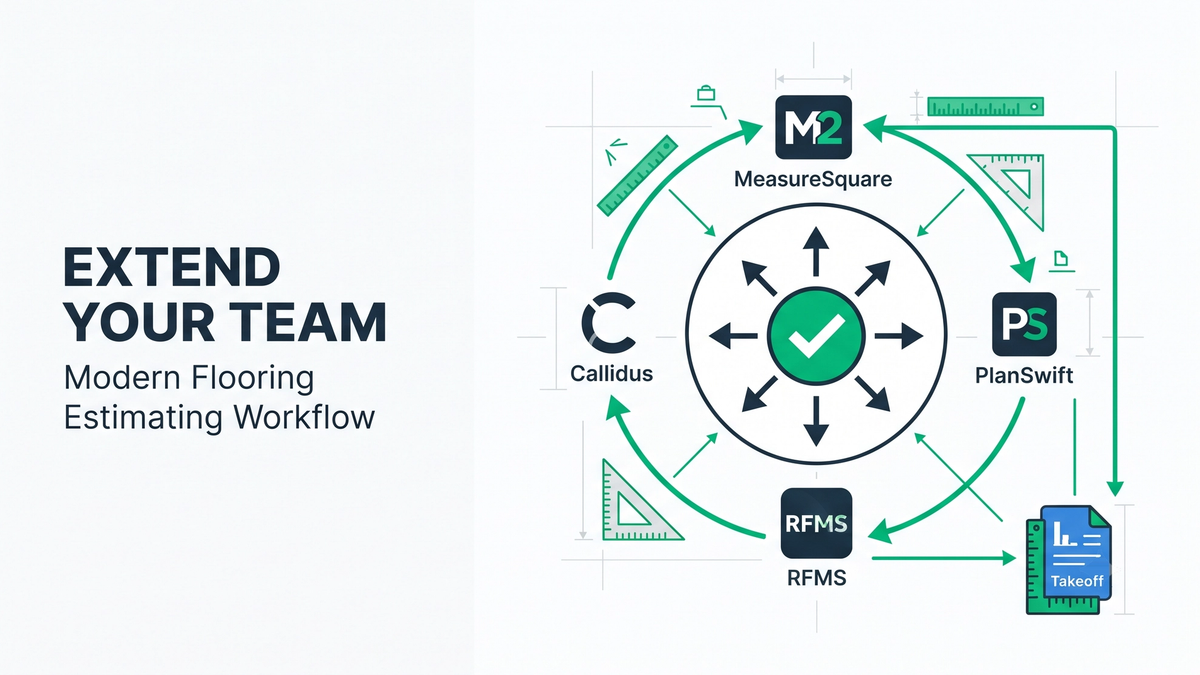
This is the guide to that partnership. What an outsourced flooring estimator actually does, how the software specialization works (MeasureSquare, PlanSwift, RFMS, Callidus), why the two-way relationship matters more than the price per takeoff, and how the per-bid cost math changes once the partnership matures.
If you are already at the point where the bid volume is outstripping your team's capacity, upload your plans and get a fast takeoff quote.
What an Outsourced Flooring Estimator Actually Is
An outsourced flooring estimator is a remote, dedicated professional who produces quantity takeoffs and estimating deliverables for flooring subcontractors and general contractors, working in the client's preferred software (MeasureSquare, PlanSwift, RFMS, Callidus, Bluebeam, or Stack), following the client's company standards, and integrating with the client's project managers as an extension of the in-house team. Unicalibre Estimating is architect-led, delivers peer-reviewed takeoffs, and treats the outsourced estimating relationship as a long-term partnership rather than a transactional per-project service. The result is a bid team that scales without adding headcount.
The distinction that matters here is the difference between "outsourced estimating" (the transactional per-project model that dominates the market) and "an outsourced estimator" (a dedicated person who learns your standards, becomes accountable to your workflow, and produces consistent output over time). Most contractors have tried the first model and been disappointed, because a rotating estimator on each project never learns anything about your business. The dedicated model is different. It requires more upfront investment in training and communication, and the payoff is a takeoff quality curve that improves month after month as the estimator internalizes what your GCs expect, what your installers prefer, and what your bids typically miss.
A complete deliverable reflects that discipline. Unicalibre Estimating provides peer-reviewed flooring quantity takeoffs delivered in native software formats including MeasureSquare, PlanSwift, RFMS, Callidus, Bluebeam, and Stack, with a BOQ organized by area and material, marked-up plans, scope notes flagging waterproofing and prep, a material summary tied to manufacturer data, addendum revisions handled as they land, and native files your team can import and adjust without re-entry.
Request a risk-free pilot takeoff on a real set and see the difference an accountable partnership produces.
The Per-Bid Math That Changes Everything
Talk to any flooring subcontractor who has run their own numbers, and the win rate story is remarkably consistent. Commercial flooring contractors typically win one out of every four to six bids they submit. That means every bid your team submits is only one-fourth to one-sixth of the way to a paying job. The cost of preparing that bid (in-house estimator hours, PM review time, software licensing, overhead) is real whether you win or lose. Lower the cost per bid, and the math changes fundamentally.
An outsourced flooring estimator lowers the per-bid cost in three ways. First, the estimator's fully-loaded cost is typically 50 to 60 percent below the fully-loaded cost of a domestic in-house hire (salary, benefits, PTO, software, training, overhead). Second, the estimator handles the takeoff production your in-house team was doing, freeing your in-house estimator to focus on pricing decisions, GC relationships, and closing the complete bid package (which is where they add the most value anyway). Third, the estimator increases your total bid capacity, so you can pursue projects your team would otherwise pass on, which is where meaningful upside on win rate typically hides.
The uncomfortable truth is that this math does not work in week one. It works after month three, when the estimator has calibrated to your company standards, and it works spectacularly after month six, once the partnership is fully humming. An outsourced flooring estimator requires upfront investment in teaching and development. The long-term return is exceptional precisely because the investment compounds.
Software Specialization: The Four Platforms That Matter
Flooring estimating happens in specific software. A generic outsourced estimator who "does takeoffs" is not the same as an outsourced estimator who runs your specific platform natively. The distinction matters because native file delivery is what lets your in-house team import, adjust pricing, and submit without re-entering data. Four platforms dominate commercial flooring, and each one has its own workflow, its own strengths, and its own learning curve.
MeasureSquare Outsourced Estimator
MeasureSquare is the market's leading commercial flooring takeoff and estimating platform, especially strong on carpet, sheet vinyl, tile, hardwood, and multifamily estimating with sophisticated layout algorithms and reusable-offcut logic. A MeasureSquare outsourced estimator runs takeoffs in native .xml files, handles the platform's Cut and Fit layout optimization, applies pattern-specific waste factors, plans seams against roll widths, and delivers your team a MeasureSquare project file ready to import. Your in-house estimator opens the file, adjusts pricing and labor rates, and submits. No re-entry, no double work.
The value of a MeasureSquare outsourced estimator compounds specifically on multifamily and hospitality work where the platform's layout optimization matters most. Unit-by-unit repetition rewards optimization, and an experienced MeasureSquare operator produces meaningfully tighter material orders than a generic takeoff can. If your team already runs MeasureSquare, adding an outsourced MeasureSquare estimator means your platform investment goes further, not that you switch tools.
PlanSwift Outsourced Estimator
PlanSwift dominates the general contractor and multi-trade estimating world and is widely used by flooring subcontractors who bid across mixed trade packages. A PlanSwift outsourced estimator handles digital takeoff from PDF plans, builds custom assemblies for flooring materials, applies pattern-specific waste, and delivers the finished takeoff back in native PlanSwift format. The platform's flexibility is both its strength and its risk: without disciplined workflow standards, PlanSwift takeoffs can vary widely in quality between estimators. A dedicated PlanSwift outsourced estimator who learns your assembly library and your naming conventions delivers consistent, importable takeoffs bid after bid.
For GC-facing flooring subs, a PlanSwift outsourced estimator is often the right choice because it aligns with what your GCs are already running for their overall estimating workflow. Native file compatibility down the chain makes the whole bid process smoother.
RFMS Outsourced Estimator
RFMS Measure is the go-to platform for flooring dealers and multi-line commercial flooring contractors who need estimating, ordering, and business management in one integrated environment. An RFMS outsourced estimator runs takeoffs in RFMS Measure, delivers native RFMS files, and understands the product catalog and pricing structure your team already has configured. The RFMS advantage is data continuity: your takeoff, your order, and your job tracking all live in the same environment.
The RFMS learning curve is real, which is why a dedicated RFMS outsourced estimator matters more than a per-project rotator. The estimator has to learn your product mix, your labor codes, and your workflow before the output is genuinely useful. Once calibrated, an RFMS outsourced estimator produces takeoffs that flow directly into your ordering and job costing without translation work.
Callidus Outsourced Estimator
Callidus has been the trusted flooring estimating platform for decades and remains the choice of many established flooring contractors who value its conservative estimating philosophy and its deep flooring-industry heritage. A Callidus outsourced estimator understands the platform's approach to waste factors, its product classification, and its integration with historical company standards. The platform is intentionally conservative on quantities, which many contractors prefer because material shortages are more expensive than modest over-orders.
For contractors running Callidus, having an outsourced Callidus estimator means your bid capacity scales without either replatforming (which is expensive and disruptive) or hiring in-house on a platform that fewer estimators specialize in. The right Callidus outsourced estimator brings both platform depth and the flexibility to work alongside MeasureSquare, PlanSwift, or RFMS on projects that require mixed-platform coordination.
The Two-Way Partnership That Actually Delivers
Here is what almost nobody in the outsourced estimating market says out loud: the partnership only works if both sides invest in it. This is where the transactional per-project model fails and the dedicated model succeeds. An outsourced flooring estimator does not walk into your business knowing what your PMs expect, which finishes your GCs typically specify, or how your installers prefer seams placed. Those things live in the heads of the people who work with you every day, and they have to be transferred deliberately, patiently, over time.
Every experienced PM on your team has tricks learned across a career. How to read a specification that skips over waterproofing. Which manufacturers under-classify their products. Where scope gaps typically hide between the finish schedule and the elevations. What your specific installers charge for what specific work. That knowledge is your competitive edge, and an outsourced flooring estimator only becomes valuable when they absorb it. On the other side, an experienced outsourced flooring estimator brings their own cross-client learnings: patterns they have seen across dozens of contractors, mistakes they have watched other clients make, tricks that saved margin on projects your team has never seen. Combine both sides of that knowledge exchange, and the takeoff quality goes places neither party could reach alone.
That is what "extension of your team" actually means. Not cheap remote labor. A calibrated partnership that gets sharper every month.
The Trust Objection (And How to Answer It)
Every flooring contractor considering outsourced estimating has the same objection, whether they say it out loud or not: what if the estimator misses something and I absorb the cost after award? The concern is legitimate. It is why the industry has a trust deficit around offshore estimating. And it is why the way an outsourced estimator delivers matters as much as what they deliver.
The answer to the trust objection is not "we are careful." It is process. Peer review on every deliverable, so no single estimator ships work without a second set of eyes. Same-estimator continuity, so the person on your project this week is the same person on your project next month. Native file delivery, so your team can verify quantities against your own tools. Marked-up plans, so scope decisions are visible and challengeable. Scope notes, so hidden requirements get surfaced during bid, not after award. Fast turnaround with addendum handling, so revisions land where they belong. This is what a mature outsourced flooring estimator relationship looks like, and it is what separates a partnership from a per-project outsource.
Common Concerns Contractors Raise (And Honest Answers)
Most objections to hiring an outsourced flooring estimator trace back to the same handful of worries:
- What if they miss scope? Peer review and marked-up plans surface scope decisions before they become field costs.
- What if they do not know my software? A dedicated software-specific outsourced estimator (MeasureSquare, PlanSwift, RFMS, or Callidus) delivers native files, not PDFs.
- What if the quality varies? Same-estimator continuity prevents the rotating-estimator quality problem.
- What if the turnaround is too slow? Standard turnaround is typically 24 to 48 hours for most trade packages, with same-day rush available.
- What if I lose control of my bid process? You retain pricing, labor rates, and final review. The takeoff is delivered in your platform, ready for your team's decisions.
- What if my in-house estimator resents it? In practice, the in-house estimator gets promoted from takeoff production to bid strategy, which is what most estimators actually want to be doing.
- What if it does not work? A pilot takeoff is risk-free. Send one project, evaluate the deliverable, decide from there.
Pro tip checklist before you commit to an outsourced flooring estimator:
- Have I confirmed they work in my software natively?
- Have I asked about their peer review process?
- Have I requested a sample of their marked-up plans and scope notes?
- Have I confirmed same-estimator continuity?
- Have I run a pilot takeoff before scaling?
- Have I aligned on communication cadence and turnaround?
- Have I defined my company standards and delivery expectations in writing?
- Have I budgeted for the upfront training and calibration period?
How the Estimating Models Actually Compare
DIY (owner estimating): Zero direct cost, but the owner's hours are the highest-value hours in the business, and burning them on takeoffs is one of the most expensive mistakes small subs make.
In-house estimator: Consistent output, but the fully-loaded cost is $85,000 to $125,000 per year and one person caps at a fixed bid capacity, which becomes the ceiling on your growth.
Per-project outsourcing: Cheap per takeoff, but a rotating estimator never learns your company standards, so quality varies bid to bid and scope gets missed.
Dedicated outsourced flooring estimator: The same estimator every time, working an architect-led process, peer-reviewed before delivery, learning your standards month over month. Typically a 50 to 60 percent cost reduction versus a domestic in-house hire, and bid capacity scales linearly with the partnership, not with hiring.
Request a risk-free pilot takeoff and see the difference a calibrated partnership produces on your real project types.
What Changes in the Real World
The pattern repeats across flooring subcontractors of different sizes.
A flooring subcontractor in Texas was capping at 12 bids per month with a single in-house estimator, and the win rate math was locking in revenue growth. Adding a dedicated outsourced flooring estimator running MeasureSquare took bid capacity to 25 per month within three months, freed the in-house estimator to focus on pricing and GC relationships, and lifted booked revenue by an estimated 20 to 30 percent across the following two quarters. The upfront calibration period took six weeks.
A commercial flooring contractor in Phoenix bidding hospitality and healthcare had been burning through per-project outsourcing services and never getting consistent quality. Switching to a dedicated Callidus outsourced estimator with same-person continuity brought takeoff consistency up, reduced post-award scope gaps meaningfully, and protected an estimated 5 to 10 percent of margin per project once the partnership was calibrated.
A flooring firm in Ontario running a mixed MeasureSquare and PlanSwift environment had struggled to find an in-house estimator fluent in both platforms. A dedicated outsourced estimator with native fluency in both delivered platform-appropriate takeoffs across the mixed project mix, and the firm scaled bid volume by an estimated 40 to 60 percent over eight months without adding headcount.
Same lesson every time: dedicated partnership beats transactional outsourcing. See how a dedicated estimator helps you bid more work without adding headcount.
What to Send and What You Get Back
Onboarding a dedicated outsourced flooring estimator does not require a perfect start. It requires the right inputs and a willingness to invest in calibration.
What you send: architectural plans, the finish schedule and finish legend, specifications, any addenda, your preferred estimating platform (MeasureSquare, PlanSwift, RFMS, Callidus, Bluebeam, or Stack), your company standards documentation if available, your labor rates and product catalog, and any prior takeoff samples that reflect your delivery expectations.
What you get back: a BOQ or Excel breakdown organized to your standards, marked-up plans showing scope decisions, scope notes flagging waterproofing, transitions, prep, and other easy-to-miss items, a material summary tied to manufacturer data, native software files ready for your team to import and adjust, and addendum revisions handled as they land.
Timeline: standard turnaround is typically 24 to 48 hours for most trade packages, with same-day rush available when a deadline is bearing down. Communication runs over email, phone, and your preferred PM tools, and the calibration period during the first six to eight weeks is the highest-leverage investment you will make in the relationship.
Want the onboarding checklist your team can run when starting with an outsourced flooring estimator? Download the checklist.
Frequently Asked Questions
What is an outsourced flooring estimator?
An outsourced flooring estimator is a remote, dedicated professional who produces quantity takeoffs and estimating deliverables for flooring subcontractors and general contractors, working in the client's preferred software (MeasureSquare, PlanSwift, RFMS, Callidus, Bluebeam, or Stack), following the client's company standards, and integrating with the in-house team as a long-term partner rather than a per-project vendor.
How much does an outsourced flooring estimator cost compared to an in-house hire?
A dedicated outsourced flooring estimator typically represents a 50 to 60 percent cost reduction versus the fully-loaded cost of a domestic in-house hire, which includes salary, benefits, PTO, software licensing, training, and overhead. The bigger savings come from lower per-bid cost as bid capacity increases, which changes the win rate math on the whole business.
Can an outsourced flooring estimator work in MeasureSquare, PlanSwift, RFMS, or Callidus?
Yes. A software-specific outsourced flooring estimator delivers native files in the client's preferred platform, whether that is MeasureSquare, PlanSwift, RFMS, Callidus, Bluebeam, or Stack. Native file delivery means the in-house team can import the takeoff directly, adjust pricing and labor rates, and submit without re-entering data. Software-specific specialization matters because each platform has its own workflow and learning curve.
How long before an outsourced flooring estimator pays off?
An outsourced flooring estimator requires upfront investment in teaching and development, and the return compounds over time. Most contractors see meaningful bid capacity gains within three months, and the per-bid cost math typically shifts significantly after six months once the partnership is fully calibrated. The relationship is a long-term investment, not a week-one cost cut.
What is the difference between an outsourced flooring estimator and a per-project outsourcing service?
A per-project outsourcing service typically rotates estimators from job to job, so no single person learns your company standards, and quality varies bid to bid. A dedicated outsourced flooring estimator is the same person every project, learning your GCs' typical specs, your installers' preferences, and your company standards over time. Peer review and same-estimator continuity separate a partnership from a transactional service.
The Partnership Is the Product
An outsourced flooring estimator is not cheap labor and it is not a shortcut. It is a partnership that solves the per-bid math no in-house team can solve on its own, lets your existing estimators focus on the pricing decisions and complete bid packages where they add the most value, and scales your bid capacity without adding headcount. The upfront investment in teaching, calibration, and shared standards is real, and the long-term return, once the partnership is humming, is exceptional. Cost savings combined with increased capacity, month after month, is what changes the trajectory of a flooring subcontractor business.
Bid season does not wait, and the flooring subs who scale first are the ones who solve the estimating bottleneck first. A disciplined, peer-reviewed, software-native, architect-led outsourced flooring estimator relationship is what lets your business bid more, protect margin, and let your in-house team do the work only they can do. That is the difference between capping at your current bid volume and compounding revenue year over year.
Book a call and send your plans for turnaround and pricing. Start the partnership, invest in the calibration, and let the per-bid math work in your favor.