
Sheet Vinyl Weld Rod Estimating: Why 500 LF Is Not Enough
Sheet vinyl weld rod estimating fails when it is one generic total. Break weld rod out by product, color, and spec so purchasing and the crew can use it.

Amruta Naik
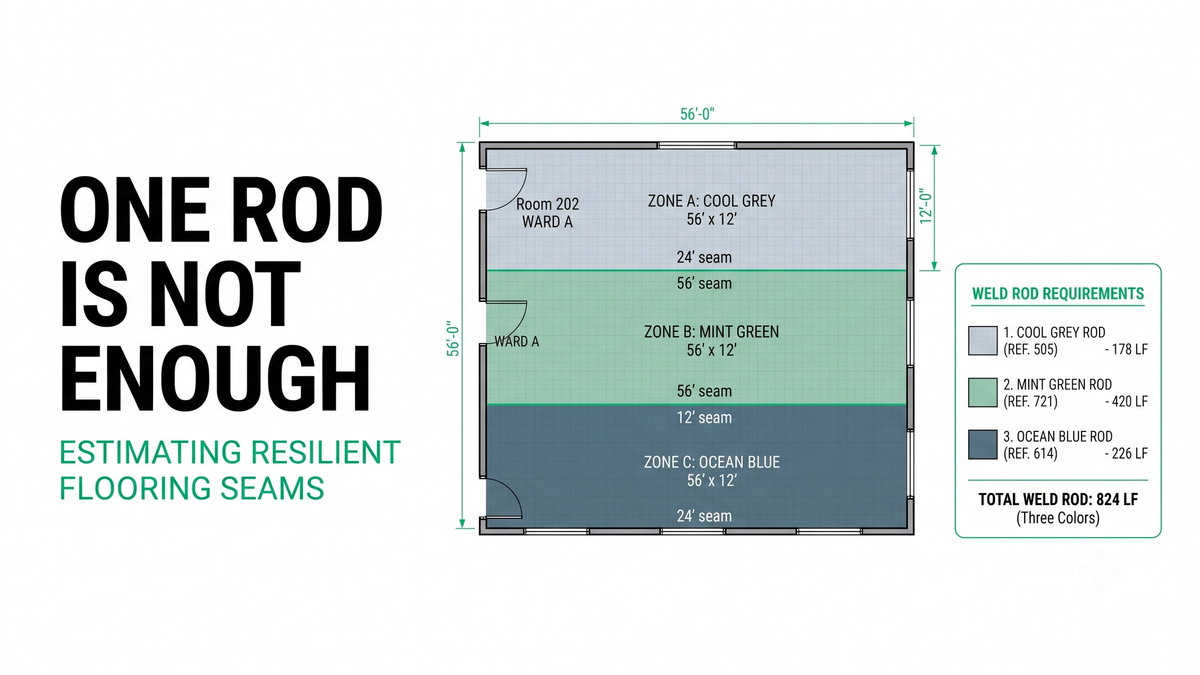
The Takeoff Said 500 LF. The Installer Needed Three Colors.
The flooring takeoff said 500 linear feet of weld rod. The installer needed three different colors. That gap is where sheet vinyl weld rod estimating quietly costs a flooring sub money after award. The seam math was right. The purchasing information was wrong. And nobody catches it until the installer is standing in a healthcare corridor holding a spool that does not match the patient-room vinyl.
This is the trap with resilient accessories. A total linear footage of seams can be perfectly accurate and still fail the two teams that depend on the takeoff. Purchasing cannot order spools from a generic number, and the install crew cannot match rod to product from a single line. The bid summary looks finished. The field does not.
The costs of that gap are not small, and they all land after you have already won the job:
- Rush orders on the missing color, at a premium, on a schedule you do not control
- Install delays while the crew waits for rod that should have been on site
- Mismatched seams the GC notices before you do, on a job where appearance is part of the spec
- Rework and callbacks on healthcare and commercial resilient floors where welding quality is inspected
- Margin quietly leaking between award and closeout because the accessory scope was thin
None of this is a measurement failure. The seam length was correct. The failure is treating weld rod as one number instead of a set of purchasing and installation instructions. This guide breaks down how to take off weld rod the way purchasing orders it and the crew installs it, why color-matched versus contrast welding is the detail that catches good estimators, and how the same discipline protects every other accessory line on a resilient job.
If you are pricing a multi-color sheet vinyl job right now and the accessory scope is thin, upload your plans and get a fast takeoff quote.
What Sheet Vinyl Weld Rod Estimating Actually Means
Sheet vinyl weld rod estimating is the takeoff of heat weld rod that seals seams in welded resilient flooring, quantified in linear feet. A complete weld rod takeoff breaks the total down by product, color, and welding specification, so it is ready for purchasing and installation. Unicalibre Estimating quantifies weld rod by product and color, tied to the finish schedule.
That last part is the whole point. Seam length is where a weld rod takeoff starts, not where it ends. A disciplined weld rod takeoff answers a full set of questions before the line goes on the bid: which weld rod is required, which sheet vinyl product it matches, which color, how many linear feet for that color, whether a minimum order quantity or spool length applies, and whether the spec calls for contrast welding instead of color-matched. That is the difference between a number and a usable material requirement.
A complete deliverable does more than list a total. It ties each rod line back to the finish schedule and the welding specification, flags any contrast-welding call before it becomes a field surprise, and hands purchasing a breakdown they can order from directly. The same logic runs through the rest of the resilient accessory scope, which is exactly where margin tends to leak.
Unicalibre Estimating is an architect-led firm that reads the drawings and the specs the way the crew will install the floor, so the smallest accessory line matches the real product on site. Our flooring estimating services break weld rod, transitions, adhesives, cove base, and nosings out the way your purchasing and install teams actually use them, then run the whole package through a peer review before delivery. If you want that breakdown on a live bid, request a risk-free pilot takeoff on a multi-color sheet vinyl job.
Why One Generic Weld Rod Total Breaks Downstream
When you estimate sheet vinyl, calculating total seam length and adding a single line is fast and tempting. Weld rod, 500 LF, done. But weld rod is not always interchangeable. Heat weld rod is manufactured to match specific sheet vinyl products and colors, so a job with more than one vinyl needs more than one rod, and the trade authorities that govern resilient installation, like the Resilient Floor Covering Institute, treat welded seams as a spec-driven system rather than a generic line.
The multi-color reality
Take a common healthcare layout: blue sheet vinyl in patient rooms, gray in corridors, beige in waiting areas. The total seam length may still be 500 LF. The real material requirement looks nothing like a single line. It might be 180 LF of blue rod, 220 LF of gray, and 100 LF of beige. Same total, completely different purchase order. A generic 500 LF line does not tell purchasing which spools to buy, and it does not tell the crew which rod goes in which room. That ambiguity is what turns into a delay, a rush order, or a mismatched seam.
Color-matched versus contrast welding: read the spec
There is a second layer a fast takeoff skips. The finish schedule lists the flooring colors, but the weld rod requirement is not automatic from there. Before assuming the rod, verify four things together: manufacturer, product line, color, and installation specification. Contrast welding is the trap. A spec may deliberately call for a contrasting rod color as a design or wayfinding choice, common in corridors and commercial spaces. If you assume color-matched rod and the spec wanted contrast, your takeoff is wrong even though your linear footage is right. Read the welding note, not just the finish color.
The accessory trap is bigger than weld rod
Weld rod is the clearest example of a broader estimating discipline: never quantify accessories as one generic total when the installation requires them by product, color, or condition. The same principle runs across the whole flooring accessory takeoff. Transitions vary by the two floor types they join and the height difference, not one count. Adhesives are manufacturer and substrate specific, often different for each product. Cove base corners and cap strips are separate from the base linear feet. Stair nosings vary by profile, material, and tread condition. Grout is by color and by tile. Edge profiles are by material, height, and finish.
The mistakes that turn a clean bid into a field problem
- Estimating weld rod as one generic linear-foot total across all colors.
- Assuming color-matched rod when the spec calls for contrast welding.
- Pulling rod color from the finish schedule without reading the welding note.
- Ignoring spool length and minimum order quantities.
- Lumping transitions, adhesives, cove base corners, and nosings as single totals.
- Not tying each rod line back to the manufacturer and product line.
- Delivering a bid summary purchasing and the crew cannot order or install from.
The discipline that protects the schedule and the seam
- Break weld rod out by product and color, every time.
- Verify manufacturer, product line, color, and welding spec together.
- Read the welding note, not just the finish color, to catch contrast calls.
- Account for spool length and minimum order quantities before the line goes on the bid.
- Tie every accessory line back to the finish schedule so purchasing and the crew can use it.
Who is best positioned to get accessories right
DIY (owner estimating after hours). Fast, but a single tired pass is exactly when weld rod gets lumped and contrast calls get missed. Least reliable on accessory scope.
In-house estimator. Strong with a resilient-literate estimator on staff, but a fully loaded domestic hire is a heavy fixed cost, and cost estimator market data shows why most subs cannot justify one for accessory-level detail alone.
Per-project outsourced takeoff. Adds disciplined accessory breakout and QA on the resilient jobs that matter, turned on when you need it.
Dedicated remote estimator (FTE model). The same estimator applying product-level accessory discipline on every bid, typically a 50 to 60 percent cost reduction versus a fully loaded in-house hire.
What Product-Level Accessory Takeoffs Change
The payoff shows up in the field, not on the bid summary. A few anonymized patterns.
A healthcare flooring subcontractor running multi-color sheet vinyl was lumping weld rod into one total and repeatedly hitting rush orders on the color the crew ran short on. After moving to product-level weld rod breakouts tied to the finish schedule, rush orders and mismatched-seam callbacks fell sharply, protecting an estimated 5 to 15 percent of margin that late accessory buys had been eating.
A commercial resilient sub kept getting caught by contrast-welding calls buried in corridor specs, discovering them only when the GC flagged the seams. Once contrast welding was verified against the welding note on every bid, those field surprises largely disappeared and rework on inspected seams dropped.
A senior living flooring specialist bidding repetitive unit types found that accessory-level takeoffs, weld rod plus transitions and cove base corners, cut field surprises and reclaimed an estimated 10 to 15 hours a week the team had been spending chasing mismatched material after award. See how a dedicated estimator helps you bid more.
None of these are guarantees, and every resilient package differs. The pattern holds: when accessories are broken out the way the crew installs them, the schedule and the seam quality both hold, and the margin stops leaking through the smallest lines on the takeoff.
What You Send and What You Get Back
Accessory-level estimating only works when the handoff carries the specs, not just the drawings.
What you send. The drawing set, finish schedule, welding and installation specifications, addenda, and any preferred manufacturers or product lines. If a corridor or wayfinding scheme drives contrast welding, that lives in the notes, so send the full spec section.
What you get. Weld rod quantified by sheet vinyl product, color, and linear feet, each line tied back to the finish schedule, with contrast-welding calls flagged and spool or minimum-order considerations noted. Transitions, adhesives, cove base corners and caps, and nosings are broken out the same way, delivered in your native software (MeasureSquare, RFMS, Bluebeam, PlanSwift, or Callidus) with marked-up plans. Every package clears an independent peer review first, which is exactly where a generic 500 LF line gets caught and split into the colors the installer actually needs.
Timeline. Most trade packages turn in 24 to 48 hours, with same-day rush available near a deadline.
Communication. Email, phone, and your PM tools, with drawing discrepancies and welding-spec questions flagged as they surface.
Want the accessory checklist your team can run before every resilient bid? Download the checklist and apply it across every project type you bid.
Frequently Asked Questions
How do you estimate weld rod for sheet vinyl?
Calculate the total linear footage of seams from the installation layout, then break that total down by sheet vinyl product and color so each rod matches the vinyl it seals. Verify the welding specification, color-matched or contrast, against the finish schedule, and account for spool length and minimum order quantities before the line goes on the bid.
Is weld rod interchangeable between sheet vinyl colors?
No. Heat weld rod is manufactured to match specific sheet vinyl products and colors. A job with blue, gray, and beige vinyl generally needs three separate weld rods even when the total seam length is a single number. Estimating one generic weld rod total does not give purchasing or the install crew what they need to order and install correctly.
What is contrast welding in sheet vinyl seam welding?
Contrast welding uses a weld rod in a deliberately different color from the sheet vinyl, often for design or wayfinding in corridors and commercial spaces. It is specified in the installation notes, not implied by the finish color. If a takeoff assumes color-matched rod when the spec calls for contrast, the accessory scope is wrong even when the seam length is correct.
What flooring accessories get missed most in a takeoff?
The most commonly mis-estimated accessories in a flooring accessory takeoff are weld rod lumped as one total instead of by color, transitions, product-specific adhesives, cove base corners and caps, stair nosings, grout by color, and edge profiles. These get quantified as one generic number when the installation actually requires them broken out by product, color, or condition.
Can an outsourced estimator break out weld rod by product and color?
Yes. Unicalibre Estimating quantifies weld rod and other accessories by product, color, and specification, tied back to the finish schedule, and delivers native files in MeasureSquare, RFMS, Bluebeam, PlanSwift, or Callidus. Every takeoff is peer-reviewed before delivery, so generic accessory totals get caught and split before they reach purchasing.
Stop Estimating Accessories as One Generic Total
A weld rod line that reads 500 LF looks finished. On a multi-color sheet vinyl job, it is not. The seam length is only half the takeoff. The other half is telling purchasing and the install crew which rod, which product, which color, and how much of each. A takeoff is not just a number for your bid. It is a set of instructions for two other teams, and a generic total hands both of them a problem.
The estimators who break accessories out by product protect the schedule and the seam quality. The ones who lump them into a single total hand the problem to the field and hope the colors work out. On a healthcare or commercial resilient job where seams are inspected, hope is not a purchasing strategy. Industry coverage in outlets like Floor Covering Weekly keeps returning to the same theme: the details decide the job.
Bid season does not wait, and the sub whose accessory scope is right the first time is the one who protects margin between award and closeout. Book a call and send your plans for turnaround and pricing with Unicalibre Estimating, the architect-led, peer-reviewed flooring estimating partner that gets accessory scope broken out the way your crew installs it.