
Winning Every Bid? Your Flooring Bid Win Rate Is a Warning
A high flooring bid win rate can signal missing scope, not sales strength. See why winning too much erodes margin and how to price the actual job.

Amruta Naik
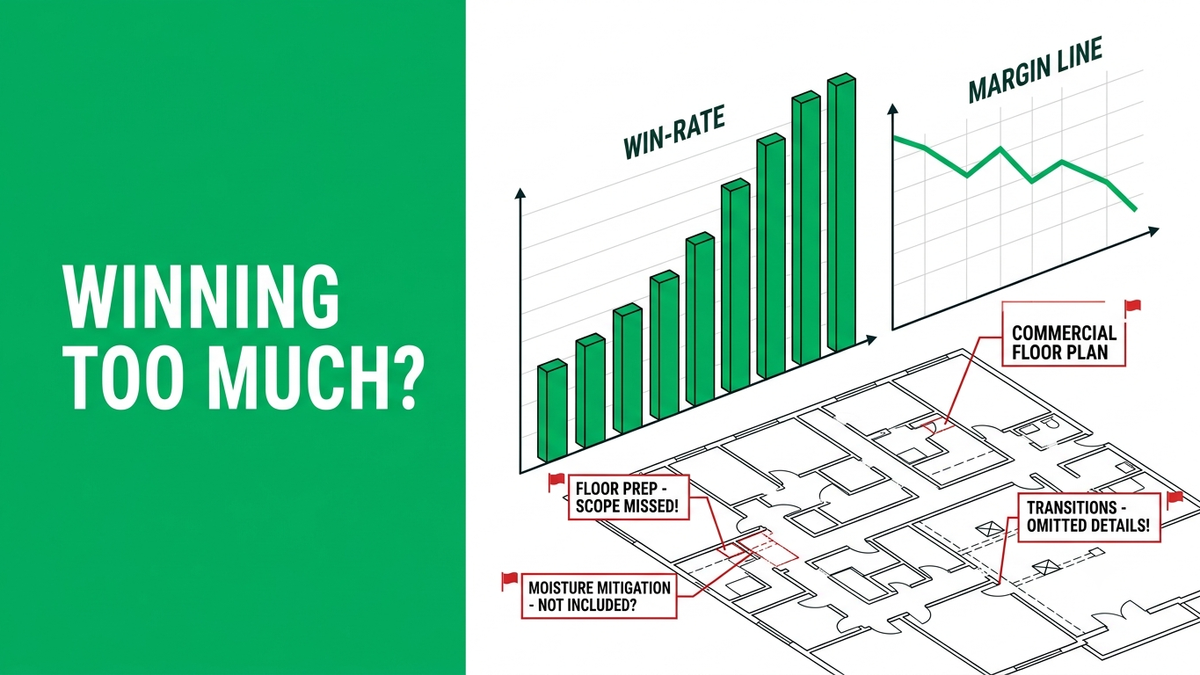
If You Win Almost Every Bid, Read This First
Here is an uncomfortable truth most flooring subs never hear: if you are winning almost everything you bid, you probably have a problem, not a hot streak. A high flooring bid win rate feels like sales momentum, market share, and a healthy pipeline. More often, it is a pricing problem wearing a trophy.
The math is boring and it always works the same way. If you are winning eight of every ten commercial flooring bids, you are almost certainly the cheapest number on the table, and there is usually a reason you are the cheapest number that has nothing to do with running a leaner shop. You are leaving something out of the takeoff.
A complete takeoff carries the full cost of the job: floor prep, moisture mitigation, transitions and weld rod, cove base and accessories, a layout-specific waste factor by product, and every note buried in Division 09. A bid built from that takeoff reflects what the work actually costs. An incomplete takeoff is missing two or three of those items. The bid built from it is a lower number, sometimes a much lower number. It wins. Then it quietly loses 5 to 15 percent of margin somewhere between award and closeout.
Nobody sits down and decides to skip moisture mitigation. The estimator did nothing wrong on purpose. They just did not see it in the drawings, which produces the exact same outcome as if they had. The bid was low, it won, and the margin evaporated after the contract was signed.
This is not a post telling you to lose more bids. It is a post asking you to look at your win rate honestly, because a 30 percent win rate on complete takeoffs beats a 70 percent win rate on incomplete ones every year, on every project type. This guide explains why scope goes missing, how it shows up in your win rate, and what to do about it before your next bid goes out.
What a High Flooring Bid Win Rate Is Really Telling You
A high flooring bid win rate is often a warning sign, not a strength. Winning most of your commercial bids usually means the takeoff is missing scope like floor prep, moisture mitigation, or transitions, so the number is too low. Unicalibre Estimating uses a mandatory second-estimator peer review to catch that missing scope before the bid goes out.
Think of your win rate as a diagnostic, not a scoreboard. If you win most of what you submit, you are consistently the low number, and the low number usually comes from an incomplete picture of the work. If you win fewer bids but the ones you win close at the margin you priced, you are pricing the actual job. That is the healthier position, even though it feels worse on the day the award list comes out.
The mechanism is simple. Missing scope lowers your number. A lower number wins more often. So a suspiciously high win rate and hidden margin erosion are the same symptom viewed from two angles. The wins feel great until closeout, when the floor prep you did not price, the moisture mitigation the spec required, or the transitions at every material change turn up as real costs you now absorb.
Unicalibre Estimating is an architect-led firm built around a simple idea: the fix for missing scope is a second set of eyes before the bid ships, not a painful discovery after award. Our flooring estimating services run every takeoff through a mandatory peer review specifically to catch the scope the first estimator was too close to see. That is not about adding cost. It is about protecting the margin you thought you already had.
If you want a second read on a live bid before it goes out, upload your plans and get a fast takeoff quote.
Why Good Estimators Miss Scope, and How to Stop
Missing scope is rarely carelessness. It is the predictable result of complex documents, deadline pressure, and a single person checking their own work.
Commercial flooring scope is scattered across the floor plan, the finish schedule, the specifications, the responsibility matrix, and Division 09 notes that nobody reads twice at 9 PM. The items that get missed are almost always the same ones, because they live in the least-obvious places.
The scope that quietly eats your margin
Floor prep, including grinding, patching, self-leveling, and adhesive removal, often assigned to you in the specs even when the drawings are silent. Moisture mitigation, a spec requirement that can carry serious cost and is easy to skip when it is buried in Division 09. Transitions and weld rod at every material change. Cove base and accessories by type and height. And a waste factor applied by layout rather than a flat percentage, because herringbone, diagonals, and directional goods generate far more waste than a blanket 10 percent assumes. Standards bodies like the National Wood Flooring Association exist partly because substrate and moisture requirements are technical enough to miss, and the National Tile Contractors Association documents the movement joints and transitions that turn into uncounted scope.
The mistakes behind a misleading win rate
- Reading a high win rate as sales strength instead of a pricing signal.
- Not tracking closeout margin against the margin you bid.
- Missing floor prep and moisture mitigation buried in Division 09.
- Applying a generic waste factor instead of a layout-specific one.
- Omitting transitions, weld rod, and cove base at material changes.
- Sending bids out with no independent check on scope.
- Chasing the volume of wins instead of the profitability of wins.
What to do better, starting this week
- Track win rate and closeout margin together. One number without the other hides the problem.
- Audit your last five won jobs. Compare what the bid assumed against what the job actually cost at closeout.
- Run a standardized scope checklist so nothing in Division 09 gets skipped under deadline.
- Peer-review every bid before it ships, by someone who did not build the takeoff.
- Treat a suspiciously high win rate as a prompt to re-check completeness, not a reason to celebrate.
Who is best positioned to catch the miss
DIY (owner estimating after hours). Cheapest and least reliable, because you review past your own assumptions when you are most tired, which is exactly when scope disappears.
In-house estimator. Strong with a second estimator on staff, but a fully loaded domestic hire is a heavy fixed cost, and cost estimator market data shows why most subs cannot staff two estimators just to peer-review each other.
Per-project outsourced takeoff. Adds a disciplined, independent takeoff and QA on the bids that matter, turned on when you need it.
Dedicated remote estimator (FTE model). The same estimator building complete, peer-reviewed takeoffs on every bid, typically a 50 to 60 percent cost reduction versus a fully loaded in-house hire.
Want a complete takeoff you can trust the win rate on? Request a risk-free pilot takeoff and compare it against your own.
What Complete Takeoffs Do to the Numbers
The change shows up not in how many bids you win, but in how the ones you win close. A few anonymized patterns.
A commercial flooring subcontractor was winning roughly 70 percent of its bids and could not understand why the year was not more profitable. A closeout review showed floor prep and moisture mitigation missing from a chunk of the won work. After adding complete, peer-reviewed takeoffs, the win rate settled into a lower, healthier range while closeout margin recovered by an estimated 5 to 15 percent, because the wins now priced the actual job.
A multifamily flooring specialist kept absorbing transition and cove base costs after award. Once those accessories were captured on every takeoff, the company reported that its won bids finally closed near the margin it had priced, and it stopped treating post-award cost surprises as a normal part of business.
A healthcare flooring contractor caught that a recurring moisture mitigation requirement had been missing from bids on similar project types. Pricing it correctly protected a meaningful percentage of margin that a high win rate had been masking. See how a dedicated estimator helps you bid more.
None of these are guarantees, and every project set differs. The pattern is consistent: complete takeoffs trade a few hollow wins for wins that actually make money.
How to Pressure-Test Your Own Win Rate
You do not need a consultant to run this. You need your last five won bids and an honest hour.
What to pull. The bid takeoff, the final scope, and the closeout numbers for the last five jobs you won. For each, compare the margin you bid against the margin you actually closed at, and list every cost that showed up after award that was not in the takeoff.
What you are looking for. A pattern. If the same items keep appearing after award (floor prep, moisture mitigation, transitions, weld rod, cove base), that is your missing-scope signature, and it is fixable with a checklist and a second review.
Timeline and support. If you want an independent takeoff to benchmark against your own, most trade packages turn in 24 to 48 hours, delivered in your native software (MeasureSquare, RFMS, or Callidus) with a full scope breakdown and marked-up plans.
Want the scope checklist that keeps Division 09 items from slipping through? Download the checklist and run it across every project type you bid.
Frequently Asked Questions
Is a high win rate bad for a flooring contractor?
Not always, but a consistently high flooring bid win rate is a warning sign worth investigating. Winning most of what you submit usually means you are the cheapest number, and the cheapest number often comes from a takeoff missing scope like floor prep or moisture mitigation. A lower win rate on complete takeoffs frequently produces more profit.
What win rate should a commercial flooring contractor aim for?
There is no single correct number, because it varies by market and bid strategy, but a win rate that is very high across the board often signals incomplete pricing rather than a competitive edge. The better target is a win rate where the jobs you win close at the margin you bid, which usually means a more selective, complete-takeoff approach.
How does missing scope affect a flooring bid?
Missing scope lowers your bid number, which makes you win more often and then lose margin after award. Commonly missed items include floor prep, moisture mitigation, transitions, weld rod, and cove base. Because these turn into real costs at closeout, an incomplete takeoff can erode 5 to 15 percent of margin on a job that looked profitable when you bid it.
How do I know if my flooring takeoffs are missing scope?
Audit your last five won jobs and compare the bid margin against the closeout margin. If the same items keep appearing after award as unbudgeted costs, your takeoffs have a consistent scope gap. A standardized scope checklist and an independent peer review before submission are the most direct ways to close it.
Why does peer review matter for flooring estimating?
Because the estimator who built the takeoff already knows what they intended to include, so they read past their own gaps. An independent second estimator has no such blind spot and is far more likely to catch missing floor prep, transitions, or a spec requirement buried in Division 09 before the bid goes out rather than after award.
Look at the Number Honestly
A high win rate is one of the most flattering numbers in your business and one of the most misleading. Winning almost everything usually means you are the cheapest bid, and being the cheapest bid usually means the takeoff was incomplete. The wins feel like momentum right up until closeout, when the scope you did not price turns into margin you do not keep. A smaller number of complete, correctly priced wins beats a big number of hollow ones every single year.
None of this means bidding to lose. It means pricing the actual job, tracking closeout margin as closely as you track wins, and putting a second set of eyes on every takeoff so the miss gets caught before submission instead of after award. That is exactly why every takeoff at Unicalibre Estimating clears a mandatory peer review before it leaves.
So here is the honest question to end on: what does your actual closeout margin look like on the last five bids you won? If you are not sure, that uncertainty is the answer. Book a call and send your plans for turnaround and pricing with Unicalibre Estimating, the architect-led, peer-reviewed flooring estimating partner built to protect the margin your win rate is hiding.