
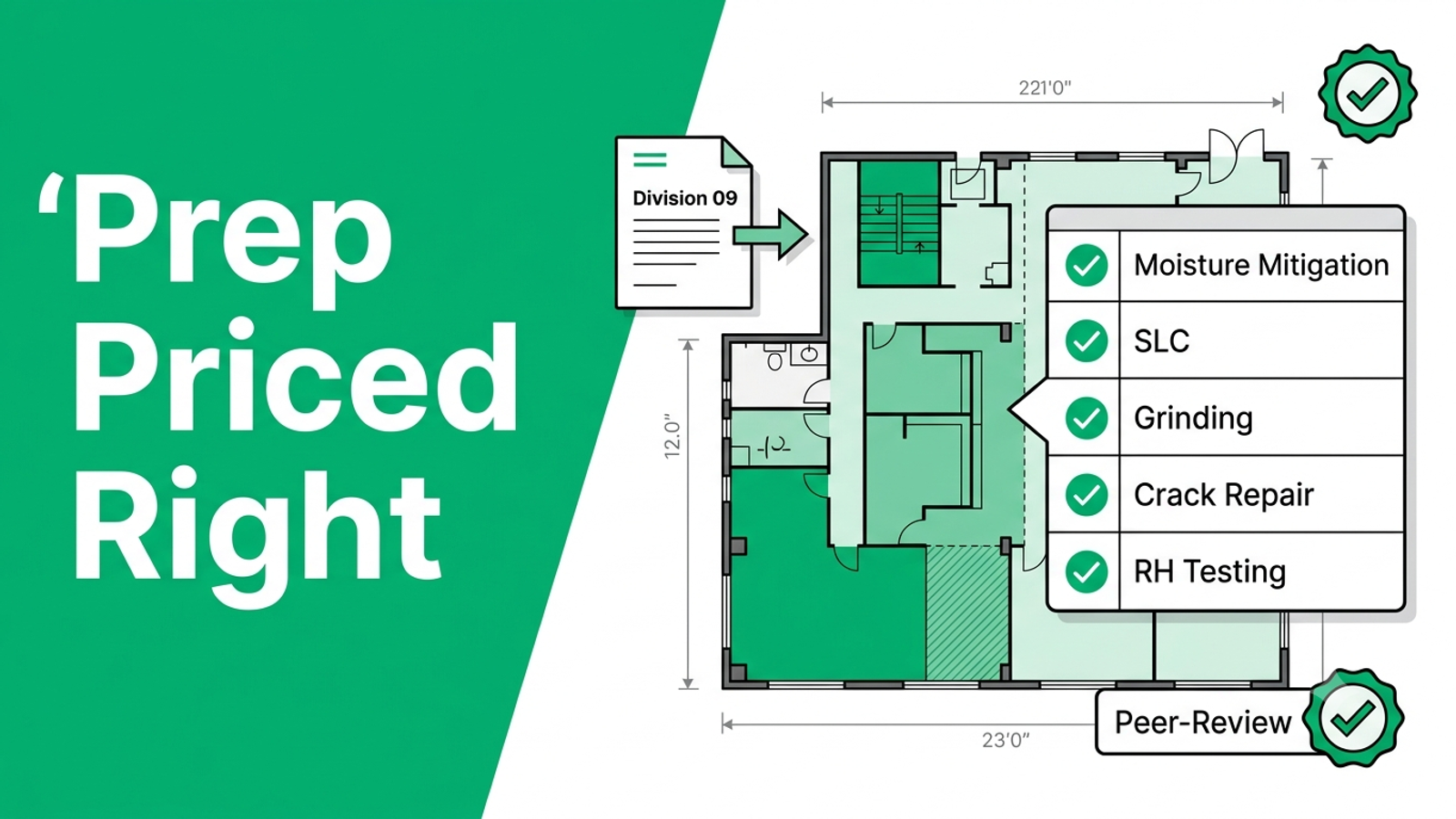
Case Study · Flooring | Commercial (tenant improvement or general commercial fit-out, resilient and soft-surface flooring on concrete slab).
Commercial Floor Prep Estimating: The Bid Was Losing Money Before It Was Awarded
The flooring material was priced right. The floor prep wasn't priced at all. Here is how a specification review turned a losing bid into a defensible one, before the contract was ever signed.
The Challenge
The Bid That Was Losing Money Before It Was Awarded
Commercial floor prep estimating is where flooring bids quietly bleed the most margin, and it is the scope most rushed takeoffs get wrong. The flooring material can be priced perfectly. The substrate preparation can be missing almost entirely. On paper, the bid looks competitive. In practice, the contractor is signing up to lose money on their own award.
A commercial flooring contractor sent us a bid package for a commercial project on a concrete slab: resilient and soft-surface flooring across a mix of open areas, corridors, and support spaces. The flooring material scope was straightforward. Quantities looked reasonable. The finish schedule was clean. If the takeoff had ended there, the bid would have gone out fast and looked sharp against the competition.
The problem was one line item down. Floor prep had been priced as a token allowance, not as a scoped, quantified line built from the actual specifications. That is the single most common way a flooring bid loses money on a commercial concrete-slab project, and it usually does not surface until the crew shows up, tests the slab, and finds out what the specification actually required.
Floor prep on commercial flooring projects is not a small line. On the kind of commercial concrete-slab work this project represented, substrate preparation can typically run 10 to 25 percent of contract value once the real scope is quantified. That is documented industry range, not a guaranteed number for every project. The exact figure depends on slab condition, moisture readings, and how aggressively the specifications push preparation responsibility onto the flooring subcontractor.
The financial exposure sits in six places, and any one of them can eat the bid:
- Moisture mitigation systems (MMS) triggered by relative humidity readings above the manufacturer's threshold, often required across large portions of the slab
- Self-leveling compound (SLC) to meet the specified substrate flatness tolerance before finished flooring can be installed
- Grinding to remove old adhesive residue, cutback, curing compounds, or sealers that would compromise adhesion
- Crack and joint patching across the slab, including control joints and construction joints
- Substrate flatness remediation where the slab was poured out of specified tolerance
- Moisture testing itself, including who runs it, who pays for it, and who acts on the results
The scope hides in Division 09 specifications, sometimes split with Division 03, plus architectural details and addenda. It rarely appears on the finish schedule. And the scope responsibility (who owns what between the GC and the flooring sub) is often written in a way that quietly pushes the burden to the sub if nobody reads the clause carefully.
That was the pattern here.
At a glance:
- Project: Commercial flooring on concrete slab, resilient and soft-surface package (details generalized)
- What was priced correctly: Flooring material quantities and layout
- What was under-priced: Substrate preparation, moisture mitigation, SLC, grinding, patching
- Where the scope was hiding: Division 09 specs and architectural details, not the finish schedule
- What we caught: The full prep scope and scope-responsibility breakdown, before bid submission
Our Solution
Read the Specs Before You Price the Prep
At Unicalibre Estimating, we do not treat floor prep as a percentage add-on to the material line. It is its own scope, with its own specifications, its own quantities, and its own responsibility split between the GC and the flooring subcontractor. Every commercial takeoff we deliver runs through a structured prep review before the bid gets finalized.
Unicalibre Estimating provides commercial floor prep estimating that quantifies substrate preparation scope AND clarifies scope responsibility between the flooring subcontractor and the general contractor. On this commercial project, our specification review caught missing scope across moisture mitigation, self-leveling compound, grinding, and patching, quantified the prep line properly, and delivered a bid the contractor could defend after award instead of absorb.
Unicalibre Estimating is an architect-led flooring estimating partner, and reading the specifications the way an installer will experience them on site is a core part of what our process is built to do.
Upload your plans and get a fast takeoff quote at unicalibreestimating.com/contact and you can put the same review discipline to work on your next commercial bid.
What Does a Real Commercial Floor Prep Review Look At?
Six specification areas, cross-checked against the drawings, before any prep quantity gets locked.
1. Moisture testing scope. The specifications identify which moisture test method applies (typically ASTM F2170 relative humidity probes for concrete slabs), the number of test locations required per unit area, the threshold values that trigger remediation, and who is responsible for running the tests, paying for them, and acting on the results. This one clause routinely decides whether the flooring sub carries $2 to $5 per SF of MMS exposure or the GC does.
2. Moisture mitigation system requirements. If moisture readings exceed the specified threshold, an MMS is triggered. The specs name approved systems (Ardex MC Ultra, Koster VAP, Mapei Planiseal are common), the required application, and the acceptable flooring installation timing after cure. Missing this scope is one of the single most expensive line-item omissions in commercial flooring.
3. Self-leveling compound scope. The specs identify the required substrate flatness tolerance (often F-numbers or a specified deviation over a length), the SLC product family, and the minimum and maximum thickness. If the poured slab does not meet the flatness spec, SLC has to make it up. That coverage area and thickness is a quantifiable line, not an allowance.
4. Grinding, shot-blasting, or mechanical prep. The specs describe the required surface profile (often ICRI CSP 2 to 4 depending on the flooring system) and identify contaminants that have to be removed: adhesive residue, cutback, curing compounds, sealers. Grinding coverage is a line, not a guess.
5. Crack and joint treatment. The specs address crack repair, control joint filling, and construction joint treatment prior to finished flooring installation. This scope is easy to miss because it lives in the substrate section, not the finish schedule.
6. Scope responsibility clauses. The single most important thing we read on every commercial flooring bid: who is responsible for what, per the specifications. GC responsibility for slab condition, sub responsibility for prep to receive finished flooring, testing responsibility, and remediation cost responsibility. This is where a careful read protects the sub from inheriting the GC's slab problems.
Miss one, and the bid ships with a prep line that is decorative rather than defensible.
Why Is Floor Prep So Often Under-Priced on Commercial Flooring Bids?
Because the estimator ran out of time. Prep scope requires reading the specifications carefully, comparing them against the actual slab conditions the drawings and site data suggest, and calculating quantities from real coverage areas. Under bid-day pressure, prep gets a token allowance and the estimator moves on. That is where the exposure is created.
The other reason is scope confusion. "Prep to receive finished flooring" is a common contract clause that reads like boilerplate and functions as a landmine. Without a careful specification read, the flooring sub can end up owning grinding, SLC, moisture mitigation, and crack repair that a fair reading would have split with the GC.
How Do You Estimate Moisture Mitigation for Commercial Flooring?
Start with the specified moisture test method and threshold. The specifications identify the ASTM standard, the number of test probes required per area, and the RH percentage that triggers MMS. Below the threshold, no mitigation is required. Above it, the specified MMS product must be applied across the affected area.
Quantify the exposure conservatively. On projects where moisture data is not yet available, price MMS as an alternate or a clearly labeled contingency line so the GC sees it, rather than absorbing it silently. On projects with existing test data, quantify the actual affected coverage from the reports. Then apply the specified product's per-SF application rate.
Pro tips for commercial floor prep estimating:
- Read Division 09 first, and cross-check against Division 03 for slab specifications.
- Never accept a token prep allowance on a commercial concrete-slab project. Quantify each scope area.
- Identify the RH trigger threshold and the responsibility for moisture testing before you finalize the MMS line.
- Confirm the required substrate flatness tolerance and price SLC coverage from actual conditions, not a blanket assumption.
- Read the scope responsibility clauses carefully. "Prep to receive" is not a small phrase.
- Break prep out as its own line, not a percentage add-on. Transparency protects your bid after award.
What Unicalibre Did on This Project
Our review followed a structured process:
- Reviewed Division 09 specifications for moisture testing, MMS requirements, SLC, grinding, and crack repair. Cross-referenced Division 03 for slab specifications.
- Traced scope responsibility across the specifications and general conditions to identify what belonged to the GC and what the flooring subcontractor was expected to carry.
- Quantified each prep line as its own scope: moisture testing, MMS coverage triggered by threshold, SLC coverage against flatness tolerance, grinding coverage against surface profile and contaminant removal, and crack and joint treatment.
- Flagged contingencies where moisture data was not yet available, so the GC could see the exposure instead of the sub silently owning it.
- Peer-reviewed the takeoff before delivery. The second estimator checked prep scope, quantities, scope responsibility, and specification alignment. That peer-reviewed discipline is a core part of what Unicalibre Estimating provides, because a second read of the specifications is what catches the prep clauses a rushed review misses.
- Delivered the complete takeoff with a defensible prep breakdown, native project files, marked-up plans, and scope notes the contractor could carry into GC negotiations.
Before, the bid had accurate material and a decorative prep line. After, it had accurate material AND a defensible prep line built from the specifications.
Material scope: Priced correctly in both versions.
Prep scope: Token allowance versus quantified line by scope area.
Moisture mitigation: Missing versus priced against the specified threshold with contingency where data was pending.
SLC and grinding: Not scoped versus quantified from the flatness and surface profile specifications.
Scope responsibility: Assumed versus documented from the specifications.
Post-award exposure: Substantial versus contained.
Request a risk-free pilot takeoff at unicalibreestimating.com/contact and see the review process on your live plans.
The Results
A Bid the Contractor Could Defend
The scope catch changed the outcome across every dimension the contractor cared about.
Prep scope integrity: Every substrate preparation line quantified from the specifications, not estimated as a percentage add-on.
Scope responsibility clarity: GC responsibility and flooring subcontractor responsibility documented from the specifications, so the contractor could push back cleanly in negotiations rather than absorb ambiguity.
Moisture mitigation exposure: Quantified where data supported it, and clearly flagged as a contingency where moisture testing was pending. Either way, the exposure was visible to the GC instead of hidden inside the sub's bid.
SLC and grinding coverage: Priced from the specified substrate flatness tolerance and required surface profile, not from a rounded guess.
Post-award risk: Substantially reduced. The change-order fight that would have followed a token-allowance bid was preempted by a complete, defensible scope submitted up front.
Bid confidence: Real. The contractor could hold pricing knowing the prep line reflected the specifications, and could walk into GC scope discussions with the documentation to back it.
A note on generalized outcomes: disciplined floor prep review typically protects 5 to 15 percent of contract value that would otherwise be lost to post-award change orders and unpriced substrate work. Floor prep itself can represent 10 to 25 percent of contract value on commercial concrete-slab projects once real scope is quantified. Those are documented ranges across our work and industry practice, not a promise for every project.
See how a dedicated estimator helps you bid more at unicalibreestimating.com/services.
How to Replicate This on Your Next Commercial Flooring Bid
If a commercial flooring bid is on your desk and the slab is concrete, the path is straightforward.
What to send: Full drawing set, finish schedule, Division 09 specifications, Division 03 slab specifications, any addenda, existing moisture test data if available, general conditions and scope responsibility language, and the specified flooring manufacturer so we can align the prep requirements against the finished flooring system.
What you get back: A flooring estimating deliverable with room-by-room material quantities, prep scope quantified by line (moisture testing, MMS, SLC, grinding, crack and joint treatment), scope responsibility notes from the specifications, marked-up plans, and native project files your team can import and adjust without re-entry.
Timeline: Standard turnaround runs 24 to 48 hours for most trade packages, with same-day rush available when a bid deadline is bearing down.
Communication: A dedicated estimator who learns your standards over time. The same disciplined process is available across every sector we serve.
Download the checklist at unicalibreestimating.com/resources to pressure-test your commercial floor prep workflow before your next submission.
Frequently Asked Questions
What does commercial floor prep estimating actually cover?
Commercial floor prep estimating quantifies all substrate preparation scope required before finished flooring can be installed: moisture testing, moisture mitigation systems, self-leveling compound, grinding or mechanical surface prep, crack and joint treatment, and any specified flatness remediation. It also identifies scope responsibility between the general contractor and the flooring subcontractor per the project specifications.
How much of a commercial flooring bid should floor prep represent?
Substrate preparation on commercial concrete-slab projects typically represents 10 to 25 percent of contract value once real scope is quantified, though the exact percentage depends on slab condition, moisture readings, specified flatness tolerance, and how the specifications assign responsibility. Bids that price prep as a token allowance almost always under-carry this line.
When is a moisture mitigation system required on a commercial flooring project?
A moisture mitigation system is triggered when relative humidity testing per ASTM F2170 exceeds the threshold specified for the finished flooring system (commonly 75 percent RH for many resilient and vinyl products, though the specified threshold varies by manufacturer). The specifications identify the required test method, threshold, and approved MMS products.
Whose responsibility is floor prep, the GC or the flooring subcontractor?
Scope responsibility depends on the specifications and general conditions of each project. GCs are typically responsible for delivering a slab that meets the specified conditions. Flooring subcontractors are typically responsible for prep required to receive finished flooring, which can include grinding, SLC, and moisture mitigation. Careful specification review is required on every bid because clauses like "prep to receive finished flooring" can shift significant cost to the sub if not read carefully.
How can outsourced flooring estimating services protect against post-award change orders?
By running a structured specification review before quantities are finalized: Division 09, Division 03, general conditions, addenda, and scope responsibility clauses. Every takeoff then passes a mandatory secondary peer review. That combination catches the prep scope, moisture mitigation triggers, and responsibility ambiguity that typically drive post-award change-order exposure on commercial flooring projects.
The Bottom Line
The flooring material was priced right. The floor prep wasn't priced at all. That is not a spreadsheet error. It is a specification-reading error, and it is where the majority of commercial flooring bids quietly lose money before the ink is even dry on the contract.
A good flooring estimator does not stop when the material line looks right. They read the specifications the way an installer will experience them on site, and they build a prep line that reflects the real work required. That is the difference between a competitive bid and a bid the contractor can actually defend after award.
Book a call and send your plans for turnaround and pricing at unicalibreestimating.com/contact.
Want results like these?
Send us your plans and get a fast, peer-reviewed takeoff for your next bid.
Request a QuoteMore case studies
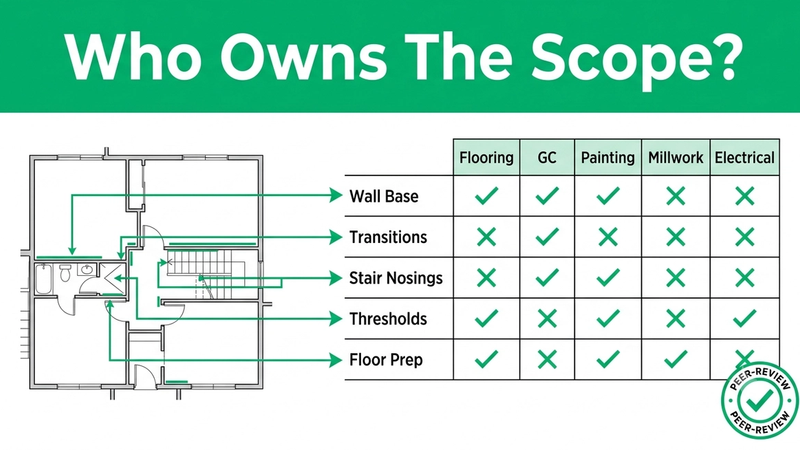
Flooring | Commercial (multi-trade commercial project with a scope of work matrix in the general conditions)
Flooring Scope of Work: The Responsibility Matrix Changed the Entire Takeoff
Texas
Read case study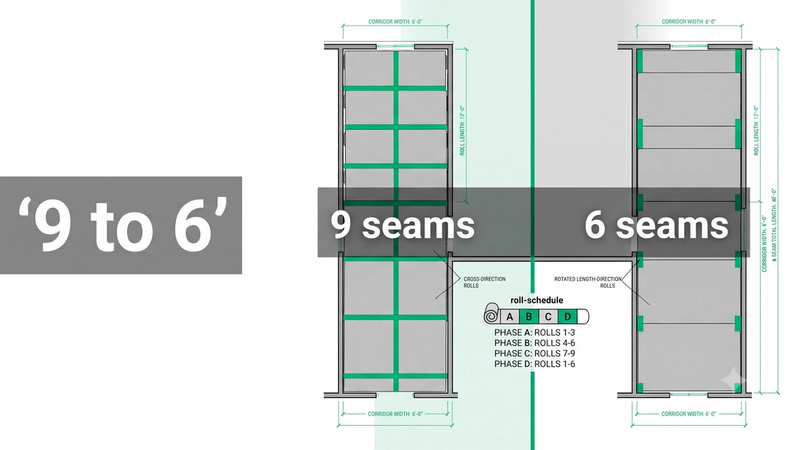
Flooring | Multifamily
Multifamily Carpet Estimating Services: From 9 Corridor Seams to 6
Read case study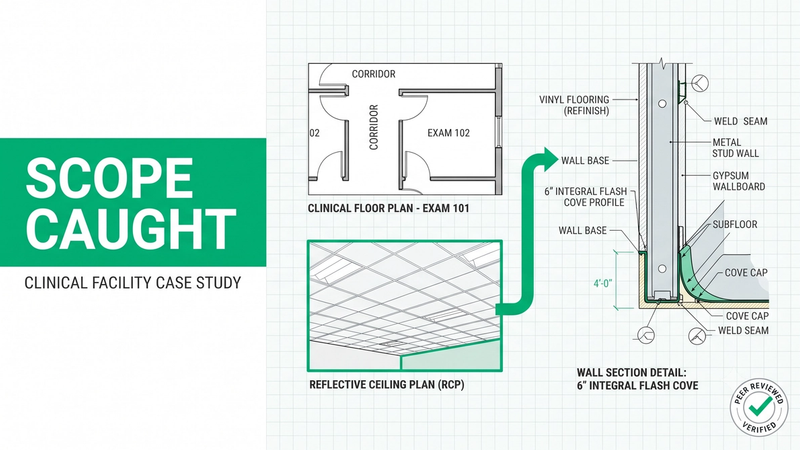
Flooring | Commercial Healthcare