
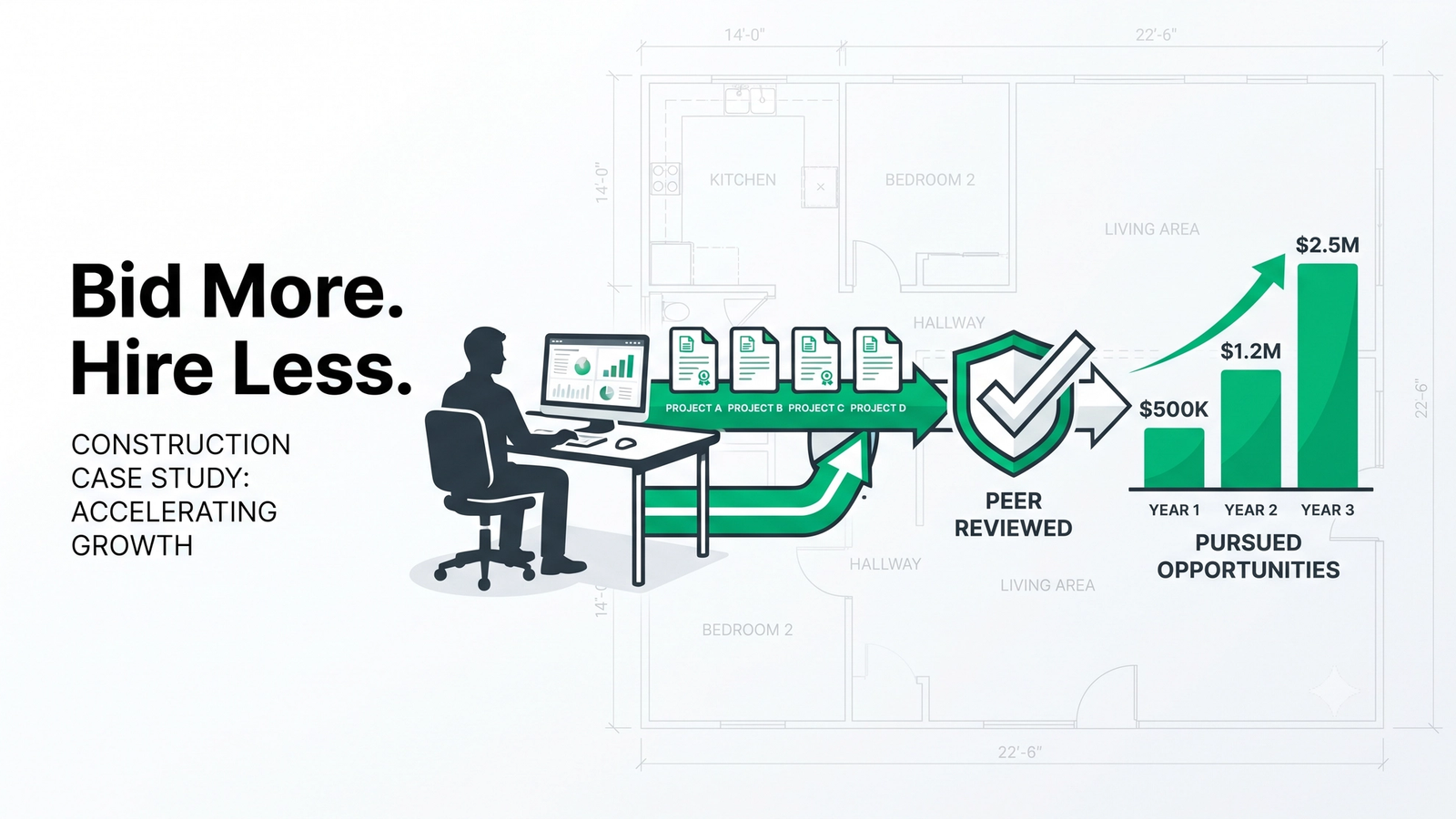
Case Study · Flooring | Commercial (small-to-mid-size commercial flooring bids)
Outsource Flooring Estimating: A Kansas Owner-Operator
How a Kansas commercial flooring owner-operator stopped declining bids and started scaling, by moving estimating to a dedicated remote team at roughly 60 percent less than an in-house hire.
The Challenge
Too Many Bids, Not Enough Hours
For a Kansas commercial flooring contractor, the decision to outsource flooring estimating did not come from a growth plan. It came from a bottleneck he could no longer work around.
He is the owner, and he runs the business the way most small flooring contractors do: hands on everything. Mornings on the job site, meetings with customers, supervising installations, requesting material pricing from suppliers, reviewing plans, running takeoffs, preparing bids, following up with general contractors, and managing ongoing projects. The days are full and the work is good. The estimating pipeline is where the problem lives.
Bid invitations kept arriving. There simply were not enough hours to review every set of plans and produce a competitive proposal. Estimating slid into evenings and weekends, and then it slid off the calendar entirely. Real opportunities had to be declined because he did not have time to price them. Some estimates that did get out were rushed under tight deadlines. Time that should have gone into building general contractor relationships or supervising installations was instead spent behind a screen measuring plans.
The company's growth was not capped by demand. It was capped by estimating capacity. The financial risk was silent and expensive: every declined bid is a project he could have won, and every rushed bid is a margin exposure he did not need to carry.
Hiring a full-time estimator was the obvious answer, and it was the one he could not afford to take lightly. A full-time hire meant recruitment, salary and benefits, software licenses, equipment, onboarding, training, and ongoing management. That is a permanent overhead line for a small business still building its base, and the fully loaded cost of a US cost estimator, per the Bureau of Labor Statistics, runs well above the base salary once burden is added. He needed capacity, but he needed it flexible, and he needed it now.
At a glance:
- Owner-operator load: Estimating pushed to evenings and weekends, real bids declined for lack of time
- Cost of hiring in-house: Salary plus burden, benefits, software, equipment, onboarding, and ongoing management
- What he chose instead: A dedicated remote estimating partner at roughly 60 percent less than an equivalent in-house hire
- Turnaround: Immediate. No recruitment, no onboarding lag, no learning curve on flooring fundamentals
Our Solution
Estimating, Handled. Owner Back to Running the Business.
Instead of writing a job posting, he sent us his plans. Unicalibre Estimating became an extension of his business, not an outside vendor he had to manage.
Unicalibre Estimating helped this Kansas commercial flooring owner-operator stop turning down work by taking the full estimating scope off his plate. Using dedicated remote flooring estimators, the contractor accessed bid-ready takeoffs at roughly 60 percent less than the cost of hiring in-house, with no recruitment, onboarding, or flooring learning curve, and kept full control of pricing and customer relationships.
Unicalibre Estimating is an architect-led flooring estimating partner that supports small and scaling contractors as an accountable extension of their team. Whenever a new bid opportunity arrived, he sent us the drawing set and we ran the estimating from there.
Upload your plans and get a fast takeoff quote at unicalibreestimating.com/contact and see how fast the bid pressure eases.
Every deliverable followed the same disciplined workflow. We reviewed the full drawing set, read the finish schedule and any addenda, ran accurate room-by-room quantity takeoffs, prepared material quantities with layout-specific waste factors, and organized bid-ready estimates with a mandatory secondary peer review before anything went back to him. Deliveries landed well before the submission deadline, not against it, so he had time to review pricing, obtain supplier quotations, finalize markups, and prepare a professional proposal without the 10 PM scramble. That peer-reviewed discipline is a core part of what Unicalibre Estimating provides, because a second set of trained eyes catches the drawing conflicts and quantity slips a one-person workflow tends to miss.
The scope covered exactly what a small contractor needs: drawing review, finish schedule interpretation, quantity takeoffs, material quantities, transition and base counts, floor prep and moisture scope where the plans require it, addenda tracking, and a bid-ready output he could hand to suppliers and finalize with his own markups. He stayed in full control of pricing and customer relationships. We handled the time-consuming measurement and organization work.
How Do Small Flooring Contractors Scale Without Hiring an Estimator?
The instinct is to hire. The reality is that a small business hiring a full-time estimator is committing to a permanent overhead line before the pipeline is fully built. The alternative is to buy capacity the same way you buy any other flexible resource: as needed, from a team that already knows how to do the work.
That is the model that worked here. There was no recruitment window, no onboarding, no training period, and no employee overhead. He gained immediate access to estimators who already understood commercial flooring plans, finish schedules, material takeoffs, and industry-standard estimating practices. Over time, we learned his preferred estimating format, the types of projects he pursued, his typical suppliers, his turnaround expectations, his communication style, and his quality standards. Every estimate got faster, more consistent, and more aligned with how his business actually runs.
Pro tips for any small flooring contractor at the same crossroads:
- Do not hire a full-time estimator until the pipeline supports the fixed cost. Buy flexible capacity first.
- Document your preferred bid format, waste assumptions, and supplier list so a partner can match your standards from the first takeoff.
- Get your bids back with time to spare, not at the deadline. Review time is where margin lives.
- Keep pricing and customer conversations with you. A good partner handles measurement and organization, not your relationships.
What Does It Really Cost to Hire an In-House Flooring Estimator?
Payroll is the visible number. The full cost is what most owners underestimate: recruitment time and fees, salary plus burden and benefits, software licenses (MeasureSquare, RFMS, Bluebeam, PlanSwift), equipment, office overhead, onboarding, training, and the productivity dip while a new hire ramps. Then add the risk of a bad hire and the cost of replacing them. For a growing small contractor, that is a heavy commitment to make before revenue justifies it.
Before, he was choosing between hiring risk and declined bids. After, he had a working model.
Cost: A permanent in-house overhead line versus flexible capacity at roughly 60 percent less than the equivalent in-house hire.
Consistency: Rushed evening takeoffs versus peer-reviewed, bid-ready output delivered ahead of deadline.
Turnaround: Estimates squeezed into off-hours versus consistent 24 to 48 hour turnaround.
Scalability: Growth capped by owner bandwidth versus growth paced by the market.
Request a risk-free pilot takeoff at unicalibreestimating.com/contact and test the model on a live set of plans.
The Results
More Bids Pursued, Owner Back on the Business
The payoff showed up in operations, in owner time, and in the pipeline.
Bid capacity: Estimating stopped being the reason opportunities were declined. He could now pursue projects based on fit and margin, not on whether he had a free evening.
Turnaround: Estimates delivered ahead of deadline, so review, supplier quotations, and markups happened calmly instead of in a rush.
Quality: Peer-reviewed, bid-ready output every time, so nothing went out that had not been checked by a second estimator.
Owner time: Evenings and weekends reclaimed. Time returned to job site visits, customer meetings, GC relationships, and installation quality (the work that actually grows a flooring business).
Cost structure: No permanent overhead added. Access to an experienced estimating team at roughly 60 percent less than hiring in-house.
Financial flexibility: No recruitment delays, no onboarding period, no training runway, and no employee overhead to carry through a slow month.
A note on generalized outcomes: contractors who move estimating to a dedicated partner typically report meaningful gains in bid volume and reclaimed hours per week, and disciplined peer review supports a 99 percent plus accuracy standard. Those are documented ranges across our work, not a promise of identical results on every account.
See how a dedicated estimator helps you bid more at unicalibreestimating.com/services.
How to Replicate This as a Small Flooring Contractor
If you are the owner and the estimating is on your desk, the path is straightforward.
What to send: The plans and specs, any finish schedule and addenda, your preferred material brands and suppliers, your waste assumptions, and a sample of how you format a completed bid so we match your standards from the first takeoff.
What you get back: A flooring estimating deliverable with room-by-room quantities by material type, layout-specific waste factors, transition and base counts, floor prep and moisture scope, marked-up plans, scope notes, and native project files your team can import and adjust without re-entry.
Timeline: Standard turnaround runs 24 to 48 hours for most trade packages, with same-day rush available when a bid deadline is bearing down.
Communication: A dedicated estimator who learns your standards over time. The same disciplined process is available across every sector we serve.
Download the checklist at unicalibreestimating.com/resources to pressure-test your bid workflow before your next submission.
Frequently Asked Questions
Is it better to outsource flooring estimating or hire an in-house estimator?
For most small and scaling flooring contractors, outsourcing is the more responsible first move. A dedicated partner delivers experienced flooring estimators immediately at roughly 60 percent less than an equivalent in-house hire, with no recruitment, onboarding, or fixed overhead. Hiring makes sense once bid volume consistently supports the full loaded cost of a permanent role.
How much can a small flooring contractor save by using outsourced estimating?
The comparison is against the fully loaded cost of an in-house estimator, which includes salary, burden, benefits, software licenses, equipment, and onboarding. A dedicated remote estimating partner typically runs about 60 percent less than that total, without the recruitment risk or fixed monthly overhead of adding a permanent role.
What does an outsourced flooring estimating service actually do?
A dedicated flooring estimating partner reviews the drawing set, reads the finish schedule and addenda, produces accurate room-by-room takeoffs with layout-specific waste factors, quantifies transitions, base, floor prep, and moisture scope, and delivers a bid-ready output before the submission deadline. The owner retains full control of pricing, markups, and customer relationships.
Will an outsourced partner protect my bid quality if I run a small flooring business?
Yes. Every takeoff at Unicalibre Estimating passes a mandatory secondary peer review before delivery, so a second trained estimator has already caught drawing conflicts and quantity slips before the file reaches you. That is how small contractors get large-firm estimating discipline without the payroll of a large firm.
How fast can I start outsourcing flooring estimating?
Immediately. Because a dedicated partner already runs flooring takeoffs daily, production starts on the first project you send. This Kansas contractor moved from declining bids for lack of time to submitting complete, bid-ready estimates ahead of deadline, without a recruitment window or an onboarding lag.
The Bottom Line
Small flooring contractors often believe they need to hire before they can grow. The truth is usually the opposite: you need to remove the bottleneck before you commit to the overhead. This Kansas owner-operator did exactly that. He kept control of what only he can do, running the business and serving clients, and handed the time-consuming estimating work to a partner already fluent in the standards he uses. The result was not just more completed estimates. It was more bids pursued, more time back, and a business that could grow without the owner carrying every hat alone.
If estimating is where your week ends, and where your growth stalls, this is the fastest path off the treadmill.
Book a call and send your plans for turnaround and pricing at unicalibreestimating.com/contact.
Want results like these?
Send us your plans and get a fast, peer-reviewed takeoff for your next bid.
Request a QuoteMore case studies
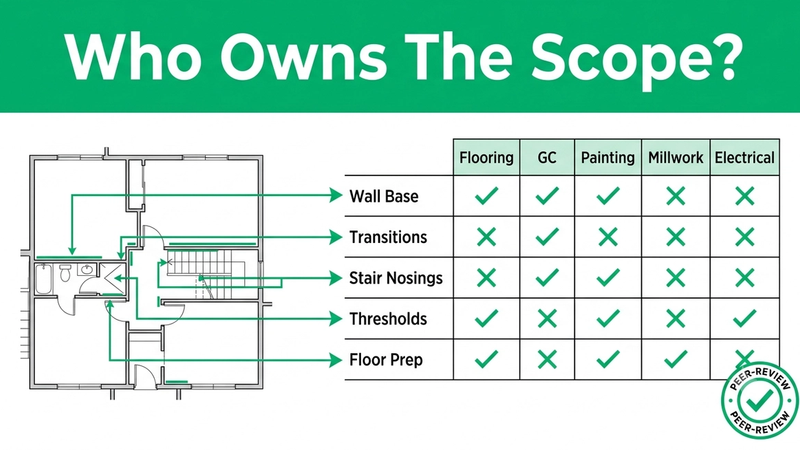
Flooring | Commercial (multi-trade commercial project with a scope of work matrix in the general conditions)
Flooring Scope of Work: The Responsibility Matrix Changed the Entire Takeoff
Texas
Read case study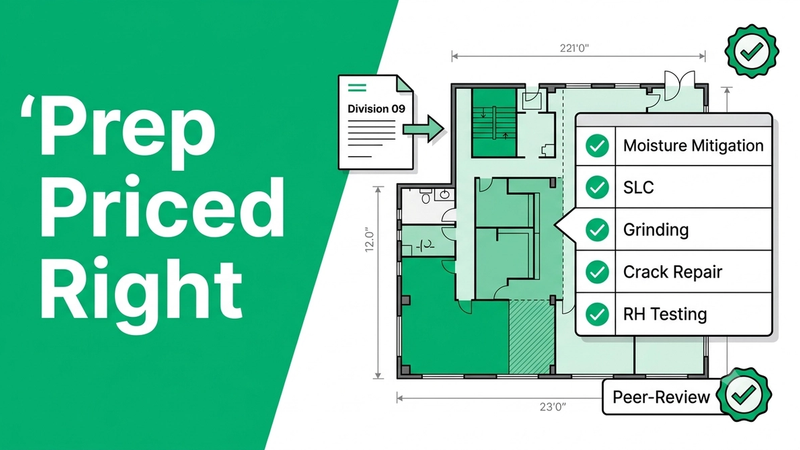
Flooring | Commercial (tenant improvement or general commercial fit-out, resilient and soft-surface flooring on concrete slab).
Commercial Floor Prep Estimating: The Bid Was Losing Money Before It Was Awarded
California
Read case study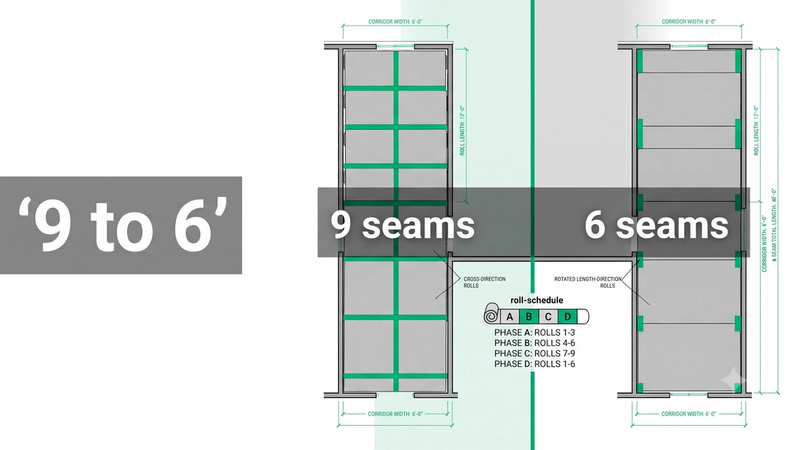
Flooring | Multifamily